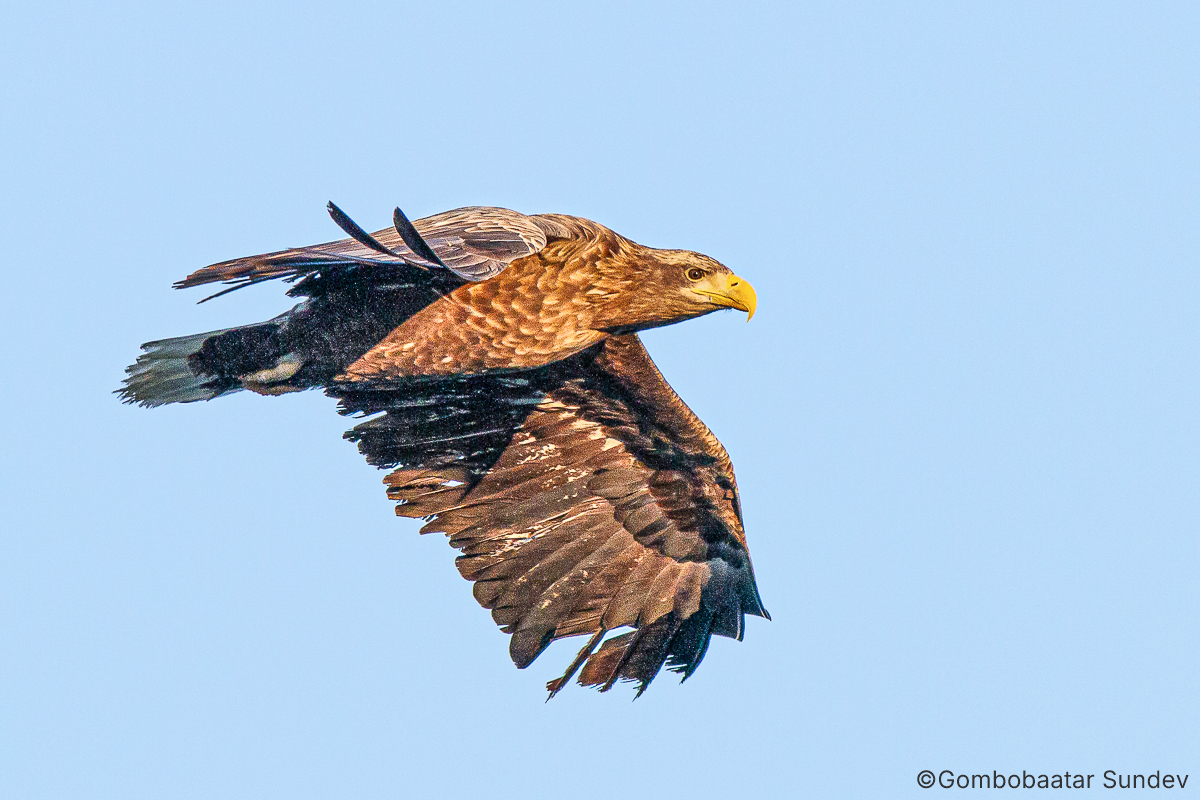
White-tailed Eagle
- Common Name: White-tailed Eagle
- Scientific Name: Haliaeetus albicilla
- Nepali Name(s): कङ्कम चिल (Kangkam Chil)
- IUCN Red List Status: Least Concern (LC)
- National Red List Status: Critically Endangered (CR)
- CITES Appendix: Appendix I
Measurements & Physical Profile
- Body Length: 74–92 cm
- Wingspan: 193–244 cm
- Weight: 3,100–6,900 g
Did You Know?
The White-tailed Eagle is a massive, heavy-set raptor often referred to as the "flying barn door" due to its remarkably broad, rectangular wings. Adults are unmistakable, featuring a pure white, wedge-shaped tail that contrasts sharply with their dark brown body. It is a dominant predator that often forces smaller raptors to abandon their hard-earned catches.
Distribution & Habitat
Global Distribution
Widely distributed across northern Eurasia, stretching from Greenland and Iceland across Europe and Russia to the Pacific coast of Asia.
Distribution within Nepal
A very rare winter visitor or accidental vagrant. Nepal sits on the extreme southern periphery of its wintering range. Sightings are exceptional and usually involve individual birds recorded in large lowland wetlands or high-altitude mountain lakes during severe northern winters.
Preferred Habitats
Large, undisturbed bodies of water, including lakes, rivers, and coastal areas, surrounded by mature trees or cliffs for nesting and perching.
Elevational Range
Primarily lowlands and mountain valleys near water bodies, though they can be found at varying altitudes depending on the availability of open water.
Seasonal Occurrence
Rare winter visitor or irregular vagrant.
Behavior & Ecology
Flight & Foraging Behavior
Uses a slow, heavy, yet powerful flapping flight. It is an opportunistic feeder, often hunting by scanning from a high perch or soaring over water to snatch fish near the surface.
Social & Roosting Habits
Typically seen singly or in bonded pairs. In wintering areas, they may gather at communal roosts if food is abundant, but they are generally less social than some other eagle species.
Diet & Ecosystem Role
Diet Breakdown
An apex predator with a broad diet:
- Fish (Primary): Captures large fish from the surface of water bodies.
- Waterbirds: Regularly hunts ducks, geese, and coots.
- Mammals: Takes small mammals and frequently scavenges on carrion, especially in winter.
Ecological Role
As a top-tier predator in aquatic ecosystems, it helps maintain the health of fish and waterbird populations, often acting as a scavenger that cleans up carcasses from shores and ice.
Breeding Biology
The White-tailed Eagle does not breed in Nepal. Breeding season typically initiates in late winter to early spring, with courtship activities often beginning as early as February or March. Pairs exhibit exceptional site fidelity, constructing massive, long-lasting nests out of thick branches and twigs, often positioned high in mature trees or on inaccessible sea cliffs and rocky outcrops. The female typically lays a clutch of 1-3 eggs (usually 2), which are incubated by both parents—though primarily the female—for a duration of 35 to 45 days. Following hatching, the young remain in the nest for a prolonged fledging period of 70 to 90 days. Even after achieving their first flights, the juveniles typically remain dependent on parental food provisioning for an additional two to three months before they become fully independent.
Migration
- Status: Migratory; rare visitor to Nepal.
- Movement: Populations in the far north migrate south in winter as water bodies freeze; the few birds occasionally found in Nepal are likely individuals that have strayed far from these primary migration routes.
Population Status
- Global Population Estimate: 20,000 -60,000 mature individuals.
- Population Trend: Increasing
- National Population Estimate (Nepal): Unknown.
- Monitoring & Surveys: Occasionally recorded during raptor migration count and monitoring of wetlands areas.
Threats
- Habitat Loss: Drainage of wetlands and disturbance near traditional nesting sites.
- Contaminants: Historically, organochlorine pesticides (like DDT) caused eggshell thinning, leading to massive declines, though populations have recovered significantly in many regions.
- Power Lines: Susceptibility to electrocution on large power infrastructure.
Conservation Actions
Existing Measures
- Legal Protections: Listed under CITES Appendix I (highest level of protection against international trade).
- Protected Area Foothold: Protected globally under various national and international environmental laws.
Recommended Measures
- Wetland Protection: Preserving large, undisturbed freshwater habitats.
- Pollution Control: Reducing the use of persistent chemicals in agricultural areas near river systems.
References
- BirdLife International (2021). Species factsheet: White-tailed Sea-eagle Haliaeetus albicilla. Downloaded from https://datazone.birdlife.org/species/factsheet/white-tailed-sea-eagle-haliaeetus-albicilla on 07/08/2026
- Ferguson-Lees, J., & Christie, D. A. (2001). Raptors of the World. Christopher Helm, London.
- Inskipp C., Baral H. S., Phuyal S., Bhatt T. R., Khatiwada M., Inskipp, T, Khatiwada A., Gurung S., Singh P. B., Murray L., Poudyal L. and Amin R. (2016). The status of Nepal’s Birds: The national red list series. Zoological Society of London, UK.
- Naoroji, R. (2006). Birds of Prey of the Indian Subcontinent. Om Books International, New Delhi.
- Orta, J., G. M. Kirwan, D. A. Christie, P. F. D. Boesman, and J. S. Marks (2023). White-tailed Eagle (Haliaeetus albicilla), version 1.1. In Birds of the World (S. M. Billerman, Editor). Cornell Lab of Ornithology, Ithaca, NY, USA. https://doi.org/10.2173/bow.whteag.01.1