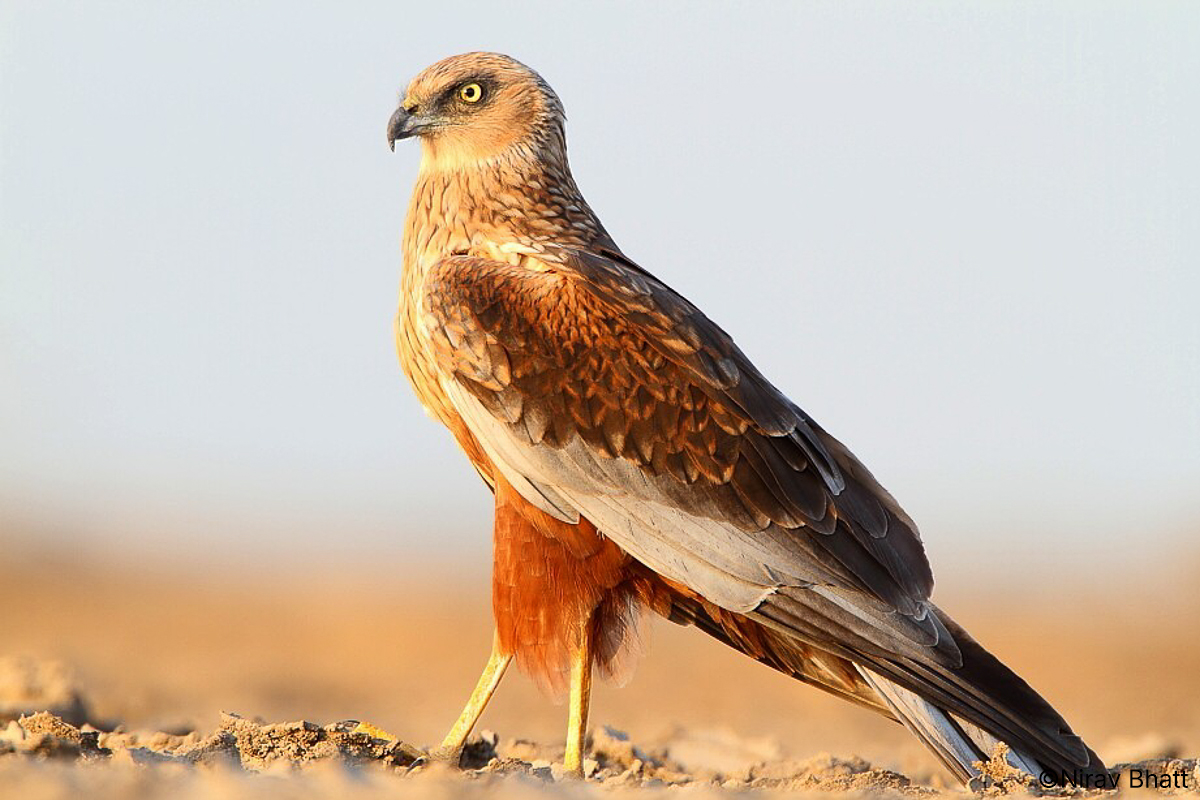
Western Marsh Harrier
- Common Name: Western Marsh Harrier
- Scientific Name: Circus aeruginosus
- Nepali Name(s): सिम भुइँचिल (Sim Bhuichil)
- IUCN Red List Status: Least Concern (LC)
- National Red List Status (Nepal): Vulnerable (VU)
- CITES Appendix: Appendix II
Measurements & Physical Profile
- Body Length: 43–54 cm
- Wingspan: 115–145 cm
- Weight: 405–960 g
Did You Know?
The Western Marsh Harrier is the largest and most robust of the harrier species. It is famous for its "moth-like" flight—gliding low over wetlands with its wings held in a pronounced, shallow "V" shape. Its ability to remain almost silent while hovering just inches above reedbeds makes it a master of surprise for unsuspecting small prey.
Distribution & Habitat
Global Distribution
The Western Marsh Harrier (Circus aeruginosus) is widely distributed across the temperate and subtropical regions of the Western Palearctic. Its breeding range extends from western Europe and northwestern Africa through the Mediterranean, the Middle East, and Central Asia to northwestern China and southern Siberia. Most northern and eastern populations are migratory, wintering in southern Europe, North and sub-Saharan Africa, the Arabian Peninsula, the Indian subcontinent, and Myanmar. In contrast, populations in northwestern Africa are largely resident.
Distribution within Nepal
In Nepal, the Western Marsh Harrier is an uncommon but regular winter visitor and passage migrant. It winters primarily across the lowland Terai, where extensive wetlands provide suitable wintering habitat. The species is frequently recorded from major wetland complexes including Koshi Tappu Wildlife Reserve, Jagdishpur Reservoir, Shuklaphanta National Park, and the floodplains of Chitwan National Park. Smaller numbers also occur at marshes and reservoirs throughout the western and central Terai during migration and winter.
Preferred Habitats
The species is strongly associated with freshwater wetlands, particularly extensive reedbeds dominated by Phragmites australis, marshes, swamps, floodplains, oxbow lakes, and shallow reservoirs. During winter, it frequently forages over adjacent grasslands, paddy fields, agricultural land, and seasonally inundated floodplains where prey is abundant. Large, undisturbed wetlands with dense emergent vegetation are especially important for roosting and daytime hunting.
Elevational Range
Largely confined to Nepal's tropical and subtropical lowlands. Most observations occur below 500 m, although occasional migrants may occur in lower river valleys at slightly higher elevations during passage. Wintering birds are mostly concentrated in the Terai wetland systems.
Seasonal Occurrence
The Western Marsh Harrier is a regular winter visitor and passage migrant in Nepal. Birds typically begin arriving from late September to October, with numbers peaking between November and February. Spring migration occurs during March and early April, when birds depart for breeding grounds across Europe and Central Asia.
Behavior & Ecology
Flight and Foraging Behavior
The Western Marsh Harrier is recognized by its slow, buoyant, quartering flight over marshes and grasslands, with broad wings held in a shallow V-shaped dihedral. It hunts by flying low above vegetation while scanning and listening for prey, then drops rapidly to capture animals with its talons. It may also perch on low shrubs or reed clumps before making short hunting flights and occasionally scavenges carrion during winter.
Social and Roosting Habits
Outside the breeding season, the species is generally solitary or occurs in loose aggregations. Unlike Montagu's or Pallid Harriers, it forms relatively small communal roosts, usually within dense reedbeds or tall marsh vegetation. In areas with abundant habitat and food, dozens of individuals may roost together, although such gatherings are less frequent than in other harrier species. Dense wetland vegetation protects from predators and disturbance during overnight roosting.
Diet & Ecosystem Role
Diet Breakdown
The Western Marsh Harrier is an opportunistic predator with a broad diet that varies seasonally and geographically. Major prey includes:
- Small mammals: voles, mice, rats, and shrews (principal prey)
- Birds: waterfowl, rails, waders, passerines, nestlings, eggs, and injured birds
- Amphibians: frogs and toads
- Reptiles: lizards and small snakes
- Fish and carrion: taken opportunistically
- Large insects: grasshoppers, beetles, dragonflies, and other invertebrates when abundant.
Ecological Role
As one of the principal avian predators of wetlands, the Western Marsh Harrier plays an important role in maintaining ecological balance by regulating populations of rodents, amphibians, waterbirds, and other small vertebrates. Its presence reflects the availability of healthy reedbeds, marshes, and floodplain ecosystems, making it an excellent indicator of wetland quality. By occupying the upper levels of the wetland food web, it contributes to ecosystem stability and biodiversity conservation.
Breeding Biology
Throughout its breeding range, nesting begins from April to May. Typically breeds in dense reedbeds, with pairs forming in spring after dramatic aerial displays, including talon-locking maneuvers. Builds large platform nests made of reeds, sticks, and grasses concealed within dense reedbeds or marsh vegetation, occasionally nesting in cereal fields. Females lay 3–6 eggs, which are incubated for 31–38 days, while young fledge approximately 35–40 days after hatching. Males may occasionally be polygynous, breeding with two or more females in seasons of high food availability. Nesting success relies heavily on the availability of undisturbed, high-quality wetland vegetation for protection.
Migration
- Status: Migratory; passage migrant and winter visitor to Nepal.
- Movement: Migrates from breeding grounds in Europe and Central Asia to milder regions including the Indian subcontinent. The species exhibits strong fidelity to traditional wintering wetlands, often returning to the same marshes in successive years.
Population Status
- Global Population Estimate: 600,000 – 1,100,000 mature individuals.
- Population Trend: Stable globally, but populations in South Asia are localized and threatened by habitat loss.
- National Population Estimate (Nepal): Fewer than 750 individuals.
- Monitoring & Surveys: There is no dedicated monitoring program for this species. However, it is regularly recorded as an incidental sighting during raptor migration counts and other systematic biodiversity surveys within the Tarai region.
Threats
- Wetland Degradation: Drainage of marshes, agricultural encroachment, and pollution significantly reduce its primary hunting grounds.
- Disturbance: Human activity and noise pollution in wetland areas can force birds to abandon preferred feeding sites.
- Pesticide Poisoning: Secondary poisoning via rodenticides or insecticides used in surrounding farmlands.
Conservation Actions
Existing Measures
- Legal Protections: Listed under CITES Appendix II.
- Wetland Conservation: Its status as a migrant bird relies on the protection of Ramsar sites and other critical wetlands in the Terai.
Recommended Measures
- Reedbed Restoration: Actively managing and restoring reedbeds in protected areas to ensure cover and prey abundance.
- Buffer Zone Management: Promoting pesticide-free zones around wetlands to reduce the risk of secondary poisoning.
References
- BirdLife International (2021). Species factsheet: Western Marsh-harrier Circus aeruginosus. Downloaded from https://datazone.birdlife.org/species/factsheet/western-marsh-harrier-circus-aeruginosus on 07/08/2026
- Ferguson-Lees, J., & Christie, D. A. (2001). Raptors of the World. Christopher Helm, London.
- Inskipp C., Baral H. S., Phuyal S., Bhatt T. R., Khatiwada M., Inskipp, T, Khatiwada A., Gurung S., Singh P. B., Murray L., Poudyal L. and Amin R. (2016). The status of Nepal’s Birds: The national red list series. Zoological Society of London, UK.
- Orta, J., P. F. D. Boesman, J. S. Marks, E. Garcia, and G. M. Kirwan (2020). Western Marsh Harrier (Circus aeruginosus), version 1.0. In Birds of the World (J. del Hoyo, A. Elliott, J. Sargatal, D. A. Christie, and E. de Juana, Editors). Cornell Lab of Ornithology, Ithaca, NY, USA. https://doi.org/10.2173/bow.wemhar1.01