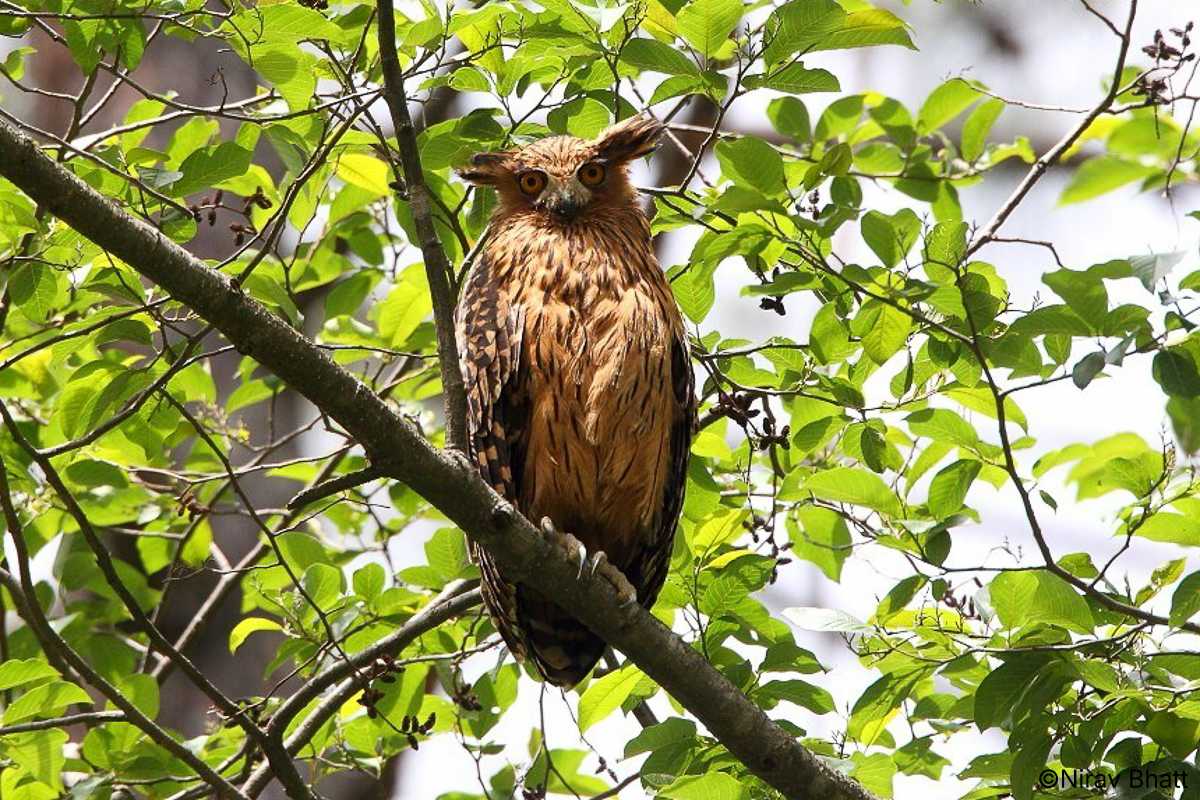
Tawny Fish-Owl
- Common Name: Tawny Fish-Owl
- Scientific Name: Ketupa flavipes
- Nepali Name(s): कैलो मलाहा हुचिल (Kailo Malaha Huchil)
- IUCN Red List Status: Least Concern (LC)
- National Red List Status: Rare Resident
- CITES Appendix: Appendix II
Measurements & Physical Profile
- Body Length: 48–58 cm
- Wing Length: 41–47.7 cm
- Weight: 2250 g
Did You Know?
The Tawny Fish-Owl is one of the heaviest owl species in the world. It is highly specialized for a life near water, featuring unique, rough-textured toe pads that provide extra grip for snatching slippery fish from mountain streams. Unlike typical forest owls, it has partially feathered legs, a trait that helps it balance its aquatic lifestyle with life in the forest canopy.
Distribution & Habitat
Global Distribution
The Tawny Fish-Owl (Ketupa flavipes) is distributed across the Himalayan foothills and adjoining montane regions of South and Southeast Asia. Its range extends from Nepal, northern India, Bhutan, and Bangladesh east through Myanmar, southern China, Laos, northern Vietnam, and Taiwan. The species inhabits subtropical and temperate broadleaved forests associated with clear, fast-flowing rivers and streams, typically in remote, undisturbed landscapes. Although widespread across its range, it occurs at low densities and is generally considered uncommon due to its specialized habitat requirements and nocturnal behavior.
Distribution within Nepal
The Tawny Fish-Owl is a rare and localized resident in Nepal, with its distribution largely confined to the lowland forests and riverine habitats of the central and western Terai. Although the species was first described from Nepal by Hodgson in 1836 and historical specimens were collected from the lower hills and Hetauda, nearly all recent records originate from Chitwan National Park and its buffer zone, including nearby community forests such as Janakauli and Namuna. The owl inhabits mature forests along perennial rivers and streams, where it depends on undisturbed riparian habitats for foraging and nesting. Its apparent rarity likely reflects its nocturnal habits and the limited survey effort in suitable habitats rather than a truly restricted distribution.
Preferred Habitats
The Tawny Fish-Owl is closely associated with old-growth subtropical and temperate broadleaved forests traversed by clear, fast-flowing rivers and mountain streams. It prefers remote, undisturbed riparian forests with dense canopy cover, large mature trees for nesting, and an abundant supply of aquatic prey. The species generally avoids heavily modified landscapes and is considered an indicator of intact forested river ecosystems.
Elevational Range
The species typically occurs between 1,500 and 2,450 m above sea level throughout the Himalayas and adjoining mountain ranges, although it has been recorded at lower elevations in parts of Nepal and Southeast Asia where suitable riverine forests persist. Seasonal altitudinal movements are limited and are generally associated with local environmental conditions rather than true migration.
Seasonal Occurrence
The Tawny Fish-Owl is a year-round resident throughout its range, including Nepal. Adults occupy permanent territories centred on river valleys and remain within these areas throughout the year. Activity is generally greatest during the breeding season (November–February), but the species can be encountered in suitable habitats year-round.
Behavior & Ecology
Flight & Foraging Behavior
Primarily nocturnal but often active at dusk, dawn, and occasionally on overcast days, the Tawny Fish Owl hunts by perching quietly along riverbanks before making short, powerful flights to capture prey. It catches fish by swooping to the water surface with its talons and also searches shallow streams for crabs, frogs, and other aquatic animals. Its broad wings and silent flight enable efficient hunting within densely forested river corridors.
Social & Roosting Habits
The species is highly solitary and strongly territorial, usually occurring singly or in pairs during the breeding season. During daylight it roosts inconspicuously in dense foliage, large riverside trees, or rocky ledges close to streams. When disturbed, it often remains motionless, relying on its cryptic plumage for camouflage rather than immediately taking flight.
Diet & Ecosystem Role
Diet Breakdown
The Tawny Fish Owl is an opportunistic predator whose diet consists mainly of:
- Aquatic prey (Primary): Fish, crabs and freshwater shrimp are important dietary components.
- Amphibians: Frogs and toads are commonly taken.
- Other prey: Small mammals, reptiles, birds, and large aquatic insects are consumed opportunistically
Ecological Role
As a top predator of forested river ecosystems, the Tawny Fish Owl helps regulate populations of fish, amphibians, and crustaceans, contributing to balanced aquatic food webs. Because it depends on clean rivers, mature riparian forests, and minimal human disturbance, its presence is widely regarded as an indicator of healthy and well-preserved mountain stream ecosystems.
Breeding Biology
The Tawny Fish-Owl typically breeds from November to February, selecting nesting sites in large tree cavities, rock crevices, or repurposed raptor nests within undisturbed, mature riparian forests. Females lay a small clutch of 1–2 eggs. No detailed information is available on the incubation and fledging period; however, it is believed they incubate for 35–40 days while the male provides food. Following hatching, the male continues to assist with provisioning, while the female focuses on brooding. The young fledge after 7–8 weeks but remain reliant on their parents for several months as they master complex aquatic hunting skills.
Migration
- Status: Resident (non-migratory).
- Movement: Adults are sedentary and maintain permanent territories along mountain streams and river valleys throughout the year. Juveniles disperse only short distances after fledging to establish their own territories.
Population Status
- Global Population Estimate: Unknown.
- Population Trend: Decreasing, primarily because of habitat degradation and loss of mature riparian forests.
- National Population (Nepal): Estimated at fewer than 20 individuals, making it one of Nepal's rarest owls.
- Monitoring: No long-term systematic monitoring programme currently exists in Nepal.
Threats
- Habitat Degradation: Hydropower development, river regulation, pollution, and degradation of forest streams reduce foraging habitat and prey availability.
- Deforestation: Loss of mature riverside forests removes nesting cavities and daytime roosting sites.
- Human Disturbance: Expanding tourism, trekking, logging, and infrastructure development near river valleys may disrupt breeding and reduce habitat quality.
- Illegal Hunting and Trade: Although less frequently targeted than some owl species, occasional trapping and persecution for traditional beliefs and the illegal wildlife trade remain localized threats.
Conservation Actions
Existing Measures
- Legal Protection: Listed under CITES Appendix II, regulating international trade.
- Protected Areas: The species occurs within protected areas such as Chitwan National Park, where important riverine forest habitats receive legal protection.
- National Conservation: Included under Nepal's Owl Conservation Action Plan (2020–2029), which promotes research, habitat conservation, and awareness for threatened owl species.
Recommended Measures
- Protect Riparian Forests: Conserve mature riverine forests and establish buffer zones around important nesting and foraging habitats.
- Maintain River Health: Minimize impacts of hydropower development, pollution, and excessive water extraction to preserve natural stream flow and aquatic prey populations.
- Research and Monitoring: Conduct systematic surveys to determine population size, distribution, and breeding ecology in Nepal.
- Community Awareness: Promote conservation education among local communities and reduce disturbance around known nesting sites.
References
- Avipedia. (n.d.). Tawny Fish Owl. Available at: https://avipedia.org/bird-species/tawny-fish-owl (Accessed: 9 August 2026).
- BirdLife International (2018). Species factsheet: Tawny Fish-owl Ketupa flavipes. Downloaded from https://datazone.birdlife.org/species/factsheet/tawny-fish-owl-ketupa-flavipes on 09/08/2026.
- Holt, D. W., R. Berkley, C. Deppe, P. L. Enríquez, J. L. Petersen, J. L. Rangel Salazar, K. P. Segars, K. L. Wood, and J. S. Marks (2020). Tawny Fish-Owl (Ketupa flavipes), version 1.0. In Birds of the World (J. del Hoyo, A. Elliott, J. Sargatal, D. A. Christie, and E. de Juana, Editors). Cornell Lab of Ornithology, Ithaca, NY, USA. https://doi.org/10.2173/bow.tafowl1.01
- Inskipp C., Baral H. S., Phuyal S., Bhatt T. R., Khatiwada M., Inskipp, T, Khatiwada A., Gurung S., Singh P. B., Murray L., Poudyal L. and Amin R. (2016). The status of Nepal’s Birds: The national red list series. Zoological Society of London, UK.
- König, C., F. Weick, and J.-H. Becking (2008). Owls of the World. Second edition. Christopher Helm, London, UK.