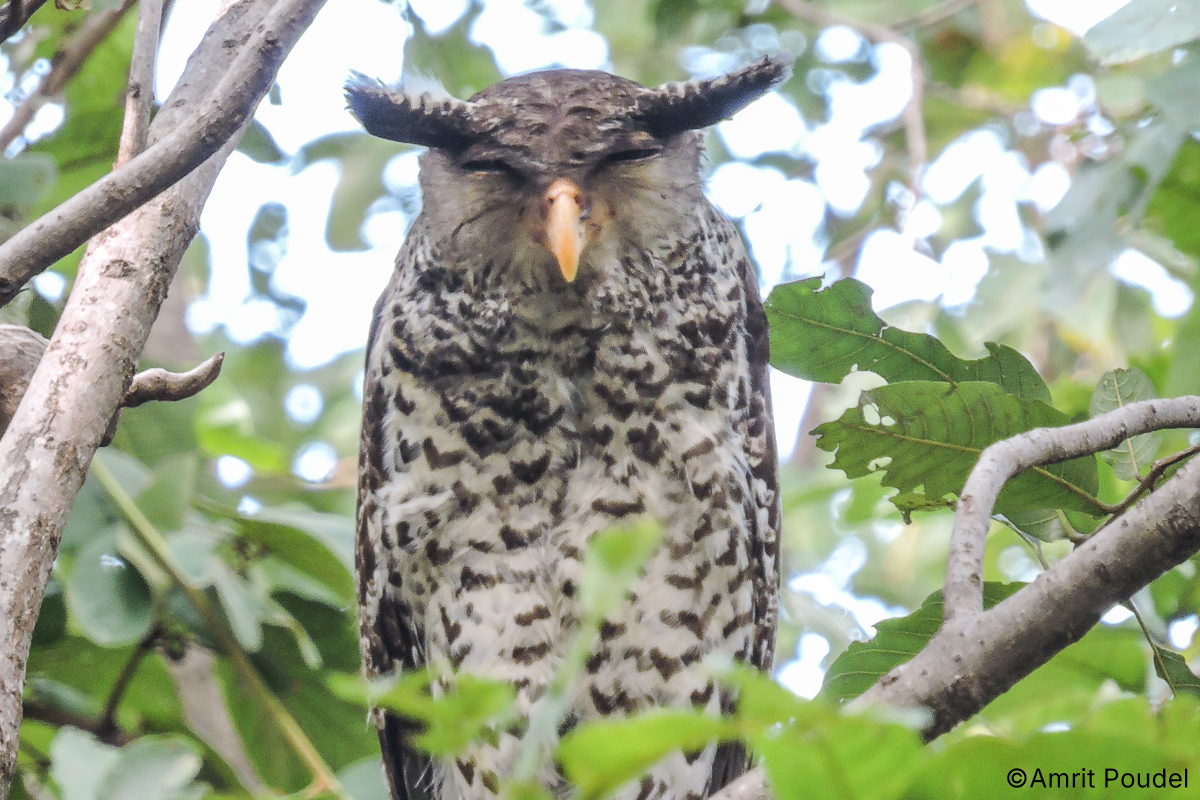
Spot-bellied Eagle-Owl
- Common Name: Spot-bellied Eagle-Owl (formerly known as Forest Eagle-Owl)
- Scientific Name: Ketupa nipalensis (formerly Bubo nipalensis)
- Nepali Name(s): महाकौशिक (Mahakaushik)
- IUCN Red List Status: Least Concern (LC)
- National Red List Status: Endangered (EN)
- CITES Appendix: Appendix II
Measurements & Physical Profile
- Body Length: 51–63 cm
- Wing Length: 37–47 cm
- Weight: 1,300–1,500 g
Did You Know?
Often referred to as the "Ghost of the Forest," the Spot-bellied Eagle-Owl is one of Asia’s largest and most formidable owls. It is famous for its human-like, deep, booming calls that can be heard from a significant distance in the quiet of the night. It also possesses long, scruffy-looking ear tufts that slant to the side, giving it a distinctive and somewhat "grumpy" appearance.
Distribution & Habitat
Global Distribution
Distributed across the Indian subcontinent and Southeast Asia, ranging from the Himalayan foothills and India through Bhutan, Bangladesh, Myanmar, and parts of Thailand, Laos, Cambodia, and Vietnam.
Distribution within Nepal
It is a rare resident. Given that the species was first described from a specimen collected in Nepal (its type locality is Nepal), it holds a special place in Nepalese ornithology. While widely distributed in theory, it is elusive and rarely encountered due to its strictly nocturnal and secretive nature.
Preferred Habitats
Requires dense, old-growth evergreen or moist deciduous forests. It is most frequently found in deep, undisturbed forest valleys, subtropical/tropical foothills, and riparian zones.
Elevational Range
Typically found between 900 and 2,100 meters, though it can occasionally be recorded from the lowlands up to 3,000 meters in the Himalayas.
Seasonal Occurrence
Year-round permanent resident; it maintains established territories throughout the year.
Behavior & Ecology
Flight & Foraging Behavior
A powerful and bold predator, it hunts primarily at night using a "sit-and-wait" approach from a high canopy perch. It is agile enough to navigate dense forest cover to pounce on prey.
Social & Roosting Habits
Secretive and largely solitary. During the day, it roosts in dense foliage or tree cavities, where its grayish-brown plumage provides excellent camouflage against tree bark.
Diet & Ecosystem Role
Diet Breakdown
One of the most aggressive hunters among owls, it takes a wide range of prey:
- Birds (Primary): Large birds such as pheasants, junglefowl, and peafowl.
- Mammals: Capable of killing surprisingly large prey, including golden jackals, hares, civets, and even small fawns.
- Other: Reptiles (including large monitor lizards), fish, and amphibians.
Ecological Role
As an apex nocturnal predator in forested environments, it regulates the population of various forest vertebrates, maintaining the ecological balance of the canopy and forest floor.
Breeding Biology
The breeding season in Nepal typically occurs from February to March. They usually repurpose the large stick nests of other raptors or utilize deep tree hollows. Only one egg is typically laid, which the female incubates alone while the male provides food. Information is not available about the incubation period and fledging.
Migration
- Status: Permanent resident; non-migratory.
- Movement: Established pairs remain within their home range year-round.
Population Status
- Global Population Estimate: Unknown.
- Population Trend: Decreasing.
- National Population Estimate (Nepal): 50 – 250 individuals.
- Monitoring & Surveys: There are currently no systematic population monitoring activities for this species.
Threats
- Habitat Degradation: The primary threat to this species is the loss and fragmentation of mature, dense forest tracts, which are essential for its nesting and foraging requirements.
- Anthropogenic Disturbance: Increasing human encroachment into remote forest valleys, coupled with illegal hunting and persecution—often driven by localized superstitions and beliefs in folk magic—continues to impact local population stability.
Conservation Actions
Existing Measures
- Legal Status: The species is listed under CITES Appendix II, providing a framework for regulating international trade.
- Protected Area Network: Presence is confirmed within several of Nepal’s national parks and protected areas, which offer critical refuge for the old-growth forest habitats required by the species.
Recommended Measures
- Habitat Preservation: Prioritizing the conservation of undisturbed, high-canopy forest tracts remains the most critical requirement for the long-term survival of this owl.
- Community Engagement & Awareness: Implementing targeted outreach programs in forest-adjacent communities to dispel myths and cultural misconceptions that contribute to the persecution of these birds.
References
- BirdLife International (2018). Species factsheet: Spot-bellied Eagle-owl Bubo nipalensis. Downloaded from https://datazone.birdlife.org/species/factsheet/spot-bellied-eagle-owl-bubo-nipalensis on 09/08/2026
- Holt, D. W., R. Berkley, C. Deppe, P. L. Enríquez, J. L. Petersen, J. L. Rangel Salazar, K. P. Segars, K. L. Wood, J. S. Marks, and C. Hansasuta (2022). Spot-bellied Eagle-Owl (Ketupa nipalensis), version 1.1. In Birds of the World (S. M. Billerman, P. Pyle, and N. D. Sly, Editors). Cornell Lab of Ornithology, Ithaca, NY, USA. https://doi.org/10.2173/bow.sbeowl1.01.
- Inskipp C., Baral H. S., Phuyal S., Bhatt T. R., Khatiwada M., Inskipp, T, Khatiwada A., Gurung S., Singh P. B., Murray L., Poudyal L. and Amin R. (2016). The status of Nepal’s Birds: The national red list series. Zoological Society of London, UK.
- König, C., F. Weick, and J.-H. Becking (2008). Owls of the World. Second edition. Christopher Helm, London, UK.
- Lewis, D. (2020). Forest Eagle Owl (Bubo nipalensis). The Owl Pages. Available at: https://www.owlpages.com/owls/species.php?s=1350 (Accessed: 9 August 2026)