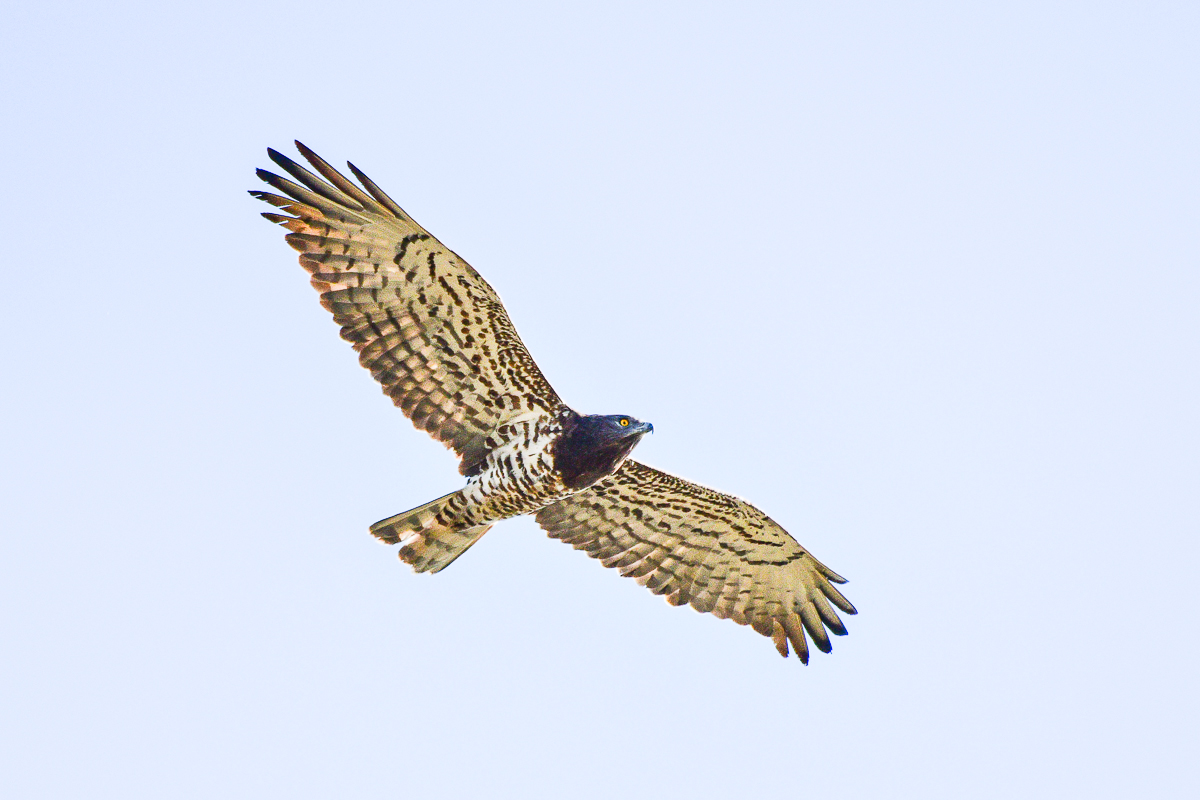
Short-toed Snake-Eagle
- Common Name: Short-toed Snake-Eagle
- Scientific Name: Circaetus gallicus
- Nepali Name(s): सर्पहारी चिल (Sarpahaari Chil)
- IUCN Red List Status: Least Concern (LC)
- National Red List Status: Least Concern (LC)
- CITES Appendix: Appendix II
Measurements & Physical Profile
- Body Length: 62–70 cm
- Wingspan: 166–188 cm
- Weight: 1,200–2,300 g
Did You Know?
The Short-toed Snake-Eagle is a master of the skies, often spending more time on the wing than most other eagles. It has an owl-like rounded head with large, striking yellow eyes and is uniquely adapted to its serpent-hunting lifestyle. It frequently uses "hovering" flight, similar to a kestrel, to scan for prey from heights of up to 500 meters before initiating a shallow, direct dive.
Distribution & Habitat
Global Distribution
The Short-toed Snake-Eagle is widely distributed across the Palearctic and parts of the Indo-Malayan region. Its range extends from southern Europe and the Mediterranean through the Middle East, Central Asia, and the Indian subcontinent to northwestern China and parts of Southeast Asia, including Indonesia. Northern breeding populations migrate to sub-Saharan Africa during winter, whereas populations in South Asia and parts of Southeast Asia are largely resident.
Distribution in Nepal
In Nepal, the Short-toed Snake-Eagle is primarily regarded as a winter visitor and passage migrant, although BirdLife International currently maps the species as a resident breeder despite the absence of confirmed breeding or summer records in the country. The species is most frequently encountered in the lowland Terai and adjacent lower foothills, particularly in open habitats. It is regularly recorded in the Koshi region, especially at Koshi Tappu Wildlife Reserve and Koshi Barrage, but is rarer in the far west and also remains rare elsewhere. Occasional records from the mid-hills, including Kakani and the Annapurna region, indicate its use of migratory routes across the country.
Preferred Habitats
The species thrives in open-country environments, including cultivated plains, arid stony deciduous scrub, and complex grassland-forest mosaics. A critical requirement for its presence is the availability of mature trees for nesting, coupled with expansive, unobstructed open areas that allow for effective foraging.
Elevational Range
The Short-toed Snake-Eagle primarily occupies the lowlands and lower hill slopes. However, it is a proficient soarer and may be observed at various altitudes during its seasonal migrations or when performing wide-ranging foraging flights.
Seasonal Occurrence in Nepal
In Nepal, most records occurring between October and March, and peak observations during December–February. Passage migrants have been recorded during both autumn (September–November) and spring (March–April), particularly along the Annapurna migration corridor and the central hill ranges.
Behavior & Ecology
Flight and Foraging Behavior
The Short-toed Snake-Eagle is a master of thermal soaring, frequently utilizing updraughts to maintain altitude with minimal energy expenditure. It is exceptionally active in the air and employs a distinctive hovering technique to fixate on prey movement below. Once a target—predominantly snakes or lizards—is spotted, the eagle executes a swift, direct, and controlled glide to capture its prey.
Social and Roosting Habits
These eagles are typically solitary, maintaining a reserved and quiet demeanor for the majority of the year. They are generally silent outside of the breeding season, during which they become notably more vocal, utilizing characteristic musical whistling calls to communicate and establish territory.
Diet & Ecosystem Role
Diet Breakdown
As its name implies, it is a specialist:
- Reptiles (Primary): Snakes (both venomous and non-venomous) and lizards comprise the vast majority of its diet.
- Small Mammals: Occasionally takes rodents, rabbits, or hedgehogs.
- Other: Rarely consumes amphibians, large insects, or even small birds.
Ecological Role
The Short-toed Snake-Eagle is a highly specialized predator that plays an important ecological role by regulating populations of snakes and other reptiles. Snakes constitute approximately 80–95% of its diet, although it also occasionally feeds on lizards, amphibians, small mammals, birds, and large insects when reptile prey is scarce. By maintaining balanced reptile populations, the species contributes to ecosystem stability and healthy trophic interactions. Its dependence on abundant reptile prey and structurally diverse habitats makes it a valuable indicator of well-functioning open landscapes with intact food webs. As a top predator, the Short-toed Snake Eagle also reflects the ecological integrity of habitats where pesticide use is limited and natural prey communities are maintained.
Breeding Biology
Breeding typically occurs from March to May. They construct small, relatively inconspicuous stick nests high in the crowns of trees. The female lays a single white egg. The male provides food for the female during the 45–47 day incubation period, and the young eagle remains in the nest for 60–80 days before fledging.
Migration
- Status: It is considered a resident species in South Asia, however there is no breeding and summer record in Nepal. Northern populations migrate to sub-Saharan Africa as well in South Asia including Nepal.
- Movement: Migratory populations typically leave breeding grounds in September/ October and return by April/May.
Population Status
- Global Population Estimate: 50,000 – 100,000 mature individuals.
- Population Trend: Stable
- National Population Estimate (Nepal): Unknown.
- Monitoring & Surveys: Monitored via regional raptor migration watch points and biodiversity surveys.
Threats
- Habitat Loss: Intensive agriculture and the loss of scrubland reduce prey availability.
- Power Line Collisions: Like many large raptors, they are susceptible to collisions and electrocution on poorly insulated power lines.
- Disturbance: Human activity near nesting sites can cause abandonment.
Conservation Actions
Existing Measures
- Legal Protections: Listed under CITES Appendix II, which helps regulate international trade.
- Protected Areas: Its presence in protected areas such as Koshi Tappu Wildlife Reserve, Chitwan National Park etc. provides a safe foraging habitat in Nepal.
Recommended Measures
- Landscape Connectivity: Preserving the mosaic of forest patches and open grasslands is crucial for maintaining snake populations.
- Infrastructure Safety: Installing bird-safe designs on high-voltage power lines.
References
- BirdLife International (2021). Species factsheet: Short-toed Snake-eagle Circaetus gallicus. Downloaded from https://datazone.birdlife.org/species/factsheet/short-toed-snake-eagle-circaetus-gallicus on 07/08/2026
- Ferguson-Lees, J., & Christie, D. A. (2001). Raptors of the World. Christopher Helm, London.
- Inskipp C., Baral H. S., Phuyal S., Bhatt T. R., Khatiwada M., Inskipp, T, Khatiwada A., Gurung S., Singh P. B., Murray L., Poudyal L. and Amin R. (2016). The status of Nepal’s Birds: The national red list series. Zoological Society of London, UK.
- Naoroji, R. (2006). Birds of Prey of the Indian Subcontinent. Om Books International, New Delhi.
- Orta, J., G. M. Kirwan, and E. Garcia (2020). Short-toed Snake-Eagle (Circaetus gallicus), version 1.0. In Birds of the World (J. del Hoyo, A. Elliott, J. Sargatal, D. A. Christie, and E. de Juana, Editors). Cornell Lab of Ornithology, Ithaca, NY, USA. https://doi.org/10.2173/bow.shteag1.01
- The Peregrine Fund. (2026) Short-toed Snake-eagle. Available at: https://peregrinefund.org/explore-raptors-species/eagles/short-toed-snake-eagle (Accessed: 7 August 2026).