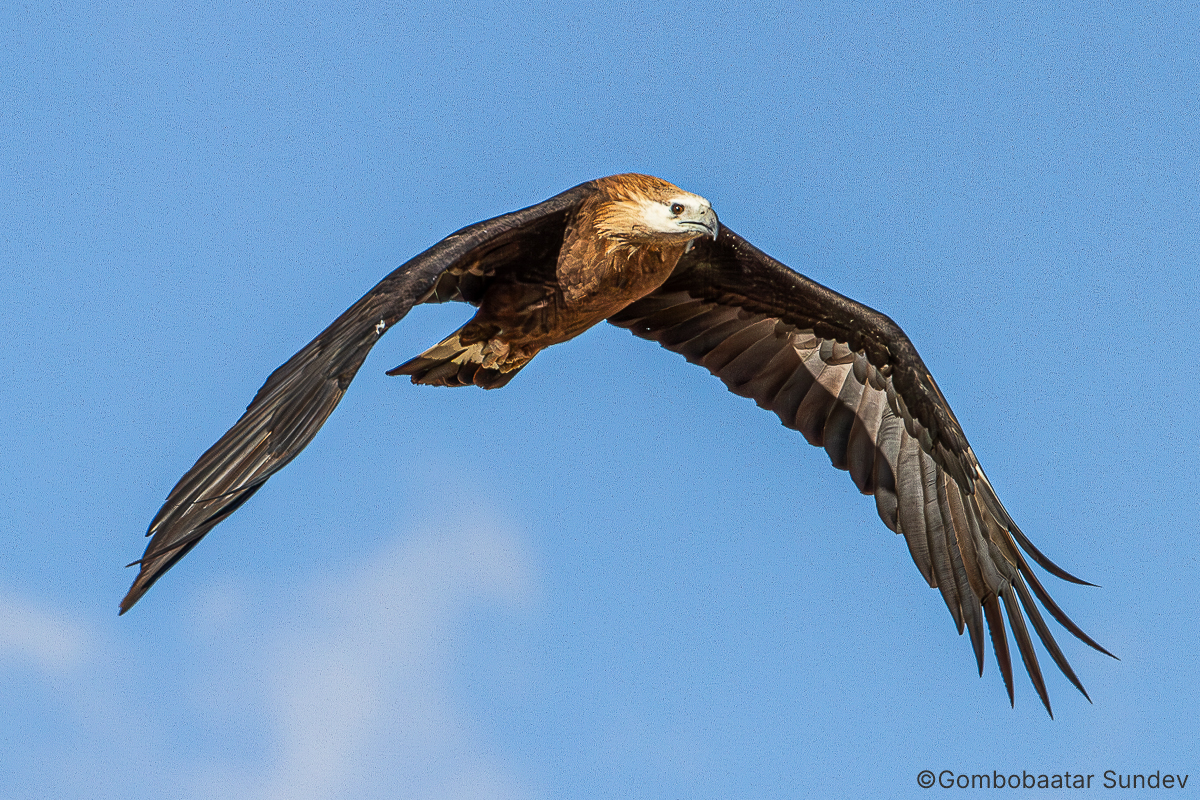
Pallas's Fish-Eagle
- Common Name: Pallas's Fish-Eagle
- Scientific Name: Haliaeetus leucoryphus
- Nepali Name(s): सानो कङ्कम चिल (Sano Kangakam Chil)
- IUCN Red List Status: Endangered (EN)
- National Red List Status: Critically Endangered (CR)
- CITES Appendix: Appendix II
- CMS Appendix: Appendix II
Measurements & Physical Profile
- Body Length: 72–89 cm
- Wingspan: 185–222 cm
- Weight: 2,040–3,700 g
Did You Know?
Sporting a striking dark brown body, a pale creamy-white head, and a bold white band across its broad black tail, the Pallas's Fish-Eagle is a magnificent apex predator of Asia's large wetlands. It possesses immense physical strength, capable of diving onto the water's surface to seize giant catfish and carp that weigh nearly as much as the eagle itself. It is also a notorious bully, frequently using its massive size to chase down and terrorize other fish-eating birds, like ospreys and storks, mid-air until they drop their freshly caught prey!
Distribution & Habitat
Global Distribution
The Pallas's Fish-Eagle is native to Central, Southern, and East Asia. Its highly fragmented range extends from the steppes of Kazakhstan and Mongolia (where northern populations are summer breeders) southward into the major river basins of the Indian Subcontinent, encompassing northern India, Nepal, Bangladesh, and parts of Myanmar.
Distribution within Nepal
In Nepal, it is an extremely rare and localized resident breeder and winter visitor. Its distribution is strictly restricted to large, low-altitude wetland complexes and river networks. It is primarily recorded in the eastern and central lowlands, with Koshi Tappu Wildlife Reserve, the Koshi Barrage area, and the river systems of Chitwan National Park serving as its historical and current national strongholds. Sightings outside these core protected wetlands are exceptional.
Preferred Habitats
Large, wide, slow-flowing tropical rivers, extensive freshwater lakes, deep marshes, and seasonal wetlands (jheels). Large man-made reservoirs, structural canals, and fish-farming ponds located adjacent to major riverine forest patches. It requires large, mature trees near water bodies for perching and nesting.
Elevational Range
Strictly a lowland wetland specialist in Nepal, generally restricted to elevations below 300 meters above sea level within the Tarai plains. Occasionally seen in 2000 meters elevation during migration flight.
Seasonal Occurrence
Observed year-round as a permanent resident in its core lowland riverine habitats. However, local numbers are occasionally supplemented during the winter months (November to February) by regional migrants or dispersing sub-adults moving along major trans-Himalayan river valleys.
Behavior & Ecology
Flight & Foraging Behavior
The flight of the Pallas's Fish-Eagle is powerful and heavy, featuring deep, deliberate wingbeats and long glides on broad, rectangular wings held flat or slightly curved. It hunts primarily from an exposed vantage point—such as a tall dead snag or a high branch overlooking a river channel. Upon spotting movement, it launches into a low-altitude glide, dropping steeply to pluck heavy fish directly from the water's surface with its massive, rough-textured talons. It is also highly adept at kleptoparasitism, aggressively robbing other piscivorous birds of their food.
Social & Roosting Habits
Typically observed hunting singly or operating in dedicated, lifelong territorial pairs. They are solitary and highly sensitive birds that maintain large foraging territories along river banks. They require high, unobstructed roosting perches in mature trees close to the water edge, where they spend long hours scanning the channels. During the early winter breeding season, they become highly vocal, uttering a series of loud, raucous, gull-like barking calls—“krraak-krraak-krraak”—to announce their territory.
Diet & Ecosystem Role
Diet Breakdown
The Pallas's Fish-Eagle is a heavy-duty, opportunistic carnivore specialized in wetland prey:
- Fish (Primary): Large freshwater fish, particularly surface-dwelling or shallow-water species like large catfish, carp, and snakeheads.
- Waterbirds: A significant portion of its diet consists of waterbirds, including coots, ducks, grebes, young storks, and herons, taken directly from surface water or reedbeds.
- Mammals & Reptiles: Occasional hunting of water snakes, frogs, turtles, and small wetland rodents.
- Carrion: Will readily scavenge dead fish or animal remains washed up along river banks, especially during the winter.
Ecological Role
As a top-tier apex predator of large freshwater wetland systems, the Pallas's Fish-Eagle is a vital indicator of aquatic ecosystem health. By selectively culling large fish and abundant waterbirds, it regulates lower-trophic wetland communities, prevents localized overpopulation of specific fish species, and reflects the overall chemical safety, clarity, and structural biological integrity of major river systems.
Breeding Biology
The breeding season in Nepal occurs during the dry winter months, stretching from October to March, ensuring that nesting avoids the turbulent, high-water monsoon floods. Courtship features loud, synchronized vocal duets and spectacular aerial cartwheels where pairs lock talons and tumble through the sky over their river territory.
The pair constructs a monumental, exceptionally bulky platform nest made of thick branches, sticks, and aquatic reeds, which can expand over 1.5 to 2 meters wide through successive years of reuse. The nest basin is lined with softer materials like grass, straw, and green leaves. It is invariably positioned high up in the primary fork of a massive, mature, isolated tree (such as a silk-cotton/Kapok tree) standing directly on a river bank or within an adjacent riverine forest island. The female lays a clutch of 2 to 3 pristine white eggs. Incubation lasts for approximately 40 to 45 days and is shared by both parents, though the female spends the majority of time on the nest. The altricial chicks require intense care and are fed high-protein fish portions, eventually fledging and leaving the nest after a long period of 70 to 85 days.
Migration
- Status: Mainly migratory, although some birds remain in their breeding ground during the non-breeding period.
- Movement: The Pallas's Fish-Eagle moves from its southern breeding grounds in northern India north to its nonbreeding grounds in north-central Asia during the boreal summer (June–August). Few individuals may remain in the breeding grounds in the nonbreeding season.
Population Status
- Global Population Estimate: 1,000 to 2,499 mature individuals.
- Population Trend: Decreasing rapidly across its entire global range.
- National Population Estimate (Nepal): Fewer than 20 individuals.
- Monitoring & Surveys: There is no monitoring going on for this species.
Threats
- Wetland Degradation & Siltation: Large-scale damming, water diversion, gravel mining, and the draining of wetlands for agriculture destroy their foraging grounds and alter river hydrology.
- Loss of Nesting Trees: Severe logging, riverbank erosion, and human encroachment have systematically cleared the old-growth, massive trees required to support their heavy nests.
- Pollution & Bioaccumulation: Heavy agricultural run-off, industrial chemical dumping, and domestic sewage pollute major river systems, causing toxic bioaccumulation of heavy metals and pesticides up the food chain into the fish they eat.
- Overfishing & Food Depletion: Intensive, unsustainable commercial fishing and destructive practices (like poisoning or electro-fishing) by local communities severely deplete their primary fish food base.
- Human Disturbance: Expanding tourism, heavy boating traffic, and riverside developments cause high stress, forcing pairs to abandon their traditional nests.
Conservation Actions
Existing Measures
- Highest Global Protections: Listed under CITES Appendix II and Appendix II of the Convention on Migratory Species (CMS).
- Protected Area Sanctuary: The species receives strict legal protection within core zones of Koshi Tappu Wildlife Reserve and Chitwan National Park.
Recommended Measures
- Nest Tree Demarcation: Enforcing strict, community-enforced protection zones around known active nest-trees, completely banning timber extraction or clearing within a 500-meter radius.
- Sustainable Fishery Zoning: Creating "no-fishing" zones in critical river channels where fish eagles actively forage, combined with strict crackdowns on illegal electro-fishing.
- Riverine Eco-Tourism Buffers: Regulating commercial boat safaris and rafting routes to maintain a safe, low-noise buffer distance from known nesting and roosting snags during the October–March breeding window.
- Ecotoxicological Monitoring: Launching formal water-quality and fish-tissue testing programs in the Koshi and Narayani river systems to assess the impacts of pesticide loading on eagle reproductive failure.
References
- BirdLife International (2021). Species factsheet: Pallas's Fish-eagle Haliaeetus leucoryphus. Downloaded from https://datazone.birdlife.org/species/factsheet/pallass-fish-eagle-haliaeetus-leucoryphus on 06/08/2026
- Davaasuren, B., P. F. D. Boesman, C. Hansasuta, and P. Pyle (2025). Pallas's Fish-Eagle (Haliaeetus leucoryphus), version 2.0. In Birds of the World (S. M. Billerman, Editor). Cornell Lab of Ornithology, Ithaca, NY, USA. https://doi.org/10.2173/bow.pafeag1.02
- Ferguson-Lees, J., & Christie, D. A. (2001). Raptors of the World. Christopher Helm, London.
- Inskipp C., Baral H. S., Phuyal S., Bhatt T. R., Khatiwada M., Inskipp, T, Khatiwada A., Gurung S., Singh P. B., Murray L., Poudyal L. and Amin R. (2016). The status of Nepal’s Birds: The national red list series. Zoological Society of London, UK.