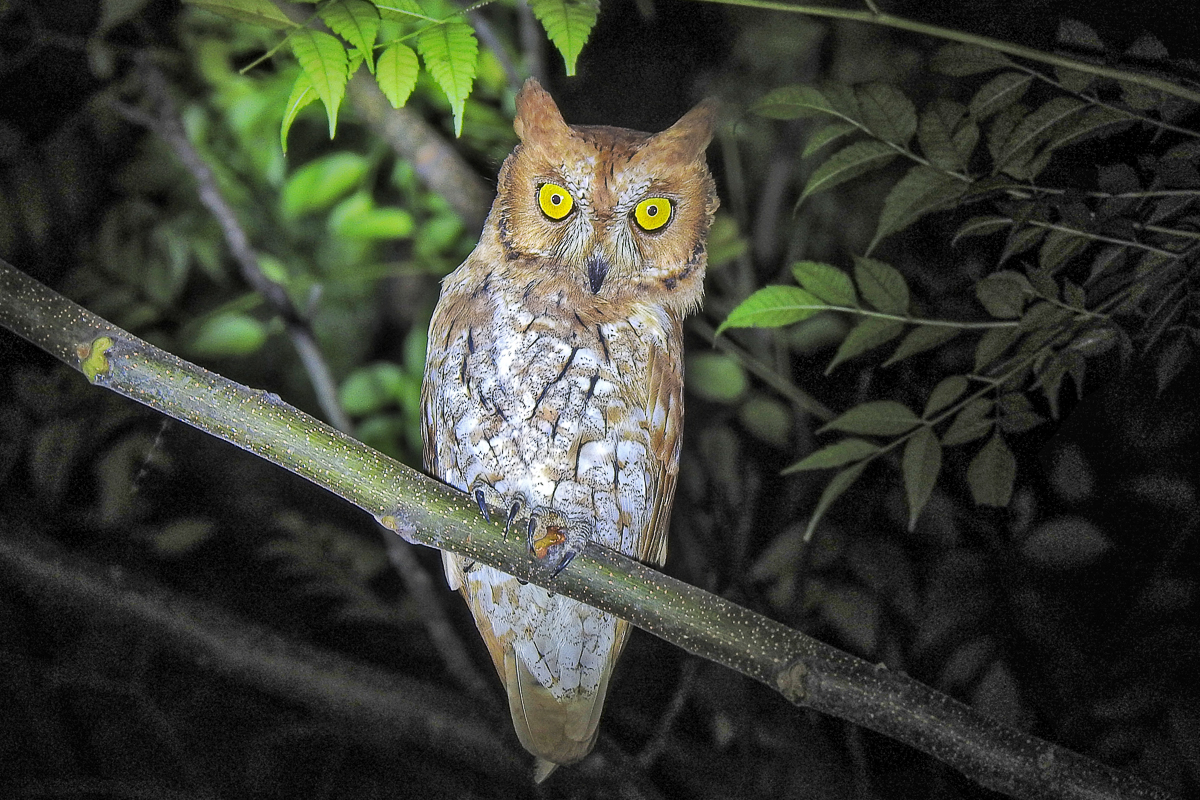
Oriental Scops-Owl
- Common Name: Oriental Scops-Owl
- Scientific Name: Otus sunia
- Nepali Name(s): लोखर्के उलूक (Lokharke Uluk)
- IUCN Red List Status: Least Concern (LC)
- National Red List Status: Data Deficient (DD)
- CITES Appendix: Appendix II
- CMS Appendix: Not listed
Measurements & Physical Profile
- Body Length: 17–21 cm
- Wingspan: 50 –53 cm
- Weight: 75–95 g
Did You Know?
The Oriental Scops-Owl is a highly variable species, existing in two distinct "color morphs"—a grey-brown phase and a more vibrant rufous (reddish) phase—which helps it blend into different types of forest bark. It possesses small, distinct ear tufts and striking bright yellow-orange eyes that are highly adapted for low-light hunting.
Distribution & Habitat
Global Distribution
Widely distributed across South, East, and Southeast Asia, ranging from the Himalayan foothills and India through China, Korea, and Japan, down to the Malay Peninsula.
Distribution within Nepal
The Oriental Scops-Owl is a resident species in Nepal, its distribution is in the lowland Nepal, including Suklaphanta National Park, Bardia National Park, Chitwan National Park, and Parsa National Park. Outside of these protected zones, records are sparse, ranging from the far west in Kailali District to the Dharan Forest Important Bird Area in the far east.
Preferred Habitats
Open woodlands, forest edges, wooded parks, and even mature gardens or orchards in rural areas. It shows a preference for areas with scattered tall trees that provide natural cavities for nesting.
Elevational Range
Primarily found in the tropical and subtropical belts, ranging from the lowlands up to approximately 1,500 meters above sea level.
Seasonal Occurrence
Year-round resident. They maintain small, localized territories throughout the year and generally do not undertake long-distance migrations within Nepal.
Behavior & Ecology
Flight & Foraging Behavior
The flight is swift, silent, and agile, allowing for sudden lunges at prey. It is primarily a nocturnal hunter, often using a "sit-and-wait" strategy from a low branch to scan for movement on the ground or among the lower foliage.
Social & Roosting Habits
Typically found solitary or in pairs. During the day, they remain strictly nocturnal and highly cryptic, roosting in thick foliage or deep inside tree holes where they remain motionless to avoid detection.
Diet & Ecosystem Role
Diet Breakdown
The Oriental Scops-Owl is a small, highly effective insectivore:
- Insects (Primary): Primarily consumes large nocturnal insects such as moths, beetles, grasshoppers, and crickets.
- Small Vertebrates: Opportunistically takes small rodents, shrews, or tiny reptiles when insects are seasonally less abundant.
Ecological Role
As a nocturnal predator of insects, it plays a key role in natural pest control within rural and forested landscapes. Its feeding habits contribute to the regulation of nocturnal insect populations, benefiting local plant health.
Breeding Biology
The breeding season in Nepal occurs from February to May. They nest exclusively in natural tree hollows or abandoned barbet and woodpecker holes. The female lays 3 to 6 (usually 3-4) white, spherical eggs, with incubation lasting approximately 24–25 days. Both parents participate in feeding the chicks, which fledge after about 30 days.
Migration
- Status: Resident; non-migratory.
- Movement: Unlike some other owl species, the Oriental Scops Owl generally stays within its home range throughout the year.
Population Status
- Global Population Estimate: Unknown.
- Population Trend: Stable.
- National Population Estimate (Nepal): Unknown.
- Monitoring & Surveys: In Nepal, there are no monitoring and surveys activities conducted.
Threats
- Habitat Loss: Deforestation and the removal of old, cavity-bearing trees significantly reduce available nesting sites.
- Pesticide Use: Secondary poisoning through the consumption of insects contaminated by insecticides used in nearby agricultural fields.
- Disturbance: Noise pollution and increased human activity in forest-edge habitats can disrupt their nocturnal hunting and breeding cycles.
Conservation Actions
Existing Measures
- Legal Protections: Listed under CITES Appendix II, regulating the international trade of owls and their derivatives.
- Protected Area Foothold: Populations are well-protected within various lowland national parks and community forest areas in Nepal.
Recommended Measures
- Nest-Tree Preservation: Encouraging local communities to protect mature trees with natural cavities.
- Pesticide Reduction: Promoting organic agricultural practices in areas surrounding forest patches to ensure a healthy prey base.
- Community Awareness: Educating local populations about the owl’s role as a natural pest-controller to foster greater protection for the species.
References
- BirdLife International (2021). Species factsheet: Oriental Scops-owl Otus sunia. Downloaded from https://datazone.birdlife.org/species/factsheet/oriental-scops-owl-otus-sunia on 09/08/2026
- Holt, D. W., R. Berkley, C. Deppe, P. L. Enríquez, J. L. Petersen, J. L. Rangel Salazar, K. P. Segars, K. L. Wood, G. M. Kirwan, and J. S. Marks (2020). Oriental Scops-Owl (Otus sunia), version 1.0. In Birds of the World (J. del Hoyo, A. Elliott, J. Sargatal, D. A. Christie, and E. de Juana, Editors). Cornell Lab of Ornithology, Ithaca, NY, USA. https://doi.org/10.2173/bow.orsowl.01
- Inskipp C., Baral H. S., Phuyal S., Bhatt T. R., Khatiwada M., Inskipp, T, Khatiwada A., Gurung S., Singh P. B., Murray L., Poudyal L. and Amin R. (2016). The status of Nepal’s Birds: The national red list series. Zoological Society of London, UK.
- König, C., F. Weick, and J.-H. Becking (2008). Owls of the World. Second edition. Christopher Helm, London, UK.