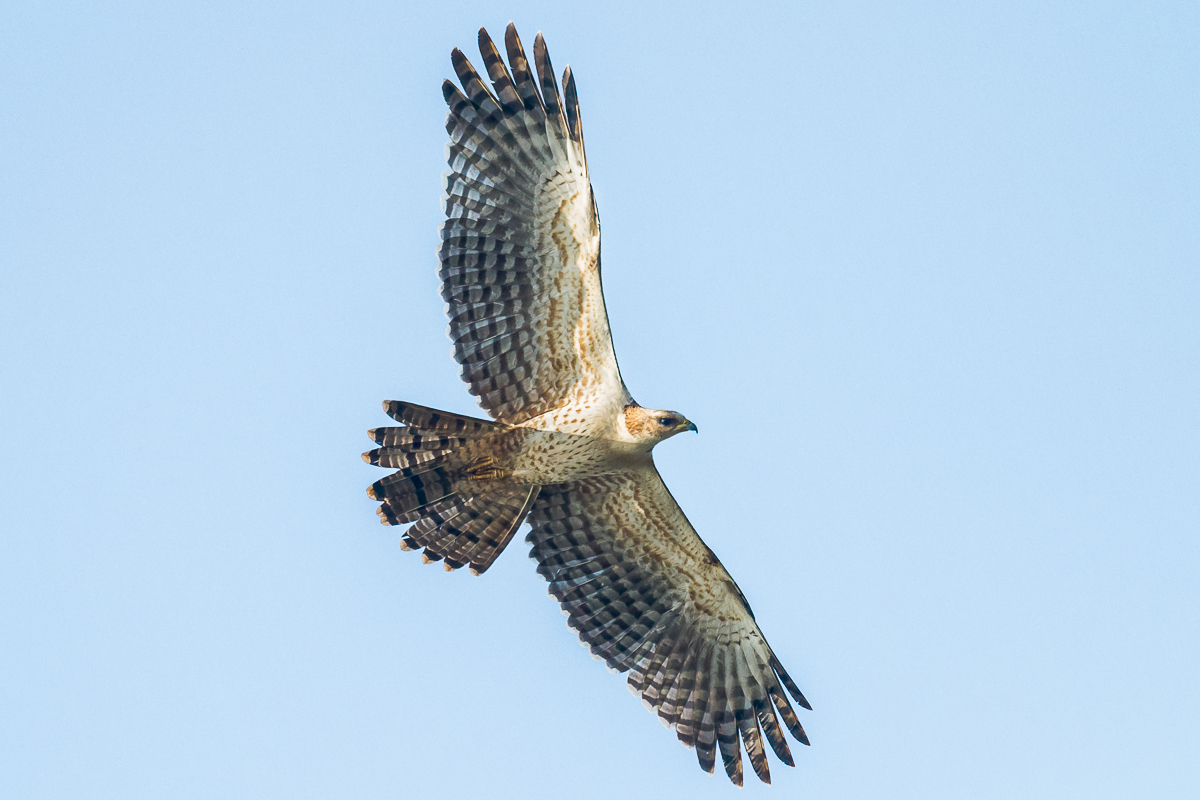
Oriental Honey-buzzard
- Common Name: Oriental Honey-buzzard
- Scientific Name: Pernis ptilorhynchus
- Nepali Name(s): मधुहा (Madhuhaa)
- IUCN Red List Status: Least Concern (LC)
- National Red List Status: Least Concern (LC)
- CITES Appendix: Appendix II
- CMS Appendix: Not listed
Measurements & Physical Profile
- Body Length: 52–68 cm
- Wingspan: 115–155 cm
- Weight: 750–1,490 g
Did You Know?
The Oriental Honey-buzzard is a master of specialized foraging, possessing unique evolutionary adaptations such as dense, scale-like feathers on its face that protect it from stings while it raids underground bee and wasp nests. It is also one of the few raptors that regularly engages in high-intensity "honey-hunting," using its specialized, hooked bill to extract larvae and pupae from deep within honeycomb structures.
Distribution & Habitat
Global Distribution
Widely distributed across Asia, ranging from Siberia and Japan through China, Southeast Asia, and the Indian subcontinent.
Distribution within Nepal
A common resident and passage migrant throughout Nepal. It is actively recorded from the lowland Tarai up through the mid-hills, frequently sighted in forest corridors and river valleys across the country.
Preferred Habitats
Diverse landscapes including deciduous forests, subtropical broadleaved hillsides, and forest edges. It is often found in agricultural mosaics where mature trees are present for nesting and forest patches remain for foraging.
Elevational Range
Primarily distributed from the lowland plains up to 3,000 meters above sea level.
Seasonal Occurrence
Year-round resident in many parts of its range (mainly in the lowlands), with significant migratory populations passing through Nepal during spring and autumn.
Behavior & Ecology
Flight & Foraging Behavior
The flight is characterized by broad, rounded wings and a long tail, often seen soaring high over forest canopies. It specializes in locating and excavating ground-dwelling bee and wasp nests, often using its talons and bill to dig into soil or rotting wood.
Social & Roosting Habits
Generally solitary, though individuals can form loose groups during migration. They roost cryptically within dense foliage, often returning to the same favored tall trees throughout the non-breeding season.
Diet & Ecosystem Role
Diet Breakdown
The Oriental Honey-buzzard is a specialized carnivore focusing on social insects:
- Insects (Primary): Larvae, pupae, and adults of bees and wasps are the core diet.
- Other: Opportunistically takes small mammals, reptiles, and occasionally small birds when insect abundance is low.
Ecological Role
As a specialized insectivore, it plays a critical role in controlling wasp and bee populations within forest ecosystems. By excavating nests, it also influences the distribution of these insects, serving as a unique regulator of forest biodiversity.
Breeding Biology
The breeding season in Nepal occurs from March through June. Pairs build large, bulky stick nests high in the canopy of mature, broad-leaved trees. The female lays 1 to 3 eggs, and incubation, shared by both parents, lasts approximately 30–35 days. Fledging takes about 40–45 days.
Migration
- Status: Resident as well as long-distance migrant.
- Movement: Migratory populations undertake massive journeys from northern breeding grounds toward warmer wintering sites. In Nepal, large numbers can be seen migrating along major ridge lines during the spring and autumn seasons.
Population Status
- Global Population Estimate: 66,666 – 666,666 mature individuals.
- Population Trend: Decreasing.
- National Population Estimate (Nepal): Unknown.
- Monitoring & Surveys: Monitored through raptor migration watch points, point counts, and opportunistic observations across national parks.
Threats
- Habitat Fragmentation: Loss of mature trees and forest patches limits nesting opportunities.
- Pesticide Use: Chemical insecticides used in agriculture may kill off the insect prey base that the honey buzzard relies on.
- Human Intrusion: Disturbance to nesting sites and the collection of forest resources can cause nest desertion.
Conservation Actions
Existing Measures
- Legal Protections: Listed under CITES Appendix II to prevent unregulated trade.
- Protected Area Foothold: Populations are well-represented within Nepal’s protected area network.
Recommended Measures
- Old-Growth Preservation: Protecting nesting trees and mature forest patches is vital for their continued success.
- Awareness: Education programs for local communities about the beneficial role this raptor plays in nature.
- Habitat Monitoring: Continued tracking of migration corridors to identify key sites for conservation intervention.
References
- BirdLife International (2021). Species factsheet: Oriental Honey-buzzard Pernis ptilorhynchus. Downloaded from https://datazone.birdlife.org/species/factsheet/oriental-honey-buzzard-pernis-ptilorhynchus on 06/08/2026
- Ferguson-Lees, J., & Christie, D. A. (2001). Raptors of the World. Christopher Helm, London.
- Inskipp C., Baral H. S., Phuyal S., Bhatt T. R., Khatiwada M., Inskipp, T, Khatiwada A., Gurung S., Singh P. B., Murray L., Poudyal L. and Amin R. (2016). The status of Nepal’s Birds: The national red list series. Zoological Society of London, UK.
- Orta, J., J. S. Marks, and G. M. Kirwan (2020). Oriental Honey-buzzard (Pernis ptilorhynchus), version 1.0. In Birds of the World (J. del Hoyo, A. Elliott, J. Sargatal, D. A. Christie, and E. de Juana, Editors). Cornell Lab of Ornithology, Ithaca, NY, USA. https://doi.org/10.2173/bow.orihob2.01