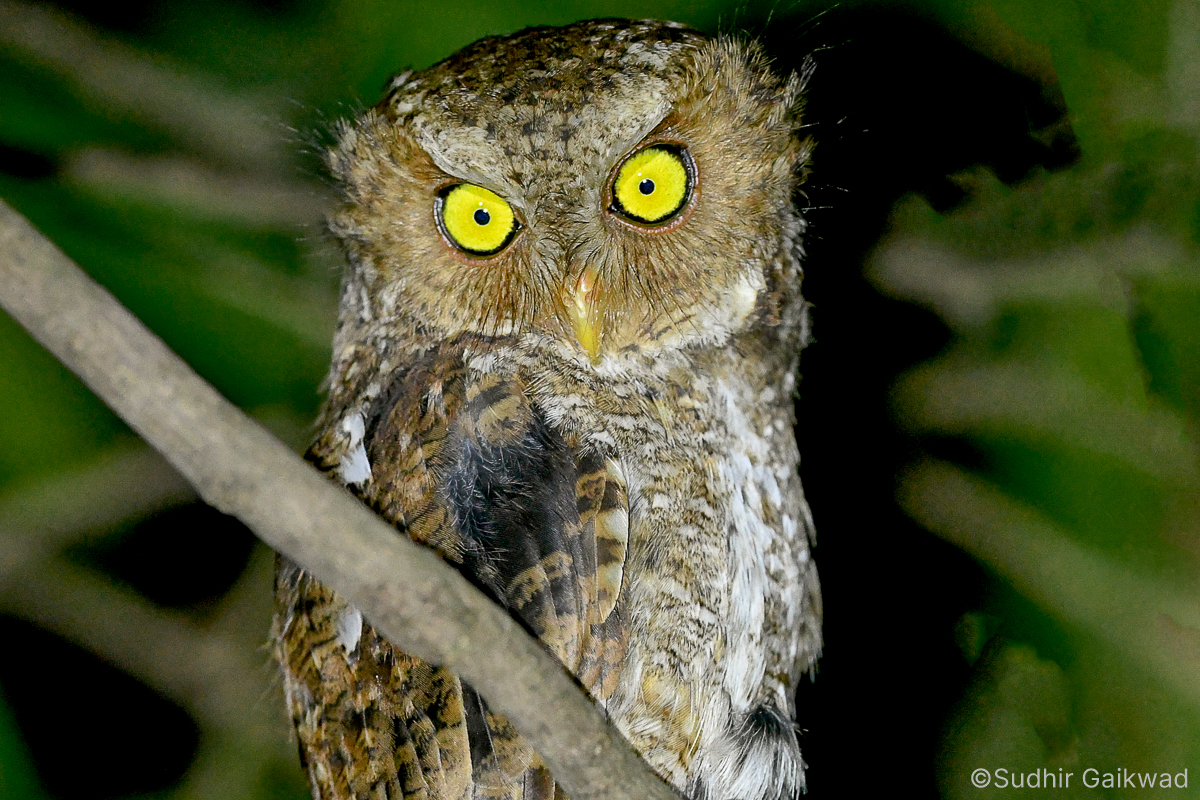
Mountain Scops-Owl
- Common Name: Mountain Scops-Owl
- Scientific Name: Otus spilocephalus
- Nepali Name(s): लेकाली उलूक (Lekali Uluk)
- IUCN Red List Status: Least Concern (LC)
- National Red List Status: Least Concern (LC)
- CITES Appendix: Appendix II
- CMS Appendix: Not listed
Measurements & Physical Profile
- Body Length: 18–20 cm
- Wing Length: 12.9–15.2 cm
- Weight: 53–112 g
Did You Know?
The Mountain Scops-Owl is a master of camouflage, perfectly mimicking the texture of moss-covered tree bark. Possessing a relatively small head with prominent ear tufts and a finely streaked plumage, this elusive raptor is a strictly nocturnal specialist. It is rarely seen by daylight, relying on its "whistling" call—a soft, rhythmic hoo-poo—to communicate across the dense, foggy mountain forests it calls home.
Distribution & Habitat
Global Distribution
The Mountain Scops-Owl is native to the montane regions of Southern and Southeastern Asia. Its range extends from the Himalayan chain in northern Pakistan, India, Nepal, and Bhutan, eastward through southern China, and southward across Myanmar, Thailand, Laos, Vietnam, and into the Malay Peninsula and Greater Sundas.
Distribution within Nepal
It is a fairly common resident breeder across the mid-hills of Nepal. It is widely distributed from the far-west to the far-east, maintaining stable territories within damp, forested mountain slopes. It is frequently encountered within protected areas, including the Shivapuri Nagarjun National Park, Langtang National Park, and the forested zones of the Annapurna Conservation Area.
Preferred Habitats
Pristine, mature montane evergreen forests, subtropical broadleaved hillsides, and temperate dense oak or coniferous woodlands. It favors deep, humid forested valleys, moss-laden ridges, and steep, tree-covered slopes. It rarely ventures into open, cleared landscapes or low-altitude dry plains.
Elevational Range
Primarily inhabits the mid-mountain belts, nesting and foraging extensively from 1,200 meters up to 2,600 meters above sea level. Individual birds are occasionally recorded at slightly lower or higher limits during seasonal fluctuations in prey availability.
Seasonal Occurrence
Year-round permanent resident. They maintain strict site fidelity to their chosen forested territories. During the peak of the winter monsoon or extreme cold, they may shift slightly to more sheltered, lower-altitude forested patches, but remain strictly within the montane forest biome.
Behavior & Ecology
Flight & Foraging Behavior
The flight of the Mountain Scops Owl is characteristically silent, buoyant, and agile. This architecture is optimized for navigating through thick canopy layers and understory vegetation. They hunt primarily via the "sit-and-wait" method. They perch motionless on a branch in the dense foliage, scanning the dark forest floor or nearby trunks for movement, before swooping silently to capture prey with surprising speed.
Social & Roosting Habits
Exclusively nocturnal and solitary, though pairs remain linked during the breeding season. They are highly cryptic, spending the entire day roosting in dark, dense foliage or within narrow tree hollows, rendering them nearly invisible. They are generally quiet throughout the day, but at dusk and during the night, they signal territory with a soft, melodic, and rhythmic whistling call that can carry long distances through the mist-filled valleys.
Diet & Ecosystem Role
Diet Breakdown
The Mountain Scops Owl is a highly efficient nocturnal insectivore and small-vertebrate predator:
- Insects (Primary): Overwhelmingly consumes large nocturnal insects, including moths, beetles, crickets, and cicadas.
- Mammals: Small rodents, such as field mice and shrews, are taken when available.
- Other: Occasionally hunts small frogs or geckos encountered on wet forest branches.
Ecological Role
As a primary nocturnal insectivore of the mid-mountain forests, the Mountain Scops Owl plays a vital role in regulating forest insect populations. By controlling the numbers of nocturnal beetles and moths, they help maintain forest health and protect foliage integrity, serving as a reliable indicator of healthy, undisturbed mature montane forests.
Breeding Biology
The breeding season in Nepal occurs from March through June, corresponding with the warmer, insect-rich spring and early summer months. Courtship involves soft vocal exchanges and mutual grooming. The pair utilizes natural tree hollows or abandoned woodpecker holes as nesting sites, usually located in mature, moss-covered trees on steep, forested slopes. They do not build a traditional stick nest; the female lays 2 to 4 small, rounded, white eggs directly on the floor of the cavity. The female incubates the eggs alone, while the male supplies the food. The incubation and fledging period is not well documented; however, it is believed incubation could last approximately 24 to 28 days, and the chick-rearing phase could last 30 to 35 days, after which the young fledge and remain within the dense canopy under parental guidance.
Migration
- Status: Permanent resident; non-migratory.
- Movement: The species does not engage in long-distance migration. Established pairs stay within their home territories year-round. However, young birds exhibit limited dispersal after fledging, seeking out unoccupied patches of suitable mature forest within the mountain ranges.
Population Status
- Global Population Estimate: Unknown.
- Population Trend: Stable.
- National Population Estimate (Nepal): Unknown.
- Monitoring & Surveys: Monitored primarily via nocturnal acoustic (call-playback) surveys, opportunistic sightings during night walks, and nest-site location in community forests.
Threats
- Deforestation & Forest Fragmentation: The clearing of mature, mossy montane forests for infrastructure or terrace farming directly removes essential nesting hollows and hunting perches.
- Loss of Mature Trees: Selective logging and firewood collection deplete the old-growth trees required for nesting.
- Pesticide Use: Secondary poisoning through the consumption of insects or rodents contaminated by agrochemicals in forest-edge agricultural plots.
- Disturbance: Increasing night-time human activity, forest fires, and noise pollution in the mid-hills disrupt nocturnal hunting and breeding.
Conservation Actions
Existing Measures
- Legal Protections: Protected under CITES Appendix II, which regulates the international trade of owls and their parts.
- Protected Area Foothold: Large populations are preserved within the national park network and forest corridors of Nepal.
Recommended Measures
- Old-Growth Preservation: Prioritizing the conservation of old-growth and mossy forest patches in community-managed lands.
- Pesticide Reduction: Promoting organic farming practices in agricultural plots bordering forested zones to prevent prey contamination.
- Acoustic Monitoring Initiatives: Supporting community-led monitoring and awareness programs that emphasize the owl’s value as a natural pest-control agent.
References
- BirdLife International (2024). Species factsheet: Mountain Scops-owl Otus spilocephalus. Downloaded from https://datazone.birdlife.org/species/factsheet/mountain-scops-owl-otus-spilocephalus on 09/08/2026
- Holt, D. W., R. Berkley, C. Deppe, P. L. Enríquez, J. L. Petersen, J. L. Rangel Salazar, K. P. Segars, K. L. Wood, and J. S. Marks (2020). Mountain Scops-Owl (Otus spilocephalus), version 1.0. In Birds of the World (J. del Hoyo, A. Elliott, J. Sargatal, D. A. Christie, and E. de Juana, Editors). Cornell Lab of Ornithology, Ithaca, NY, USA. https://doi.org/10.2173/bow.mosowl2.01
- Inskipp C., Baral H. S., Phuyal S., Bhatt T. R., Khatiwada M., Inskipp, T, Khatiwada A., Gurung S., Singh P. B., Murray L., Poudyal L. and Amin R. (2016). The status of Nepal’s Birds: The national red list series. Zoological Society of London, UK.
- König, C., F. Weick, and J.-H. Becking (2008). Owls of the World. Second edition. Christopher Helm, London, UK.
- Lewis, D. (2020). Mountain Scops Owl (Otus spilocephalus). The Owl Pages. Available at: https://www.owlpages.com/owls/species.php?s=380 (Accessed: 9 August 2026)