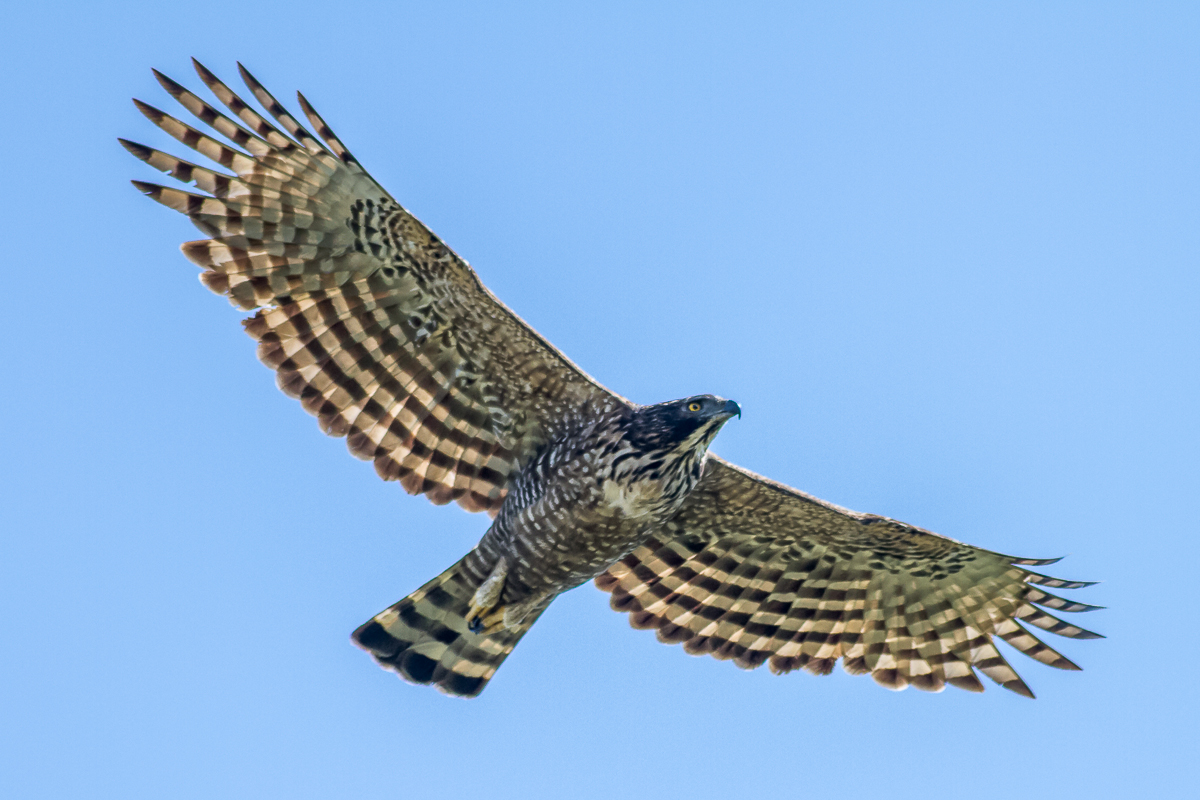
Mountain Hawk-Eagle
- Common Name: Mountain Hawk-Eagle
- Scientific Name: Nisaetus nipalensis
- Nepali Name(s): जुर्रे चिल (Jurre Chil)
- IUCN Red List Status: Near Threatened (NT)
- National Red List Status: Vulnerable (VU)
- CITES Appendix: Appendix II
- CMS Appendix: Not listed
Measurements & Physical Profile
- Body Length: 66–84 cm
- Wingspan: 134–175 cm
- Weight: 2,300–3,900 g
Did You Know?
The Mountain Hawk-Eagle is a master of heavy forest warfare. Sporting a short, prominent feather crest on its head and long, thickly feathered legs, this massive raptor possesses incredibly robust, heavy talons that exert crushing power. It routinely targets formidable arboreal and terrestrial prey, easily overpowering animals as large as fully grown pheasants, flying squirrels, and even juvenile rhesus macaques or small deer!
Distribution & Habitat
Global Distribution
The Mountain Hawk-Eagle is native to the montane regions of Southern and Southeastern Asia. Its continuous breeding range runs along the entire Himalayan chain from northern Pakistan, northwestern India, Nepal, and Bhutan, extending eastward through southwestern and central China, and southward into Myanmar, Thailand, Laos, and Vietnam.
Distribution within Nepal
It is a widespread resident breeder across the mountain ranges of Nepal. It is actively recorded from the far-west to the far-east, maintaining highly stable, localized territories within deep, forested mountain valleys. It is frequently encountered within alpine protected areas, notably the Shivapuri Nagarjun National Park, Langtang National Park, Makalu Barun National Park, and the mid-elevation valleys of the Annapurna Conservation Area.
Preferred Habitats
Pristine, mature, untamed montane evergreen forests, subtropical broadleaved hillsides, and temperate dense coniferous woodlands. Deep riverine gorges, steep forested mountain ridges, and steep, tree-covered cliffsides. It rarely leaves the canopy border and avoids completely flat, open landscapes.
Elevational Range
Primarily recorded in the mid-to-high mountain belts, nesting and foraging extensively from 600 meters up to 2,800 meters above sea level. Individual birds are frequently sighted soaring over sub-alpine meadows and ridges up to 3,500 meters during peak summer tracking.
Seasonal Occurrence
Year-round permanent resident. They maintain strict, decades-long site fidelity to their chosen forested valleys. However, during severe winter conditions when high-altitude snowpack thickens, sub-adults and some adults perform downslope altitudinal shifts into lower river valleys and tropical foothills.
Behavior & Ecology
Flight & Foraging Behavior
The flight architecture of the Mountain Hawk-Eagle features powerful, broad, rounded wings and a remarkably long, broad tail. This configuration is perfectly optimized for swift, agile navigation through tight tree networks, allowing them to turn sharply in mid-air. They hunt primarily via the "perch-and-wait" ambush method. They sit completely motionless and hidden in the dense upper canopy of a tall tree on a steep hillside, tracking movement below before executing a rapid, silent, downward stoop to strike prey on the forest floor or grab arboreal mammals off branches.
Social & Roosting Habits
Exclusively solitary or found in tightly bonded, lifelong monogamous pairs. They are fierce, highly territorial raptors that actively patrol their hunting grounds. While they occasionally soar high above the canopy during late mornings to mark territory visually, they spend most of their day roosting cryptically within deep, heavily shaded inner branches of old-growth trees. They are generally quiet but can utter a loud, piercing, metallic, double-noted whistle—“klu-kweet”—during the onset of the spring breeding cycle.
Diet & Ecosystem Role
Diet Breakdown
The Mountain Hawk-Eagle is an aggressive, powerful, high-tier carnivore:
- Birds (Primary): Large forest birds, overwhelmingly focusing on Galliformes such as Kalij Pheasants, Himalayan Monals, Satyr Tragopans, junglefowl, and various species of hill partridges or pigeons.
- Mammals: Large arboreal and terrestrial rodents, including Indian giant squirrels, Hodgson's flying squirrels, hares, marmots, and juvenile monkeys or small fawns.
- Reptiles: Large monitor lizards, skinks, and snakes are taken opportunistically when encountered in open forest clearings.
Ecological Role
As a top-tier apex predator of the mid-to-high Himalayan forest canopy, the Mountain Hawk-Eagle plays an essential regulatory role in montane biodiversity. By managing the populations of large herbivorous rodents, arboreal mammals, and ground-dwelling gamebirds, it helps protect understory vegetation structure, balances seed-dispersal patterns, and acts as a direct indicator of overall forest health and ecological continuity.
Breeding Biology
The breeding season in Nepal occurs from January through May, spanning the dry winter and early spring months. Courtship involves highly dramatic, vocal aerial displays over the home valley, with pairs performing steep sky-dances, mock talons-locking tumbles, and high-velocity chases above the forest canopy.
The pair works in tandem to construct an enormous, structurally complex platform nest out of thick sticks, branches, and roots, which can measure over 1.2 to 1.5 meters wide and deep. They line the central basin heavily with fresh green leaves to maintain humidity. This nest is typically hidden high up in the primary fork of an old-growth, mature forest tree (such as a massive oak or chestnut) growing on a steep, inaccessible slope, usually 15 to 30 meters above the ground. The female lays a clutch of 1 to 2 large, broad, off-white eggs that are delicately speckled with reddish-brown blotches. Incubation lasts approximately 40 to 44 days and is performed primarily by the female, while the male hunts. Due to intense siblicide, usually only a single chick survives to fledge, leaving the nest after a prolonged nestling phase of 65 to 75 days.
Migration
- Status: Permanent resident; altitudinal migrant.
- Movement: The species does not engage in long-distance trans-continental or cross-border migrations. Established breeding pairs stay within their home valleys year-round. However, immature birds and sub-adults exhibit significant nomadic dispersal patterns, wandering widely across mountain ranges in search of unoccupied territory. In the dead of winter, a noticeable downslope altitudinal movement occurs, drawing higher-altitude individuals down into lower valleys and tropical foothill forests.
Population Status
- Global Population Estimate: 1,200 – 6.700 mature individuals.
- Population Trend: Decreasing.
- National Population Estimate (Nepal): <100
- Monitoring & Surveys: Monitored primarily via specialized montane raptor point-counts, cliff/valley nest-mapping initiatives, and opportunistic recording at ridge-line migration corridors during altitudinal shifts.
Threats
- Deforestation & Forest Fragmentation: The rapid clearing of old-growth montane forests for road building, transmission line corridors, and agricultural terrace expansion destroys their core hunting canopies.
- Loss of Ancient Nesting Trees: Selective logging and community firewood collection consistently deplete the ancient, large-diameter trees required to support their massive, heavy stick nests.
- Prey Depletion: Heavy local hunting and snaring of forest pheasants and wild mammals directly reduce the eagle's primary food base during the critical chick-rearing season.
- Human Intrusion & Disturbance: Increasing upland infrastructure development, forest fires, and intensive non-timber forest product harvesting cause high stress, leading to frequent nest failure or abandonment.
Conservation Actions
Existing Measures
- Legal Protections: Fully protected under global legal frameworks, listed internationally under CITES Appendix II to ban unregulated commercial trade or possession of live specimens and feathers.
- Protected Area Foothold: Core nesting territories are preserved within Nepal's extensive mountain national park network and surrounding conservation area buffer zones.
Recommended Measures
- Old-Growth Canopy Sanctuaries: Establishing strict "no-logging" core micro-sanctuaries within Community Forests where known, active hawk-eagle nests are located.
- Pheasant Conservation Links: Combining raptor protection initiatives with community-led pheasant and wild small-mammal conservation to safeguard a stable prey base.
- Eco-Zoning for Mountain Roads: Mandating rigorous Environmental Impact Assessments (EIAs) for mountain road construction to avoid splitting contiguous deep-valley forest tracts.
- Targeted Breeding Registries: Creating a community-vetted national registry of active nest-trees in the mid-hills to ensure monitoring and buffer protection during the January–May breeding window.
References
- BirdLife International (2021). Species factsheet: Mountain Hawk-eagle Nisaetus nipalensis. Downloaded from https://datazone.birdlife.org/species/factsheet/mountain-hawk-eagle-nisaetus-nipalensis on 05/08/2026
- Clark, W. S., P. F. D. Boesman, G. M. Kirwan, and J. S. Marks (2020). Mountain Hawk-Eagle (Nisaetus nipalensis), version 1.0. In Birds of the World (S. M. Billerman, B. K. Keeney, P. G. Rodewald, and T. S. Schulenberg, Editors). Cornell Lab of Ornithology, Ithaca, NY, USA. https://doi.org/10.2173/bow.mouhae1.01
- Ferguson-Lees, J., & Christie, D. A. (2001). Raptors of the World. Christopher Helm, London.
- Inskipp C., Baral H. S., Phuyal S., Bhatt T. R., Khatiwada M., Inskipp, T, Khatiwada A., Gurung S., Singh P. B., Murray L., Poudyal L. and Amin R. (2016). The status of Nepal’s Birds: The national red list series. Zoological Society of London, UK.