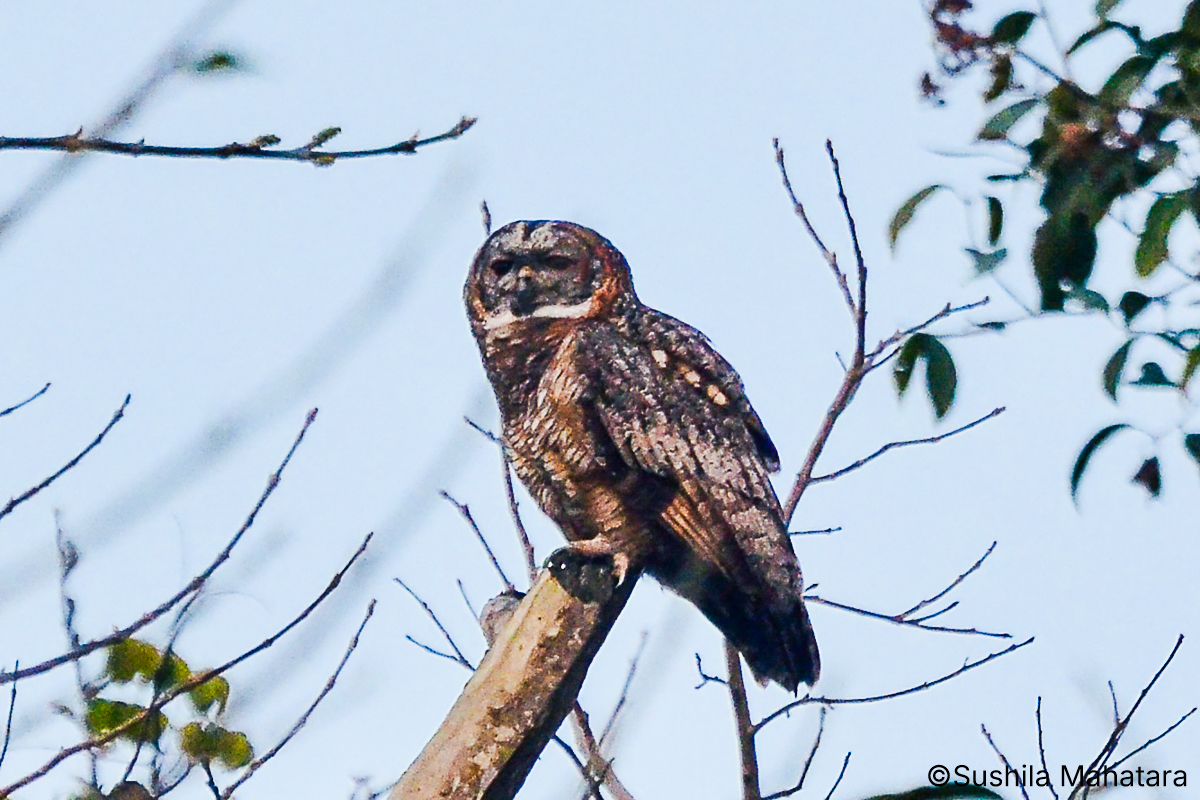
Mottled Wood-Owl
- Common Name: Mottled Wood-Owl
- Scientific Name: Strix ocellata
- Nepali Name(s): छिर्के उलूक (Chirke Uluk)
- IUCN Red List Status: Least Concern (LC)
- National Red List Status (Nepal): Data Deficient (DD)
- CITES Appendix: Appendix II
Measurements & Physical Profile
- Body Length: 41–48 cm
- Wing Length: 32 –37.2 cm
- Weight: Unknown
Did You Know?
The Mottled Wood-Owl is well-known for its haunting, melodic calls, which include a series of hollow, tremulous notes that can be heard echoing through the forest at night. It is a large, sturdy owl with a distinctive facial disc covered in fine, concentric brownish bars, earning it the "mottled" description.
Distribution & Habitat
Global Distribution
Endemic to the Indian subcontinent; widely distributed across India, Pakistan, and parts of Nepal.
Distribution within Nepal
The Mottled Wood-Owl is a localized resident in Nepal, first identified in 2015 within the Khata corridor of the Bardia National Park buffer zone. Additional populations have since been documented in the Chitwan National Park buffer zone. As a species endemic to the Indian subcontinent, these findings represent its established range within the country.
Preferred Habitats
Open, deciduous forests, well-wooded areas with mature trees, groves, and sometimes agricultural landscapes with old, large trees.
Elevational Range Occurs from the lowland plains up to approximately 1,500 meters.
Behavior & Ecology
Flight & Foraging Behavior
Exhibits relatively silent and buoyant flight, typical of the Strix genus. It is primarily a nocturnal predator that hunts from perches, scanning the ground for prey and swooping down silently.
Diet & Ecosystem Role
- Diet: Primarily consumes small mammals (rodents, mice), but also takes large insects, scorpions, small birds, and occasionally reptiles.
- Ecosystem Role: Acts as a significant nocturnal predator, regulating rodent populations in forested and agricultural habitats, which helps reduce damage to surrounding crops.
Breeding Biology
The breeding season occurs from November to April. They are cavity nesters, preferring natural hollows in large, mature trees like Ficus or Bombax species. The female lays 2 to 3 white eggs directly on the cavity floor without added materials. We have to learn about the incubation and fledging length, as there is no information available for these metrics.
Migration
- Status: Sedentary species; it remains within its established home range throughout the year and does not undertake seasonal migrations.
Population Status
- Global Population: Unknown.
- Population Trend: Decreasing.
- National Population (Nepal): Unknown.
Threats
- Habitat Loss: Clearing of mature, old-growth forests and the removal of large trees that provide essential nesting hollows.
- Disturbance: Human encroachment in forest areas and noise pollution near nesting sites.
- Pesticides: Secondary poisoning from eating rodents that have consumed toxic chemicals in nearby agricultural lands.
Conservation Actions
Existing Measures
- Protected Areas: Populations are monitored within Nepal's lowland national parks and forest corridors.
Recommended Measures
- Habitat Protection: Protecting large-diameter trees in community forests.
- Chemical Regulation: Minimizing pesticide use in agricultural patches within forest buffers.
- Awareness: Raising awareness about the owl's role in natural rodent control.
References
- BirdLife International (2024). Species factsheet: Mottled Wood-owl Strix ocellata. Downloaded from https://datazone.birdlife.org/species/factsheet/mottled-wood-owl-strix-ocellata on 09/08/2026
- Holt, D. W., R. Berkley, C. Deppe, P. L. Enríquez, J. L. Petersen, J. L. Rangel Salazar, K. P. Segars, K. L. Wood, and J. S. Marks (2020). Mottled Wood-Owl (Strix ocellata), version 1.0. In Birds of the World (J. del Hoyo, A. Elliott, J. Sargatal, D. A. Christie, and E. de Juana, Editors). Cornell Lab of Ornithology, Ithaca, NY, USA. https://doi.org/10.2173/bow.mowowl1.01
- Inskipp C., Baral H. S., Phuyal S., Bhatt T. R., Khatiwada M., Inskipp, T, Khatiwada A., Gurung S., Singh P. B., Murray L., Poudyal L. and Amin R. (2016). The status of Nepal’s Birds: The national red list series. Zoological Society of London, UK.
- König, C., F. Weick, and J.-H. Becking (2008). Owls of the World. Second edition. Christopher Helm, London, UK.