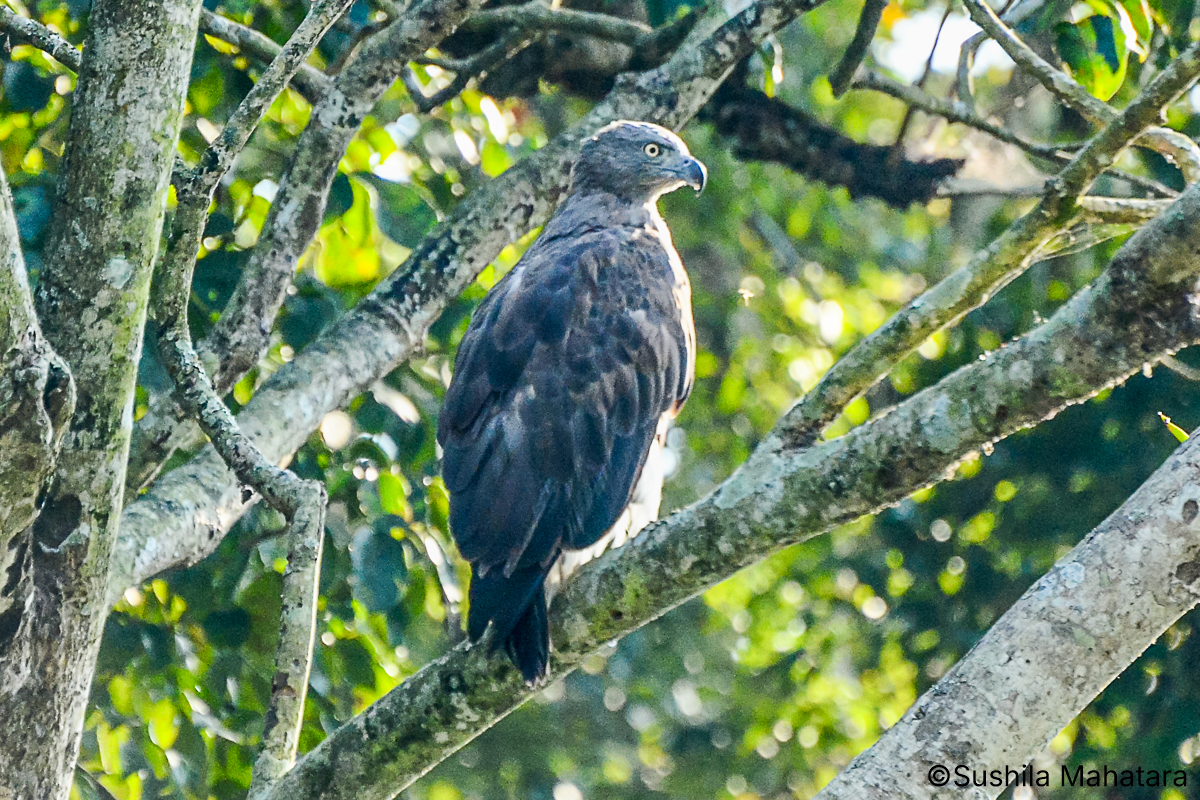
Lesser Fish-Eagle
- Common Name: Lesser Fish-Eagle
- Scientific Name: Haliaeetus humilis
- Nepali Name(s): सानो माछाकूल (Sano Machhakul)
- IUCN Red List Status: Near Threatened (NT)
- National Red List Status (Nepal): Critically Endangered (CR)
- CITES Appendix: Appendix II
Measurements & Physical Profile
- Body Length: 51–68 cm
- Wingspan: 120–165 cm
- Weight: 780 -785 g
Did You Know?
Unlike its larger relative, the Pallas's Fish-Eagle, which prefers massive lakes and marshes, the Lesser Fish-Eagle is a specialized inhabitant of fast-flowing, clear-water streams and rivers. Its smaller, more agile frame allows it to navigate the dense, wooded riparian corridors characteristic of the Himalayan foothills.
Distribution & Habitat
Global Distribution
A South and Southeast Asian endemic. Its range stretches from the Himalayan foothills of India and Nepal, eastward through Myanmar, Thailand, Malaysia, and into Indonesia.
Distribution within Nepal
An uncommon resident found primarily in the subtropical foothills. It is most frequently sighted along forested river systems in mid-hill areas, particularly within protected corridors like the Annapurna Conservation Area, Chitwan National Park buffer zones, Bardia and Shuklaphanta National Park and riverine stretches.
Preferred Habitats
Strictly tied to wooded rivers and clear, fast-flowing mountain streams. It requires large, undisturbed trees overhanging the water for perching and nesting.
Behavior & Ecology
Foraging Behavior
A patient "sit-and-wait" predator. It spends long hours perched on overhanging branches, scanning the water for surface-swimming fish. When it spots prey, it performs a short, shallow dive to snatch the fish with its talons.
Diet & Ecosystem Role
- Diet: Almost exclusively piscivorous (fish-eater). It primarily targets medium-sized fish found in clear mountain rivers.
- Ecosystem Role: Acts as a sentinel species for riparian health. Its presence indicates clean, well-oxygenated water systems and the existence of mature, continuous riverine forest cover.
Breeding Biology
The breeding season runs from December to May. Pairs construct large, bulky stick nests in tall, mature trees, almost always situated within 1–2 km of undisturbed rivers or lakes. They typically lay a clutch of 2 eggs, which both parents incubate for about 40–45 days. The nestlings are fed a diet consisting almost exclusively of fish and remain in the nest for roughly 70–80 days before fledging. Parents show strong site fidelity, often utilizing the same nesting territory for many consecutive years.
Migration
- Status: Resident.
- Movement: Non-migratory; remains within its established riverine territory throughout the year.
Population Status
- Global Population: Unknown.
- Population Trend: Decreasing.
- National Population (Nepal): <10 individuals.
Threats
- River Degradation: Dam construction, sand mining, and pollution in mountain rivers destroy the clear-water habitat necessary for its prey.
- Loss of Riparian Forest: The felling of large trees along riverbanks removes essential perching and nesting sites.
- Human Disturbance: Increased recreational activity and infrastructure development along river corridors discourage this shy eagle from nesting.
Conservation Actions
Existing measures
- Protected Areas: Most of the documented sightings and viable habitats for the species in Nepal are located within the network of protected areas, including Chitwan National Park, Bardiya National Park, and various wildlife reserves. These areas provide the necessary undisturbed riparian corridors essential for their survival.
- Legal Protection: As with other raptors, it falls under the purview of national wildlife protection laws that prohibit the killing, trapping, or harming of birds of prey. International trade is regulated under its CITES Appendix II listing.
Recommended Measures
- Riparian Protection: Establish "no-go" zones for construction and logging along key forested river stretches identified as breeding habitat.
- Water Quality Monitoring: Ensure rivers inhabited by the Lesser Fish Eagle remain free from chemical pollution and excessive sediment.
- Community Engagement: Work with riverside communities to protect large, overhanging trees, recognizing them as vital eagle nesting sites.
References
- BirdLife International (2024). Species factsheet: Lesser Fish-eagle Icthyophaga humilis. Downloaded from https://datazone.birdlife.org/species/factsheet/lesser-fish-eagle-icthyophaga-humilis on 06/08/2026
- Ferguson-Lees, J., & Christie, D. A. (2001). Raptors of the World. Christopher Helm, London.
- Karuthedathu, D. (2023). Lesser Fish-Eagle (Icthyophaga humilis), version 2.1. In Birds of the World (S. M. Billerman and B. K. Keeney, Editors). Cornell Lab of Ornithology, Ithaca, NY, USA. https://doi.org/10.2173/bow.lefeag1.02.1
- Inskipp C., Baral H. S., Phuyal S., Bhatt T. R., Khatiwada M., Inskipp, T, Khatiwada A., Gurung S., Singh P. B., Murray L., Poudyal L. and Amin R. (2016). The status of Nepal’s Birds: The national red list series. Zoological Society of London, UK.
- Naoroji, R. (2006). Birds of Prey of the Indian Subcontinent. Om Books International, New Delhi.