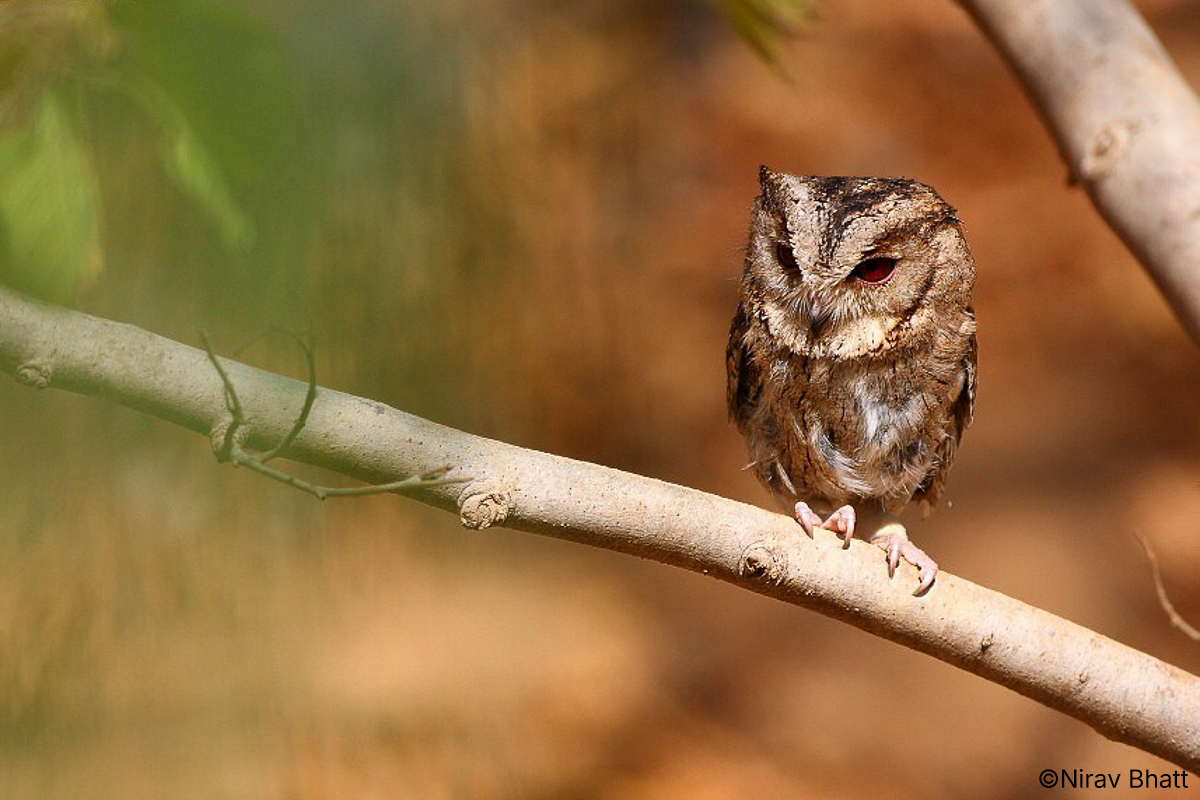
Indian Scops-Owl
- Common Name: Indian Scops-Owl
- Scientific Name: Otus bakkamoena
- Nepali Name(s): चित्रि उलूक (Chitri Uluk)
- IUCN Red List Status: Least Concern (LC)
- National Red List Status (Nepal): Least Concern (LC)
- CITES Appendix: Appendix II
Measurements & Physical Profile
- Body Length: 20–22 cm
- Wingspan: 60.5–66 cm
- Weight: 125–152 g
Did You Know?
When threatened or resting, this owl stretches its body vertically, compresses its feathers, and raises its prominent "ear tufts." Combined with bark-like plumage, this "slender pose" makes the owl look remarkably like a broken tree branch, helping it remain invisible to predators and larger birds during the day.
Distribution & Habitat
Global Distribution
Native to the southern regions of Asia, ranging from eastern Iran through Pakistan, India, Nepal, Sri Lanka, and Bangladesh. It is an exclusively sedentary, non-migratory species that maintains the same territory year-round.
Distribution within Nepal
A highly common permanent resident throughout the lowlands and lower hilly regions. It is especially abundant across the Tarai plains, the Siwalik range, and lower river valleys. Populations are well-established in protected areas (Chitwan, Bardia, Shuklaphanta) as well as the suburban fringes of the Kathmandu and Pokhara valleys.
Preferred Habitats
A highly adaptable generalist. It utilizes mature subtropical deciduous forests but thrives in human-dominated landscapes, including old orchards, village groves, urban parks, mature gardens, and agricultural woodlots.
Elevational Range
Primarily low-to-mid elevations, spanning from 75 meters up to 1,500 meters, occasionally reaching 1,800 meters in warm, wooded valleys.
Behavior & Ecology
Nocturnal Rhythms
Strictly nocturnal and crepuscular, it avoids daylight hours. Unlike many owls, it possesses large, dark brown eyes optimized for low-light forest environments. It utilizes a "sit-and-wait" hunting tactic, perching in the mid-canopy before dropping to the ground for prey.
Vocalizations
The male's territorial call is a diagnostic, monotonous, single-noted rising hoot ("whuat?" or "wuk?"), repeated every 2 to 5 seconds. This call is most prominent during the early spring breeding window.
Diet & Ecosystem Role
- Diet Breakdown: Primarily an insectivore.
- Insects (>80%): Beetles, crickets, grasshoppers, moths, and cicadas.
- Small Vertebrates: Geckos, lizards, field mice, and occasionally small birds.
- Ecosystem Role: The Indian Scops Owl plays a vital ecological role primarily as a natural pest controller. With over $80\%$ of its diet consisting of insects like beetles and grasshoppers, it prevents damaging population outbreaks in forests and agricultural areas. Additionally, by hunting small vertebrates such as field mice and lizards, it helps regulate rodent and reptile populations, maintaining a balanced nocturnal food web.
Breeding Biology
The breeding window occurs from February through May. No physical nest is built; eggs are laid on the debris floor of natural tree cavities, old woodpecker/barbet holes, or occasionally in artificial nest boxes and masonry walls. Lays 3 to 5 pure white eggs; incubation lasts for 25–27 days, managed solely by the female. Chicks hatch in white down, developing rapidly to emerge from the cavity at 3–4 weeks, but not much is known about the fledging period. Fledging remains in the parental territory for several weeks while learning to hunt.
Migration
- Status: Resident.
- Movement: Non-migratory; remains anchored within established territories throughout the year.
Population Status
- Global Population: Unknown
- Population Trend: Stable.
- National Population (Nepal): Unknown.
Threats
- Loss of Cavity Trees: Removal of dead standing timber and old trees in urban parks and orchards eliminates critical nesting sites.
- Pesticide Accumulation: Heavy use of chemical insecticides reduces the availability of its primary insect prey and risks secondary toxic bioaccumulation.
- Urban Obstacles: Vulnerable to collisions with glass facades, overhead wires, and vehicles due to its tendency to live in close proximity to human settlements.
Conservation Actions
Existing Measures
- International: Protected under CITES Appendix II.
- National: Habitat is protected within protected areas and community forests of Nepal.
Recommended Measures
- Cavity Retention: Promote the preservation of mature, dead, or decaying hollow trees in urban and agricultural planning.
- Integrated Pest Management (IPM): Encourage the reduction of chemical insecticides in village and suburban areas to protect the owl's food source.
- Urban Safety: Advocate for "bird-safe" glass treatments in areas where the owls are known to reside.
References
- BirdLife International (2025). Species factsheet: Indian Scops-owl Otus bakkamoena. Downloaded from https://datazone.birdlife.org/species/factsheet/indian-scops-owl-otus-bakkamoena on 09/08/2026
- Holt, D. W., R. Berkley, C. Deppe, P. L. Enríquez, J. L. Petersen, J. L. Rangel Salazar, K. P. Segars, K. L. Wood, and J. S. Marks (2020). Indian Scops-Owl (Otus bakkamoena), version 1.0. In Birds of the World (J. del Hoyo, A. Elliott, J. Sargatal, D. A. Christie, and E. de Juana, Editors). Cornell Lab of Ornithology, Ithaca, NY, USA. https://doi.org/10.2173/bow.insowl1.01
- Inskipp C., Baral H. S., Phuyal S., Bhatt T. R., Khatiwada M., Inskipp, T, Khatiwada A., Gurung S., Singh P. B., Murray L., Poudyal L. and Amin R. (2016). The status of Nepal’s Birds: The national red list series. Zoological Society of London, UK.
- König, C., F. Weick, and J.-H. Becking (2008). Owls of the World. Second edition. Christopher Helm, London, UK.