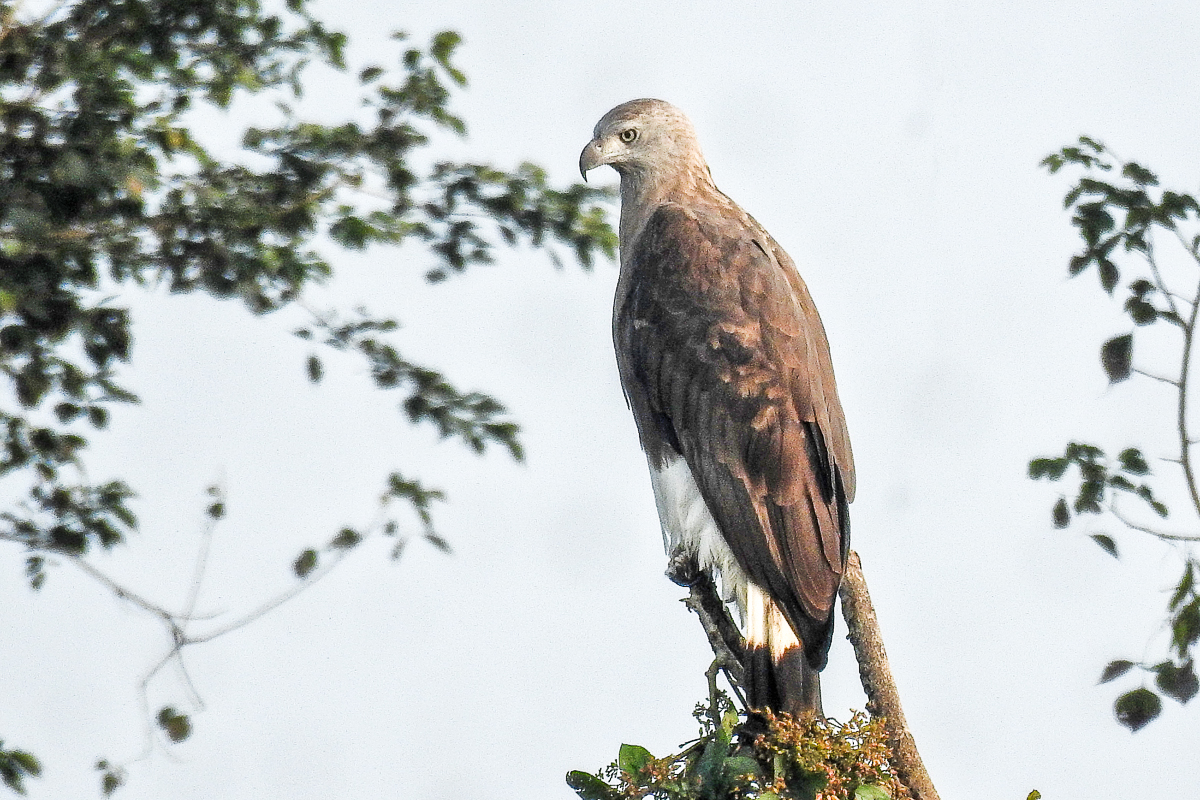
Grey-headed Fish-Eagle
- Common Name: Grey-headed Fish-Eagle
- Scientific Name: Icthyophaga ichthyaetus
- Nepali Name(s): माछाकुल (Maachhakul)
- IUCN Red List Status: Near Threatened (NT)
- National Red List Status (Nepal): Critically Endangered (CR)
- CITES Appendix: Appendix II
Measurements & Physical Profile
- Body Length: 61–75 cm
- Wingspan: 155–170 cm
- Weight: 1,500–2,700 g
Did You Know?
To prevent slippery, struggling fish from escaping, the Grey-headed Fish-Eagle has evolved highly specialized feet. The undersides of its toes are covered in tiny, rough, spiky scales called spicules. Combined with strongly curved, needle-sharp talons, this adaptation acts like natural sandpaper to lock onto heavy fish mid-plunge.
Distribution & Habitat
Global Distribution
Primarily an Indo-Malayan species. Its range spans from India, Nepal, and Sri Lanka eastward across mainland Southeast Asia (Myanmar, Thailand, Laos, Cambodia, and Vietnam) and extends south into the Sundaic islands of Indonesia (Sumatra, Java, Borneo) and the Philippines.
Distribution within Nepal
A rare, localized permanent resident strictly tied to pristine river systems, lowland oxbow lakes, and swampy forest-fringes of the subtropical Tarai plains. Stable populations are monitored within lowland protected networks, particularly in Chitwan National Park, Bardia National Park, and Koshi Tappu Wildlife Reserve. It is occasionally sighted along major outer river barrages and has been recorded as a rare vagrant in the lower Pokhara valley.
Preferred Habitats
A water-edge obligate. It requires mature, slow-moving lowland rivers, extensive oxbow lakes, large reservoirs, tidal estuaries, and waterlogged forest swamps. It depends on large, mature trees bordering open water to serve as hunting lookouts and nesting sites. It avoids rapid alpine torrents and dry, open terrestrial plains.
Elevational Range
Strictly a lowland species, clustered almost entirely from 75 meters to 300 meters, rarely wandering into the Siwalik hills up to 500 meters.
Behavior & Ecology
Flight & Foraging Behavior
A patient, heavy-bodied predator. It spends most of the day motionless on an overhanging dead branch above a river pool or lake. When a fish surfaces, it launches into a short, heavy, downward glide, snatching prey with its feet without fully submerging. In flight, it has broad, rounded wings and a short tail; its flight appears labored but possesses sudden explosive power when diving.
Social & Roosting Habits
Surprisingly vocal for a large eagle, particularly at night or during the early monsoon breeding season. It emits a loud, resonant, owl-like calling sequence ("hok-hok-hok-hok") or a harsh, laughing, or screaming yelp ("garg-garg-garg").
Diet & Ecosystem Role
- Diet Breakdown: Highly specialized piscivore.
- Fish (>90%): Freshwater catfishes, carps, snakeheads, and spiny eels (up to 1.5–2 kg).
- Other Aquatic Prey: Water snakes, large frogs, freshwater crabs, and occasionally young waterfowl.
- Carrion: Occasionally feeds on stranded fish during the dry season.
- Ecological Role: Serves as an apex predator in aquatic ecosystems, helping maintain the health of freshwater fish populations.
Breeding Biology
The breeding cycle (November–April) features intense territorial fidelity to historical nesting zones. It builds an immense, bulky stick nest platform (up to 1.5 meters across) lined with green leaves, placed 10–30 meters high in the main fork of a massive riverine tree (Bombax ceiba or Terminalia aspera). Lays 2 to 3 unspotted, pure white eggs, incubation lasts for 45–50 days, shared by both sexes. Young fledges at 10 weeks; juveniles retain a streaked brownish plumage and remain near the parent's territory to master fishing techniques.
Migration
- Status: Resident.
- Movement: Non-migratory; maintains permanent residency within its riverine territories.
Population Status
- Global Population: Unknown.
- Population Trend: Decreasing.
- National Population Estimates (Nepal): <50 individuals.
Threats
- Loss of Mature Trees: Targeted felling of giant old-growth trees (like Bombax) removes essential nesting architecture.
- Overfishing: Use of fine-mesh nets, dynamite, and poison drastically depletes native fish stocks.
- Wetland Pollution/Siltation: Industrial runoff, pesticides, and upstream deforestation reduce water clarity, hindering the eagle's ability to hunt.
- Dam/Hydropower Construction: Modification of natural river flows alters water levels, floods nesting areas, and eliminates oxbow formation.
Conservation Actions
Existing Measures
- International: Listed under CITES Appendix II.
- National: Critical aquatic habitats are protected through the protected area system.
Recommended Measures
- Protecting Nest Trees: Work with local Buffer Zone Community Forests to strictly ban logging of giant trees within 500 meters of open water.
- Fish Sanctuaries: Implement seasonal community fishing bans in core oxbow lakes during the critical November–February nesting window.
- Monitoring: Use boat-based surveys to map nesting pairs, track breeding success, and monitor chemical pollution levels.
References
- BirdLife International (2024). Species factsheet: Grey-headed Fish-eagle Icthyophaga ichthyaetus. Downloaded from https://datazone.birdlife.org/species/factsheet/grey-headed-fish-eagle-icthyophaga-ichthyaetus on 06/08/2026
- Clark, W. S., G. M. Kirwan, D. A. Christie, and C. Hansasuta (2023). Gray-headed Fish-Eagle (Icthyophaga ichthyaetus), version 1.2. In Birds of the World (J. del Hoyo, A. Elliott, J. Sargatal, D. A. Christie, E. de Juana, and P. Pyle, Editors). Cornell Lab of Ornithology, Ithaca, NY, USA. https://doi.org/10.2173/bow.gyhfie1.01.2
- Ferguson-Lees, J., & Christie, D. A. (2001). Raptors of the World. Christopher Helm, London.
- Inskipp C., Baral H. S., Phuyal S., Bhatt T. R., Khatiwada M., Inskipp, T, Khatiwada A., Gurung S., Singh P. B., Murray L., Poudyal L. and Amin R. (2016). The status of Nepal’s Birds: The national red list series. Zoological Society of London, UK.
- Naoroji, R. (2006). Birds of Prey of the Indian Subcontinent. Om Books International, New Delhi.