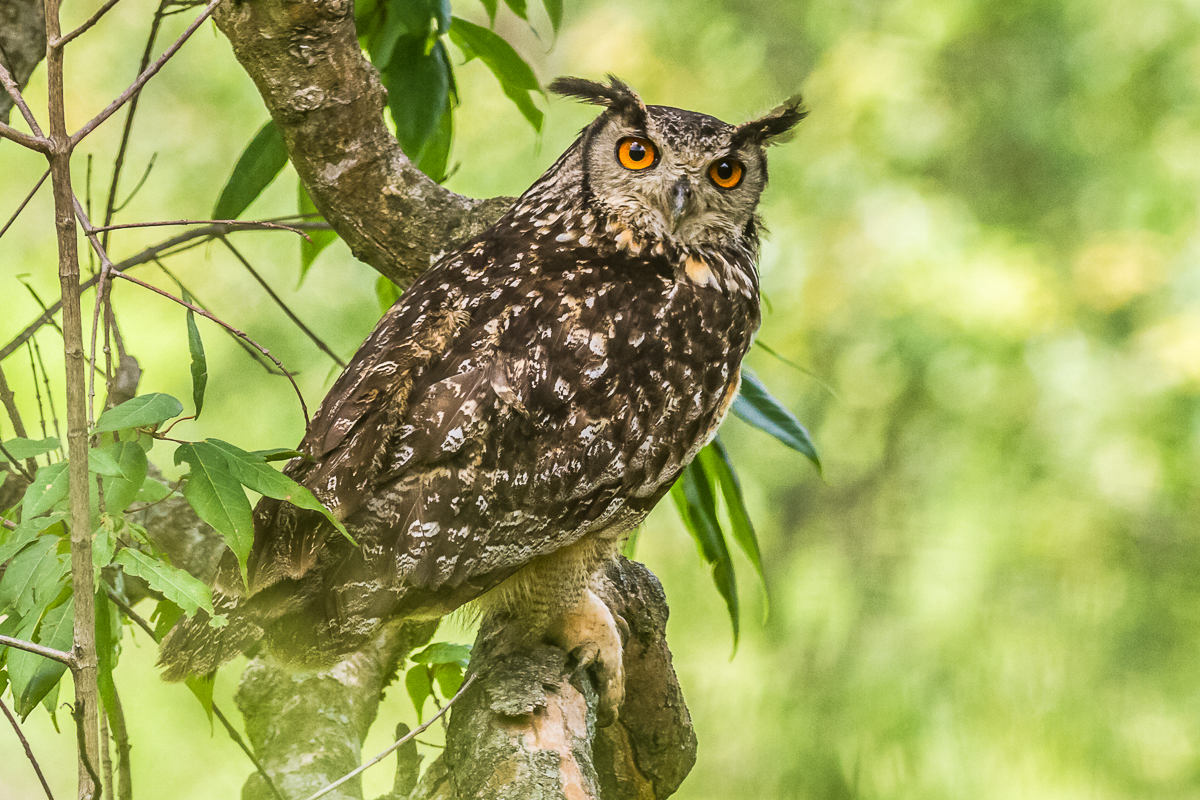
Eurasian Eagle-Owl
- Common Name: Eurasian Eagle-Owl
- Scientific Name: Bubo bubo
- Nepali Name(s): हाप्सिलो (Haapsilo)
- IUCN Red List Status: Least Concern (LC)
- National Red List Status (Nepal): Data Deficient (DD)
- CITES Appendix: Appendix II
- CMS Appendix: Not listed
Measurements & Physical Profile
- Body Length: 58–71 cm
- Wingspan: 160–188 cm
- Weight: 1,550 – 4,200 g
Did You Know?
The Apex Winged Tiger: The Eurasian Eagle-Owl is a supreme nocturnal apex predator. Equipped with massive, powerful talons that can exert crushing pressure, it regularly overpowers prey much larger than itself. It is one of the very few avian predators documented successfully hunting adult red foxes, young roe deer, and other large raptors like Peregrine Falcons and Long-eared Owls.
Distribution & Habitat
Global Distribution
The Eurasian Eagle-Owl has an enormous, continuous distribution across the Palearctic and Indo-Malayan realms. Its range spans from western Europe (Spain and Scandinavia) across Russia and Central Asia, all the way to eastern Siberia, China, Korea, and Japan, extending southward into the Middle East, Iran, and the northern margins of the Indian Subcontinent.
Distribution within Nepal
A scarce, highly localized permanent resident. Unlike the Dusky Eagle-Owl, this is predominantly an upland and montane species. It is distributed in fragmented territories across the mid-hills, upper subalpine valleys, and trans-Himalayan rain-shadow regions (such as Mustang, Dolpa, and Humla). Stable pairs are occasionally recorded along rugged rocky cliffs in the Annapurna Conservation Area and Langtang National Park.
Preferred Habitats
A specialist of rugged, open landscapes. It heavily favors steep rocky cliffs, deep mountain gorges, rocky crags, and broken clay ravines bordering open steppes, alpine meadows, or sparse coniferous forests. It avoids flat, unbroken lowlands and dense tropical closed-canopy rainforests.
Elevational Range
An impressive altitudinal generalist, distributed from lower mid-hill river gorges at 1,000 meters up to high-alpine valleys and rocky scree fields at 4,500 meters.
Seasonal Occurrence
Strictly sedentary and permanent. Settled pairs exhibit intense, lifelong territorial fidelity, remaining within the same cliff system or mountain valley for decades.
Behavior & Ecology
Flight & Foraging Behavior
Strongly nocturnal and crepuscular, active primarily from dusk to dawn. During the day, it roosts motionless in deep cliff crevices, small caves, or against the trunk of a dense pine tree. In flight, it is a massive, broad-winged silhouette that glides with surprising silence, low over mountain slopes to surprise ground prey.
Social & Roosting Habits
Vocalizations are a key part of their territoriality. The male’s call is a deep, resonant two-note hoot: "OOH-hu," which can carry over 4 kilometers in clear mountain air.
Diet & Ecosystem Role
- Diet Breakdown: Highly adaptable, generalist carnivore.
- Mammals (~75%): Montane rodents (voles, rats), Himalayan Pikas, hares, hedgehogs, and young fawns.
- Birds: Pheasants, partridges, pigeons, crows, and smaller raptors.
- Others: Agamid lizards, snakes, frogs, large beetles, and occasionally fish from shallow pools.
- Ecological Role: Functions as a top-tier nocturnal predator, regulating populations of small-to-medium mammals and birds in fragile mountain ecosystems.
Breeding Biology
The breeding cycle begins in mid-winter (December–January). Courtship involves intense vocal duets; the male displays a bright white throat patch while hooting. Does not build a nest. Instead, it scrapes a shallow depression in dirt or debris on an inaccessible cliff ledge, in a small cave, or in a rocky crevice. Occasionally reuses old stick nests of other raptors. Lays 2 to 4 (occasionally up to 6) dull white, rounded eggs. Incubation lasts for 34–36 days, performed exclusively by the female. Chicks achieve sustained flight at 7–8 weeks but remain dependent on parents until late autumn (20-24 weeks).
Migration
- Status: Resident.
- Movement: Strictly sedentary; non-migratory.
Population Status
- Global Population: 180,000 – 300,000 mature individuals
- Population Trend: Decreasing.
- National Population Estimates (Nepal): Unknown.
- Monitoring: There are no programs in Nepal to monitor its population.
Threats
- Persecution: Fear and superstition in rural villages lead to retaliatory shooting or nest destruction.
- Illegal Trade: Poached for claws, bones, and meat used in traditional medicine or rituals.
- Secondary Poisoning: Increasing use of chemical rodenticides in expanding agricultural mid-hill valleys.
- Infrastructure: Blasting of cliffs for highways, hydro-projects, and mining destroys historical nesting sites.
Conservation Actions
Existing Measures
- International: Protected under CITES Appendix II.
- Protected Areas: Stable protected areas found in regions like the Annapurna Conservation Area, Langtang, and Shey Phoksundo National Parks.
Recommended Measures
- Community Awareness: Educational workshops to dispel superstitions and highlight the owl’s role in controlling agricultural rodent pests.
- Infrastructure Guidelines: Integrate mandatory wildlife surveys into Environmental Impact Assessments (EIAs) before any cliff-blasting or construction activities.
- Acoustic Mapping: Deploy automated recording units (ARUs) during winter hooting seasons to locate and protect active breeding territories.
References
- BirdLife International (2025). Species factsheet: Eurasian Eagle-owl Bubo bubo. Downloaded from https://datazone.birdlife.org/species/factsheet/eurasian-eagle-owl-bubo-bubo on 09/08/2026
- Holt, D. W., R. Berkley, C. Deppe, P. L. Enríquez, J. L. Petersen, J. L. Rangel Salazar, K. P. Segars, K. L. Wood, and J. S. Marks (2020). Eurasian Eagle-Owl (Bubo bubo), version 1.0. In Birds of the World (J. del Hoyo, A. Elliott, J. Sargatal, D. A. Christie, and E. de Juana, Editors). Cornell Lab of Ornithology, Ithaca, NY, USA. https://doi.org/10.2173/bow.eueowl1.01
- Inskipp C., Baral H. S., Phuyal S., Bhatt T. R., Khatiwada M., Inskipp, T, Khatiwada A., Gurung S., Singh P. B., Murray L., Poudyal L. and Amin R. (2016). The status of Nepal’s Birds: The national red list series. Zoological Society of London, UK.
- The Peregrine Fund. (2026). Eurasian Eagle-owl. Available at: https://peregrinefund.org/explore-raptors-species/owls/eurasian-eagle-owl (Accessed: 9 August 2026).