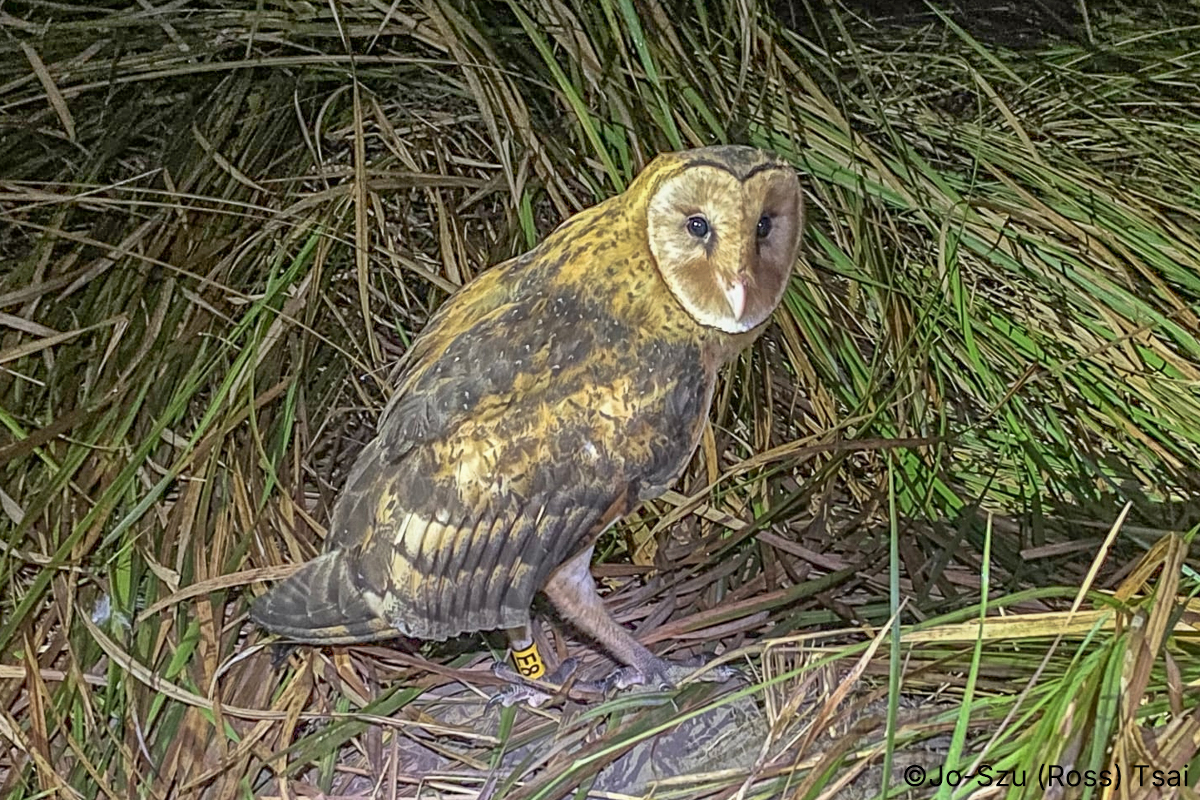
Eastern Grass-Owl
- Common Name: Eastern Grass-Owl (also known as Australasian Grass-Owl)
- Scientific Name: Tyto longimembris
- Nepali Name(s): घाँसे लाटोकोसेरो (Ghanse Laatokosero)
- IUCN Red List Status: Least Concern (LC)
- National Red List Status: Critically Endangered (CR)
- CITES Appendix: Appendix II
- CMS Appendix: Not listed
Measurements & Physical Profile
- Body Length: 32–38 cm
- Wingspan: 112 cm
- Weight: 265–582 g
Did You Know?
While it closely resembles the Barn Owl, the Eastern Grass-Owl is easily distinguished by its exceptionally long, bare lower legs (tarsi) and long toes, which project well past its tail tip in flight. This unique anatomy is an evolutionary adaptation for a life spent entirely on the ground—allowing it to easily step through, step over, and part tangled stems of dense, tall subtropical grasses without snagging its plumage.
Distribution & Habitat
Global Distribution
Distributed in fragmented patches across the eastern Palearctic, Oriental, and Australasian realms. Its highly disjunct range extends from eastern and northeastern India, Nepal, and Bangladesh, eastward through southern China and Taiwan, and southward through parts of Indochina, the Philippines, and Indonesia to Australia.
Distribution within Nepal
A rare and highly localized permanent resident breeder. It is strictly confined to the specialized tall-grass alluvial plains (grasslands) of the lowland Tarai. Primary strongholds are restricted to protected conservation units, specifically Chitwan, Bardia, and Shuklaphanta National Parks. Outside these, it is occasionally recorded in the wide floodplains of the Narayani, Koshi, and Karnali rivers.
Preferred Habitats
A highly specialized habitat obligate. It is completely dependent on undisturbed, extensive, tall, dense grasslands—particularly riverine alluvial grasslands dominated by Saccharum (Kans grass), Phragmites (reeds), and Typha (cattails). It avoids deep forests, mountainous rocky zones, and urbanized areas entirely.
Elevational Range
Strictly a lowland specialist, found in the flat Tarai floodplains from 75 meters up to 300 meters above sea level.
Seasonal Occurrence
A permanent year-round resident. While sedentary, local movements can occur when seasonal monsoon flooding submerges low-lying riverine grasslands, forcing populations to move temporarily to adjacent higher grass patches or agricultural fallows.
Behavior & Ecology
Flight & Foraging Behavior
A nocturnal hunter that quarters open meadows, relying on soft, low-altitude flights to surprise its prey. Unlike most other owls, it rarely perches in trees.
Social & Roosting Habits
Spends its days roosting completely hidden on the ground within dense grass tunnels. It constructs thin, deliberate "runways"—hidden paths under the thick canopy of bent tall-grass stems—where it can move invisibly during daylight hours. It is generally silent outside the nesting period; during breeding, it produces a harsh, rasping clicking shriek: "tsseee-chick."
Diet & Ecosystem Role
- Diet Breakdown: Highly specialized rodent predator.
- Small Mammals (~95%): Field mice, Indian bush rats, bandicoot rats, and small shrews.
- Birds: Occasionally ambushes ground-roosting birds such as quails, buttonquails, and grass-warblers.
- Insects: Takes large grassland invertebrates opportunistically, including crickets, locusts, and beetles.
- Ecological Role: Serves as a key indicator and predator of healthy alluvial grassland ecosystems.
Breeding Biology
The breeding cycle occurs primarily from October through March. Courtship involves low, hovering flights by the male over nesting meadows. It nests exclusively on the ground, creating a hidden chamber by trampling down a flat platform of living grass stems deep within an impenetrable thicket. This chamber is accessed via a long, low, arched tunnel of woven grass that conceals the site from aerial predators. Lays 4 to 6 dull white, oval eggs; incubation lasts for 30–32 days, managed entirely by the female while the male provides food; chicks are covered in dense, buff-colored down (for camouflage) and fledge at about 60 to 70 days.
Migration
- Status: Resident.
- Movement: Sedentary, with only minor local shifts during severe monsoon flooding.
Population Status
- Global Population Estimate: Unknown.
- Population Trend: Decreasing.
- National Population Estimates (Nepal): Very small population (<10)
- Monitoring & Surveys: No active monitoring programs in Nepal.
Threats
- Habitat Destruction: Drainage and conversion of floodplains into agricultural fields (wet-rice farming).
- Uncontrolled Burning: Annual dry-season grass fires can destroy active clutches, nest tunnels, and flightless young if conducted during the nesting window.
- Over-Harvesting: Intensive collection of thatch grass (Kans and Khar) removes the dense cover required for nesting and roosting.
- Woody Encroachment: Succession of open grasslands into dense scrub reduces foraging space.
Conservation Actions
Existing Measures
- International Regulations: Protected under CITES Appendix II.
- Protected Habitats: Reliant on grassland management protocols inside protected reserves like Chitwan, Bardia, and Shuklaphanta.
Recommended Measures
- Rotational Harvesting: Implement zoning for grass cutting in buffer zones to ensure patches of mature tall grass remain for year-round cover.
- Scientific Burn Management: Adjust the timing and scale of controlled burns to ensure they occur outside the October–March nesting window.
- Targeted Monitoring: Utilize acoustic monitors to map the precise population baseline in Nepal.
References
- BirdLife International (2024). Species factsheet: Eastern Grass-owl Tyto longimembris. Downloaded from https://datazone.birdlife.org/species/factsheet/eastern-grass-owl-tyto-longimembris on 09/08/2026
- Bruce, M.D. and J. S. Marks (2020). Australasian Grass-Owl (Tyto longimembris), version 1.0. In Birds of the World (J. del Hoyo, A. Elliott, J. Sargatal, D. A. Christie, and E. de Juana, Editors). Cornell Lab of Ornithology, Ithaca, NY, USA. https://doi.org/10.2173/bow.ausgro1.01
- Inskipp C., Baral H. S., Phuyal S., Bhatt T. R., Khatiwada M., Inskipp, T, Khatiwada A., Gurung S., Singh P. B., Murray L., Poudyal L. and Amin R. (2016). The status of Nepal’s Birds: The national red list series. Zoological Society of London, UK.
- The Peregrine Fund. (2026). Eastern Grass-owl. Available at: https://peregrinefund.org/explore-raptors-species/owls/eastern-grass-owl (Accessed: 9 August 2026).