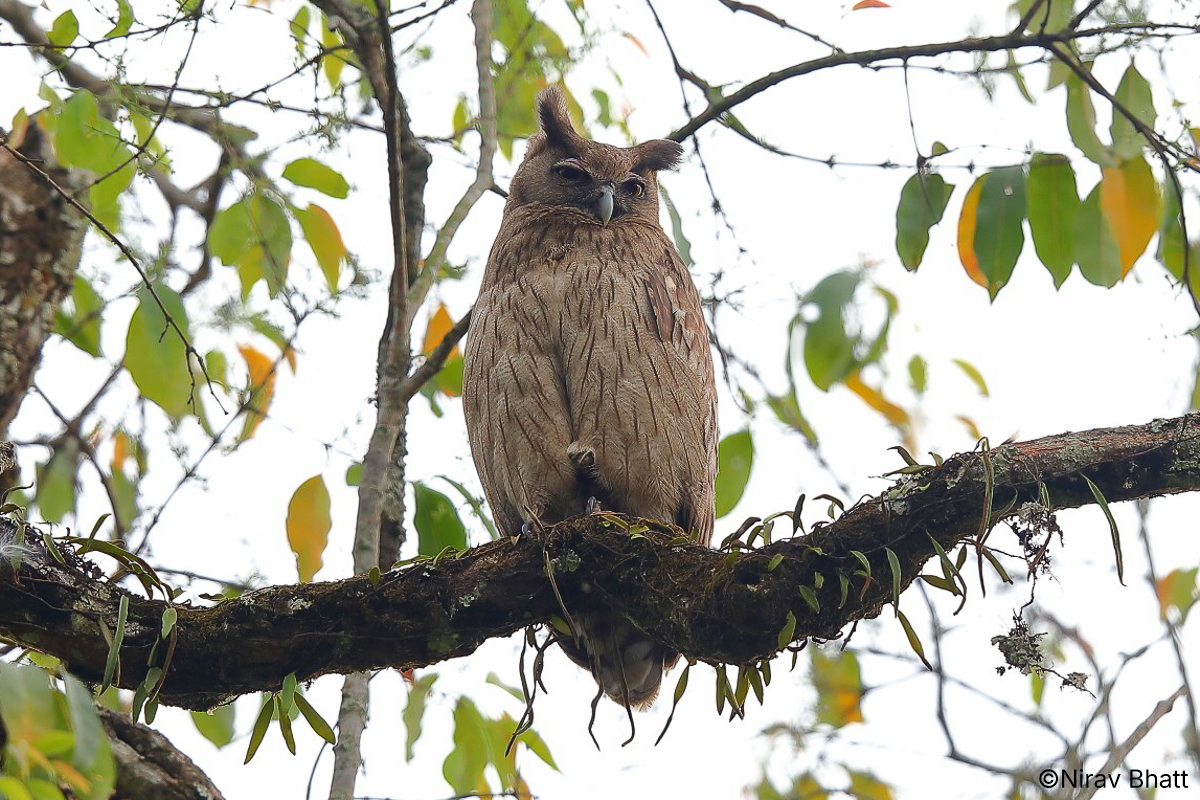
Dusky Eagle-Owl
- Common Name: Dusky Eagle Owl
- Scientific Name: Bubo coromandus
- Nepali Name(s): भासोलूक (Bhasolook)
- IUCN Red List Status: Least Concern (LC)
- National Red List Status: Critically Endangered (CR)
- CITES Appendix: Appendix II
- CMS Appendix: Not listed
Measurements & Physical Profile
- Body Length: 48–53 cm
- Wingspan: 135–150 cm
- Weight: 800–1,100 g
Did You Know?
Most large eagle-owls are strictly nocturnal ghosts, but the Dusky Eagle-Owl breaks the mold. It is regularly active during the day, particularly during overcast or cloudy weather. Even more fascinating is its choice of roommates: it shows a powerful nesting association with water bodies and open woodlands, often actively taking over the massive, old stick nests of waterbirds or diurnal raptors like kites and eagles.
Distribution & Habitat
Global Distribution
Primarily native to the Indian Subcontinent and parts of mainland Southeast Asia. Its resident footprint covers Pakistan (particularly the Indus plains), a massive swath across central, northern, and eastern India, Nepal, and Bangladesh. A separate, disjunct population exists further east in Myanmar, Thailand, and southwestern China.
Distribution within Nepal
A highly elusive, localized, and rare permanent resident. It is strictly confined to the lowland Tarai plains and the lower parts of the Churia (Siwalik) foothills. Verified records are concentrated within protected lowland floodplains, including Koshi Tappu Wildlife Reserve, Chitwan National Park, and Bardia National Park, alongside adjacent older-growth riverine pockets.
Preferred Habitats
A specialist of wet, wooded lowlands and riverine matrices. It heavily favors mature, old-growth riverine forests, swampy woodlands, and thickets bordering slow-moving rivers, marshes, and large water storage tanks. It prefers areas with ancient, massive trees—especially old Ficus (Peepal and Banyan), Mango, and Silk-cotton (Bombax ceiba) trees—that provide ample shade and large structure.
Elevational Range
Strictly a lowland specialist, found in the flat plains and low rolling foothills from 75 meters up to roughly 300 meters above sea level.
Seasonal Occurrence
A permanent, year-round breeding resident. The species displays extreme territorial and site fidelity; a settled pair will often reuse the same nesting territory or even the exact same tree structure for decades.
Behavior & Ecology
Flight & Foraging Behavior
While it hunts heavily after dusk, it is notably crepuscular and diurnal compared to other Bubo species. It spends its days roosting within the deep, dark shade of old, leafy trees near water. If disturbed during the day, or during heavily overcast monsoon afternoons, it will readily take flight and hunt actively.
Social & Roosting Habits
Highly territorial. The male’s territorial call is a deep, resonant, and eerie series of notes that accelerates and fades out: "woooo-woodoodoodoodoodoo-woooo," sounding like a dropping ball. This call is delivered most intensely at dusk, dawn, and throughout moonlit nights during the winter breeding season.
Diet & Ecosystem Role
- Diet Breakdown: A powerful, apex predator.
- Birds: Highly specialized; targets waterbirds (egrets, herons), crows, and parakeets, often plucking roosting birds from branches.
- Mammals: Medium-sized rodents, bandicoot rats, fruit bats, and young hares.
- Reptiles & Amphibians: Monitor lizards, water snakes, and large frogs along wet, muddy banks.
- Insects & Fish: Massive water beetles, grasshoppers, and occasionally fish from shallow marshy margins.
- Ecological Role: Functions as an apex avian predator in lowland riverine ecosystems, regulating populations of waterbirds, rodents, and reptiles.
Breeding Biology
The nesting cycle occurs from November through April. As it does not build its own stick nest, it almost exclusively usurps the abandoned or active giant stick nests of diurnal raptors (kites/eagles) or large waterbirds (storks/herons). These are typically situated 12–25 meters high in the main fork of a massive riverine tree, often directly over or facing water. Almost always lays 2 creamy-white, round eggs; incubation lasts for 32–35 days, managed entirely by the female while the male aggressively guards the tree and supplies food. Fledging occurs after 45–50 days, though chicks remain dependent on parental feeding within the riverine corridor for several months.
Migration
- Status: Permanent resident.
- Movement: Sedentary; maintains strict site fidelity to its nesting territory for life.
Population Status
- Global Population Estimate: Unknown.
- National Population Estimate (Nepal): Highly vulnerable/rare; absolute numbers are low (<50) due to the narrow availability of old-growth riverine habitat.
- Monitoring & Surveys: No active monitoring programs in Nepal. Information is based on opportunistic sightings and targeted acoustic surveys in lowland floodplains.
Threats
- Loss of Ancient Riverine Trees: The clearing of old-growth Ficus, mango, and silk-cotton trees along lowland rivers removes critical nesting and roosting spots.
- Disturbance of Wetlands: Gravel mining, pollution, and high human activity along lowland riverbeds disrupt sensitive breeding territories.
- Persecution: Sporadic local persecution driven by superstitions regarding large owls as bad omens.
Conservation Actions
Existing Measures
- International Regulations: Fully protected under CITES Appendix II.
- Protected Areas: Populations find sanctuary within parks like Koshi Tappu and Chitwan, though riverine tracts outside park boundaries lack enforcement.
Recommended Measures
- Mapping and Protecting Nest Trees: Set up strict protection zones around known historical nesting trees inside and outside protected boundaries.
- Riverine Habitat Restoration: Restore degraded forest buffers along lowland rivers to ensure future availability of large canopy trees.
- Targeted Acoustic Surveys: Deploy specialized automated recording units (ARUs) during the winter breeding season along river corridors to map the population baseline.
References
- BirdLife International (2025). Species factsheet: Dusky Eagle-owl Bubo coromandus. Downloaded from https://datazone.birdlife.org/species/factsheet/dusky-eagle-owl-bubo-coromandus on 07/08/2026
- Holt, D. W., R. Berkley, C. Deppe, P. L. Enríquez, J. L. Petersen, J. L. Rangel Salazar, K. P. Segars, K. L. Wood, J. S. Marks, and C. Hansasuta (2023). Dusky Eagle-Owl (Ketupa coromanda), version 1.2. In Birds of the World (S. M. Billerman, P. Pyle, and N. D. Sly, Editors). Cornell Lab of Ornithology, Ithaca, NY, USA. https://doi.org/10.2173/bow.dueowl1.01.2
- Inskipp C., Baral H. S., Phuyal S., Bhatt T. R., Khatiwada M., Inskipp, T, Khatiwada A., Gurung S., Singh P. B., Murray L., Poudyal L. and Amin R. (2016). The status of Nepal’s Birds: The national red list series. Zoological Society of London, UK.