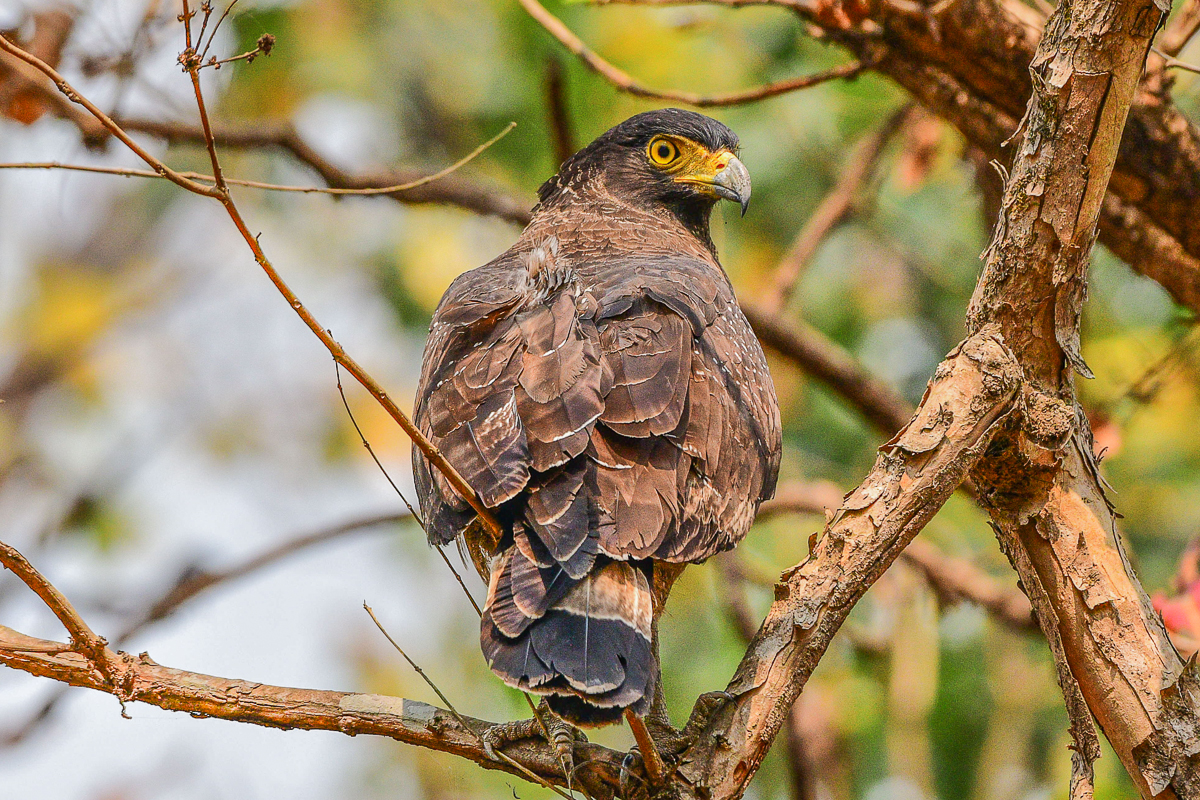
Crested Serpent Eagle
- Common Name: Crested Serpent Eagle
- Scientific Name: Spilornis cheela
- Nepali Name(s): काकाकुल (Kakakul)
- IUCN Red List Status: Least Concern (LC)
- National Red List Status: Least Concern (LC)
- CITES Appendix: Appendix II
Measurements & Physical Profile
- Body Length: 50–74 cm
- Wingspan: 109–169 cm
- Weight: 420–1,800 g
Did You Know?
As its name suggests, this eagle specializes in hunting snakes—including highly venomous cobras and vipers. To protect itself from fatal bites, it has evolved heavily armored tarsi (lower legs) covered in thick, rough, hexagonal scales that function like a "chainmail boot." When pinning a thrashing snake to the ground, it relies on its exceptionally strong, short toes and deep-curved talons to crush the reptile's skull instantly before it can strike back.
Distribution & Habitat
Global Distribution
A highly widespread raptor native to the Oriental realm. Its resident breeding footprint blankets the entire Indian Subcontinent, running along the sub-Himalayan foothill arc through Pakistan, India, Nepal, and Bhutan, extending eastward through Bangladesh, southern China, and Taiwan, and southward through mainland Southeast Asia down to the Sundaic islands of Indonesia and the Philippines.
Distribution within Nepal
A common permanent resident breeder operating primarily within the lowland plains and middle-altitude hills. It is exceptionally well-represented across the Tarai plains, the Bhabar forest belt, and the Churia (Siwalik) foothills. Populations are stable in protected strongholds like Chitwan, Bardia, Shuklaphanta, and Parsa National Parks, as well as in community-managed Sal forests.
Preferred Habitats
An edge-tolerant forest specialist. It favors tropical and subtropical wet evergreen, semi-evergreen, and moist deciduous Sal (Shorea robusta) forests. It prefers hunting along forest clearings, edges of wooded streams, riverine marshes, mangrove fringes, and mature plantations adjacent to traditional wet-rice agricultural fields.
Elevational Range
Predominantly a lowland and lower-foothill specialist, occurring from 75 meters up to 1,500 meters, with individuals occasionally hunting up to 2,000 meters during the pre-monsoon breeding season.
Seasonal Occurrence
A strict, sedentary permanent resident. Adult pairs maintain strong, year-round territory fidelity to their nesting valleys.
Behavior & Ecology
Flight & Foraging Behavior
Displays a distinctive silhouette when soaring: wings held in a shallow, curved "V" (dihedral) revealing a striking, wide white band across the underwings and tail. It is primarily a "sit-and-wait" canopy predator, spending hours perching quietly on lower-canopy branches overlooking stream beds or clearings before dropping in a steep dive to pin prey.
Social & Roosting Habits
One of the most vocal eagles in South Asia. It frequently calls while perched or soaring. Its call is a loud, piercing, musical series of high-pitched whistles: "klieu-wip-wip-wip-wip" or "queee-oh-kip-kip-kip."
Diet & Ecosystem Role
- Diet Breakdown: Highly specialized ophiophage (snake-eater) with significant dietary plasticity.
- Reptiles (Primary ~70-80%): Rat snakes, keelbacks, bronzebacks, vipers, cobras, monitor lizards, garden lizards, and skinks.
- Amphibians: Common toads and tree frogs (especially during monsoon).
- Others: Small mammals (rats, hares), ground-dwelling birds, large land crabs, scorpions, and beetles.
- Ecological Role: Serves as a top predator in lowland forest ecosystems, specifically regulating reptile and small vertebrate populations.
Breeding Biology
The breeding season runs from February through June. Courtship involves spectacular aerial duets above forest valleys with steep dives and rolls. Unlike many eagles, they build a compact, tidy platform nest of twigs lined with fresh green leaves, hidden within the dense foliage of a mature canopy tree (6–20 meters high), often near water. Lays exclusively a single egg, incubation last for 35–40 days, managed by the female while the male patrols the territory and provides food. The chick fledges after approximately 60 days but remains dependent within the parental territory for several months.
Migration
- Status: Resident.
- Movement: Sedentary; performs only minor local movements to lower valleys during extreme weather conditions.
Population Status
- Global Population Estimate: Unknown.
- National Population (Nepal): Unknown.
- Population Trend: Decreasing.
- Monitoring & Surveys: No specific monitoring and survey programs conducted in Nepal.
Threats
- Degradation of Wetlands: Siltation, gravel mining, and the draining of forest streams shrink prime reptile foraging grounds.
- Loss of Mature Canopy Trees: Clean-cutting of leafy riverbank trees removes critical nesting forks and shaded hunting perches.
- Agrochemical Poisoning: Secondary poisoning via consumption of frogs or snakes that have migrated from sprayed agricultural fields.
Conservation Actions
Existing Measures
- International Regulations: Protected under CITES Appendix II.
- Habitat: Core populations are secure within Nepal’s lowland protected national parks and connected forest corridors.
Recommended Measures
- Riverine Buffer Zones: Enforce bans on commercial sand and gravel mining in forest riverbeds bordering park buffers.
- Preservation of Nesting Trees: Work with Community Forest User Groups (CFUGs) to map and preserve large canopy trees within 100 meters of forest streams.
- Ecotourism: Use the species as a flagship for protecting intact lowland forest wetlands and train local guides in its identification.
References
- BirdLife International (2025). Species factsheet: Crested Serpent-eagle Spilornis cheela. Downloaded from https://datazone.birdlife.org/species/factsheet/crested-serpent-eagle-spilornis-cheela on 06/08/2026
- Clark, W. S., J. S. Marks, and G. M. Kirwan (2020). Crested Serpent-Eagle (Spilornis cheela), version 1.0. In Birds of the World (J. del Hoyo, A. Elliott, J. Sargatal, D. A. Christie, and E. de Juana, Editors). Cornell Lab of Ornithology, Ithaca, NY, USA. https://doi.org/10.2173/bow.crseag1.01
- Ferguson-Lees, J., & Christie, D. A. (2001). Raptors of the World. Christopher Helm, London.
- Inskipp C., Baral H. S., Phuyal S., Bhatt T. R., Khatiwada M., Inskipp, T, Khatiwada A., Gurung S., Singh P. B., Murray L., Poudyal L. and Amin R. (2016). The status of Nepal’s Birds: The national red list series. Zoological Society of London, UK.
- Naoroji, R. (2006). Birds of Prey of the Indian Subcontinent. Om Books International, New Delhi.
- The Peregrine Fund (2026) Crested Serpent Eagle. Available at: https://peregrinefund.org/explore-raptors-species/eagles/crested-serpent-eagle (Accessed: 6 August 2026).