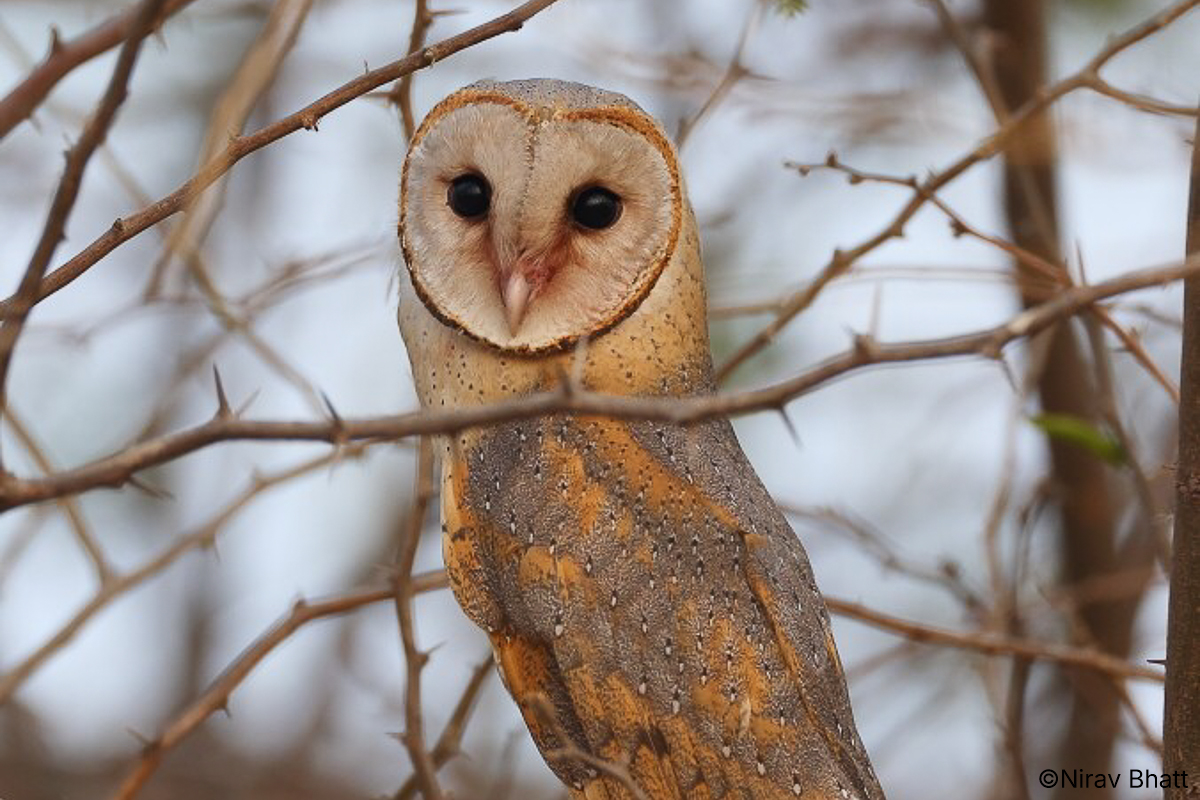
Common Barn Owl
Scientific Name: Tyto alba (sensu lato; South/Southeast Asian populations often grouped under Tyto javanica)
- Nepali Name(s): गोठे लाटोकोसेरो (Gothe Laatokosero)
- IUCN Red List Status: Least Concern (LC)
- National Red List Status: Vulnerable (VU)
- CITES Appendix: Appendix II
- CMS Appendix: Not listed
Measurements & Physical Profile
- Body Length: 33–39 cm
- Wingspan: 80–95 cm
- Weight: 400–600 g
Did You Know?
The Common Barn Owl features a stark-white, heart-shaped facial disc that acts as a natural satellite dish, funneling sound waves directly to its ears. Because its ear openings are positioned asymmetrically on its skull, the owl can calculate the precise angle and distance of a rustling rodent. In pitch-black darkness, a Barn Owl can strike and pin a field mouse moving beneath tall grass purely by sound alone!
Distribution and Habitat
Global Distribution
One of the most widespread land birds on the planet. It is cosmopolitan, encompassing the Americas, Europe, Africa, Australia, and major parts of southern and southeastern Asia. It is absent only from polar latitudes, true deserts, and extreme sub-zero regions.
Distribution within Nepal
An uncommon permanent resident breeder. It occurs across the lowlands of the Tarai plains, the interior valleys of the Churia (Sivalik) foothills, and parts of the mid-hills. Steady populations are found within the agricultural fringes of protected areas like Chitwan and Bardia National Parks, and within towns across the Kathmandu and Pokhara valleys.
Preferred Habitats
A highly open-country and farmland specialist. It avoids closed-canopy rainforests and high alpine elevations. It thrives in lowland agricultural plains, grassy pasturelands, riverine savanna mosaics, marshes, and rural settlements, showing a strong affinity for man-made structures for roosting and nesting.
Elevational Range
Predominantly in lowland and lower montane zones, from 75 meters up to 1,500 meters, with records up to 2,000 meters in mid-hill valleys during peak rodent years.
Seasonal Occurrence
A strict, permanent non-migratory resident. Adult pairs maintain long-term territorial fidelity to their established roosts or nest sites for life.
Behavior and Ecology
Flight & Foraging Behavior
Strictly nocturnal. Its flight is completely silent due to specialized comb-like serrations on the leading edges of its primary feathers, which dampen air turbulence. It waits for total twilight to hunt, using these acoustic adaptations to ambush prey undetected.
Social & Roosting Habits
Unlike typical owls, they do not "hoot." Their primary vocalization is a startling, long-drawn, rasping shriek: "shreeee-ee." When threatened at the nest, they produce defensive bill-snapping and rhythmic hissing.
Diet & Ecosystem Role
- Diet Breakdown: Highly specialized small-mammal predator with a high metabolic rate.
- Rodents (Primary ~90%+): Field mice, bandicoot rats, house rats, and Indian gerbils.
- Others: House shrews, bats, small birds (sparrows, munias, swifts), amphibians, and large nocturnal beetles.
- Ecological Role: Serves as a vital biological pest controller. A single breeding pair and their chicks can consume over 1,000 rodents in a nesting season, protecting grain and crops without chemical intervention.
Breeding Biology
The breeding season in Nepal is flexible but peaks from October through March, aligning with post-monsoon rodent abundance. They are cavity nesters, utilizing natural tree hollows, cliff crevices, or man-made structures like farm lofts, abandoned kilns, and church towers. Eggs are laid directly on bare floors or compressed prey pellets. Clutch Size: 4 to 7 eggs (up to 11 in high-prey years). Incubation: 30–32 days, managed solely by the female. Hatching is highly asynchronous. Fledging: Chicks remain in the nest for 55–65 days and are fed by parents for up to 5 weeks after leaving.
Migration
- Status: Resident.
- Movement: Non-migratory and highly sedentary.
Population Status
- Global Population Estimate: 1.96 – 3.24 m.
- National Population (Nepal): Less than 1000.
- Population Trend: Unknown.
- Monitoring & Surveys: active monitoring is not implemented.
Threats
- Rodenticide Poisoning (SGARs): The most significant threat; second-generation anticoagulant rodenticides cause fatal internal bleeding when owls consume poisoned rodents.
- Loss of Nesting Architecture: Replacing traditional wooden/brick structures with airtight concrete and metal roofs eliminates vital nesting sites.
- Vehicle Collisions: High mortality due to hunting along roadsides at night.
- Superstition: Persecution due to myths viewing them as "bad omens" due to their ghostly appearance and screeching calls.
Conservation Actions
Existing Measures
- Trade Regulations: Protected under CITES Appendix II.
- Habitat: Benefits from low-intensity agricultural matrices bordering protected zones.
Recommended Measures
- Artificial Nest Boxes: Widespread installation of wooden nest boxes on farms and grain depots.
- Integrated Pest Management (IPM): Restricting chemical rodenticides in favor of owl-based natural pest control.
- Public Awareness: Educational workshops to dispel myths and highlight the Barn Owl’s status as a partner to farmers.
References
- BirdLife International. (2021). Tyto alba. The IUCN Red List of Threatened Species 2021.
- Grimmett, R., Inskipp, C., & Inskipp, T. (2016). Birds of Nepal. Christopher Helm, London.
- König, C., & Weick, F. (2008). Owls of the World. Christopher Helm, London.
- Inskipp, C., Baral, H. S., Phuyal, S., Bhatt, T. R., Ali, M., & Acharya, R. (2016). The Status of Nepal’s Birds: The National Red List Series. Royal Zoological Society.
- Taylor, I. (1994). Barn Owls: Predator-Prey Relationships and Conservation. Cambridge University Press.
- Ali, S., & Ripley, S. D. (1987). Handbook of the Birds of India and Pakistan (Vol. 3). Oxford University Press.