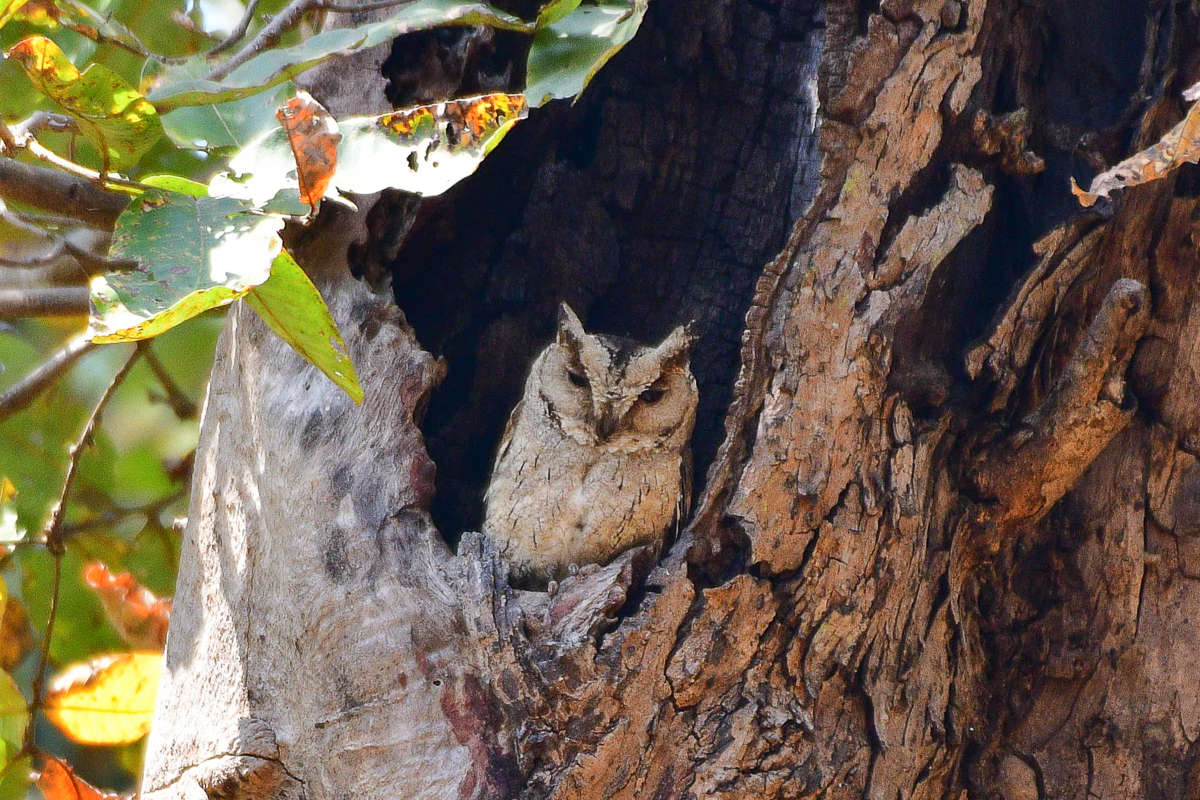
Common Name: Collared Scops-Owl
- Scientific Name: Otus lettia (formerly treated as a subspecies cluster of Otus bakkamoena)
- Nepali Name(s): ……………(……)
- IUCN Red List Status: Least Concern (LC)
- National Red List Status: Least Concern (LC)
- CITES Appendix: Appendix II
- CMS Appendix: Not listed
Measurements & Physical Profile
- Body Length: 23–25 cm
- Wing Length: 14.3–17 cm
- Weight: 194–170 g
Did You Know?
Much like its cousin the Collared Owlet, the Collared Scops-Owl features a prominent, pale buffy-white nuchal collar (a band across the back of the neck) flanked by dark markings. This creates a convincing "false face" on the back of its head. Combined with its erectile ear tufts and beautifully barred, bark-like plumage, this little owl can press itself flat against a tree trunk at dawn and completely vanish from sight, safely misleading any predators or annoying songbirds approaching from behind.
Distribution & Habitat
Global Distribution
Widely distributed across the northern and eastern regions of the Oriental realm. Its breeding footprint stretches along the entire sub-Himalayan belt from northern Pakistan, India, Nepal, and Bhutan, extending eastward into Bangladesh, Myanmar, southern China, Taiwan, and down through Thailand, Laos, Cambodia, and Vietnam.
Distribution within Nepal
A well-distributed resident breeder. It spans the entire length of the country, maintaining rich populations across the lowland Tarai plains, the Churia (Siwalik) foothills, and the inner Tarai valleys. It is frequently recorded in protected landscapes like Chitwan and Bardia National Parks, and is equally common in populated rural areas like the Kathmandu and Pokhara valleys.
Preferred Habitats
An incredibly adaptable woodland generalist. It prefers open canopy environments, including secondary growth forests, riverine woodlots, forest edges, and subtropical pine tracts. It has adapted exceptionally well to human landscapes, regularly nesting in mature suburban gardens, city parks, old orchards, and groves of ancient trees near traditional villages.
Elevational Range
Predominantly a lowland and mid-hill specialist, ranging from 75 meters up to 1,600 meters, with exceptional records up to 2,200 meters during warm summer breeding cycles.
Seasonal Occurrence
A strict, permanent non-migratory resident with high year-round territory fidelity.
Behavior & Ecology
Flight & Foraging Behavior
Strictly nocturnal. It remains inactive during daylight hours, roosting in dense foliage or tree hollows (often in mango, bamboo, or Ficus). It emerges after dusk, utilizing silent, low-flying swoops to ambush prey.
Social & Roosting Habits
Territorial and vocal, especially on clear, moonlit nights during the spring. The male’s territorial call is a clear, questioning hoot ("buwro" or a soft, melancholy "whaat?") repeated at steady intervals.
Diet & Ecosystem Role
- Diet Breakdown: Highly efficient insectivore and small-vertebrate predator.
- Insects (Primary): Large nocturnal beetles, moths, crickets, grasshoppers, cicadas, and flying termites.
- Small Vertebrates: small rodents, house shrews, tree frogs, forest skinks, and geckos.
- Birds: Occasionally ambushes small sleeping passerines at their nighttime roosts.
- Ecological Role: Provides invaluable, free pest control within agricultural and urban areas by regulating nocturnal rodent and wood-boring beetle populations.
Breeding Biology
The breeding cycle runs from February through May. Courtship involves low-pitched duets and beak-clicking. As a secondary cavity nester, it utilizes natural tree hollows or abandoned nests of barbets and woodpeckers. The female lays 3–5 glossy white eggs directly on the cavity debris. The female manages incubation (24–26 days) while the male provides food. Chicks fledge after 28–30 days.
Migration
- Status: Permanent resident.
- Movement: Non-migratory; pairs maintain the same territory for their entire adult lives.
Population Status
- Global Population Estimate: Unknown.
- National Population (Nepal): Unknown.
- Population Trend: Decreasing.
- Monitoring & Surveys: Frequently documented in general bird watching.
Threats
- Loss of Cavity Trees: Clean-cutting of old orchards and urban park trees removes vital nesting sites.
- Pesticide Abuse: Heavy use of chemical insecticides in gardens and farms reduces food supply and poses risks of secondary poisoning.
- Superstition: Occasionally targeted due to negative local myths regarding their nocturnal calls.
Conservation Actions
Existing Measures
- International Regulations: Protected under CITES Appendix II.
- Protected Areas: Stable populations exist within Nepal's national parks, buffer zones, and community-managed forests.
Recommended Measures
- Artificial Nest Boxes: Promote the installation of custom wooden boxes in urban parks and orchards to replace lost natural cavities.
- Eco-Friendly Farming: Encourage reduced pesticide use to maintain insect prey populations.
- Community Education: Conduct awareness campaigns to dispel myths and highlight the owl's role as a natural pest-controller.
References
- BirdLife International (2024). Species factsheet: Collared Scops-owl Otus lettia. Downloaded from https://datazone.birdlife.org/species/factsheet/collared-scops-owl-otus-lettia on 07/08/2026
- Holt, D. W., R. Berkley, C. Deppe, P. L. Enríquez, J. L. Petersen, J. L. Rangel Salazar, K. P. Segars, K. L. Wood, J. S. Marks, and C. Hansasuta (2024). Collared Scops-Owl (Otus lettia), version 1.2. In Birds of the World (J. del Hoyo, A. Elliott, J. Sargatal, D. A. Christie, E. de Juana, P. Pyle, S. M. Billerman, and N. D. Sly, Editors). Cornell Lab of Ornithology, Ithaca, NY, USA. https://doi.org/10.2173/bow.cosowl1.01.2
- Inskipp C., Baral H. S., Phuyal S., Bhatt T. R., Khatiwada M., Inskipp, T, Khatiwada A., Gurung S., Singh P. B., Murray L., Poudyal L. and Amin R. (2016). The status of Nepal’s Birds: The national red list series. Zoological Society of London, UK.