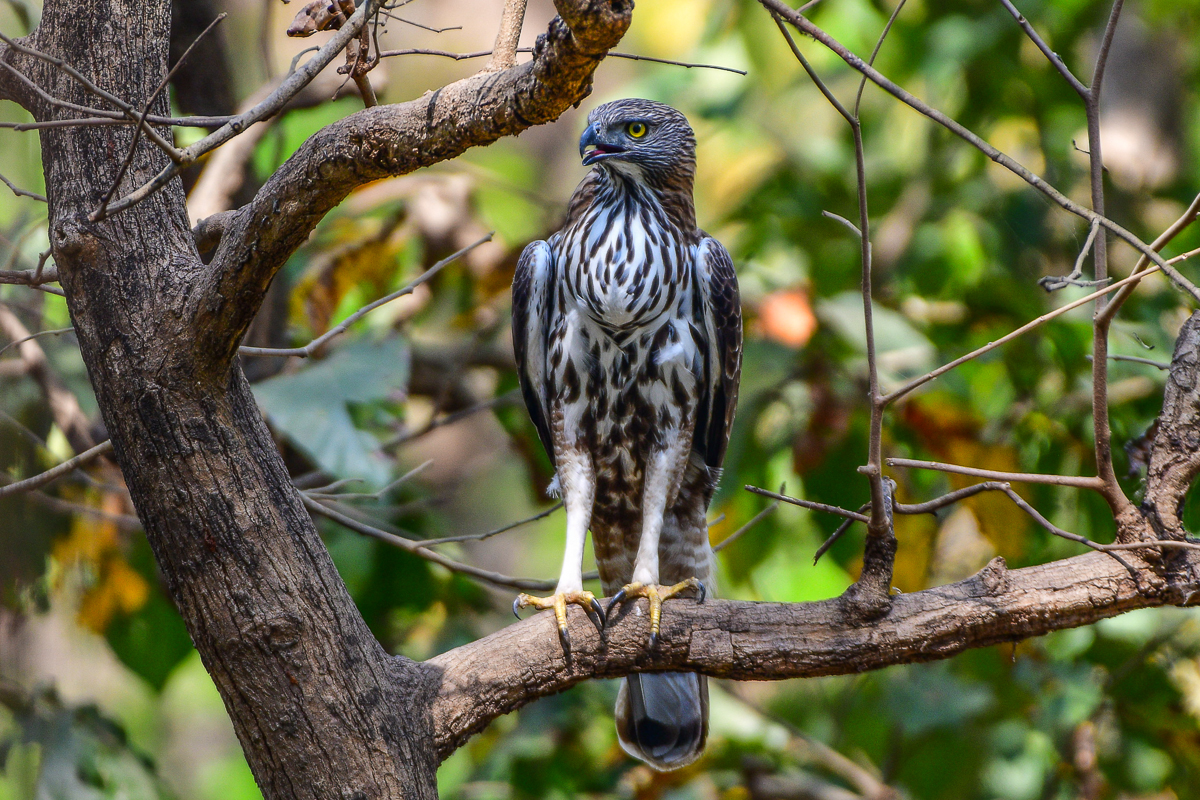
Changeable Hawk-Eagle
- Common Name: Changeable Hawk-Eagle (historically known as the Crested Hawk-Eagle)
- Scientific Name: Nisaetus cirrhatus (formerly Spizaetus cirrhatus)
- Nepali Name(s): शदलचिल (Shadal Chil)
- IUCN Red List Status: Least Concern (LC)
- National Red List Status: Least Concern (LC) / Locally Common Resident
- CITES Appendix: Appendix II
- CMS Appendix: Not listed
Measurements & Physical Profile
- Body Length: 51–82 cm
- Wingspan: 100 –160 cm
- Weight: 1300 –1900 g
Did You Know?
True to its name, the Changeable Hawk-Eagle exhibits extreme polymorphic "changeability" in its plumage. Within the exact same forest, you can find a pale-morph individual—sporting a bright white breast heavily streaked with dark vertical teardrops—living alongside a striking, uniform dark-morph individual that is completely jet-black from head to talon. This extreme color variation often confuses birdwatchers and researchers, making them look like two entirely different species!
Distribution & Habitat
Global Distribution
The Changeable Hawk-Eagle is widely distributed across the tropical and subtropical forests of South and Southeast Asia. Its continuous range spans the Indian Subcontinent, Sri Lanka, and the Himalayan foothills, extending eastward across Bangladesh, Myanmar, Thailand, Indochina, the Malay Peninsula, and Sumatra, Borneo, Java, and the Philippines.
Distribution within Nepal
In Nepal, it is a locally common resident breeder. It is widely distributed throughout the lowland Tarai plains, the Churia (Siwalik) hills, and the lower Bhabar zone. It is highly abundant and well-studied within protected areas such as Chitwan National Park, Bardia National Park, and Shukla Phanta National Park, but maintains stable numbers in managed community forests outside protected zones.
Preferred Habitats
It favors open canopy environments, forest edges, and transitional zones rather than deep, closed-canopy rainforests. It thrives in deciduous Sal (Shorea robusta) forests, riverine woodlots, savannah-woodland mosaics, and mature logged forests. It frequently ventures into savanna grasslands and agricultural forest edges to hunt.
Elevational Range
A distinct lowland and foothill specialist, recorded primarily from plains level at 75 meters up to roughly 1,000 meters. It is exceptionally recorded up to 1,500 meters in the mid-hills but is structurally replaced by the Mountain Hawk-Eagle (Nisaetus nipalensis) at higher altitudes.
Seasonal Occurrence
Observed year-round as a permanent resident across its established lowland and foothill territories.
Behavior & Ecology
Flight & Foraging Behavior
The Changeable Hawk-Eagle is an ambush apex predator of the forest canopy. It utilizes a classic "sit-and-wait" hunting strategy, spending hours perched silently and upright on a concealed branch inside a leafy tree overlooking a clearing, waterhole, or forest track. When prey emerges, it launches a swift, powerful, diving stoop, using its relatively short, broad wings and long tail to navigate tightly through thick branches.
Social & Roosting Habits
Typically observed as solitary individuals or in bonded pairs. They are highly territorial, and during the pre-monsoon breeding season, they become highly vocal and conspicuous. They emit a loud, high-pitched, piercing, multi-syllabic whistle or scream: "ki-ki-ki-ki-ki-kee-ee" or a rapidly accelerating "klee-klee-klee-eeea", with the final note rising sharply in pitch.
Diet & Ecosystem Role
- Mammals: Small to medium mammals: Tree squirrels, Indian hares (Lepus nigricollis), rats, shrews, and juvenile monkeys.
- Birds: Ambushing birds up to its own weight: Junglefowl (Gallus gallus), peafowl chicks, emerald doves, parakeets, mynas, and tree pies.
- Reptiles: Significant volume of herpetofauna: Large garden lizards, monitor lizards (Varanus sp.), skinks, and a wide variety of land snakes.
Breeding Biology
The breeding season in Nepal is highly synchronized with the cool dry winter and spring months, running from December through April. The pair exhibits strong, long-term territorial fidelity, constructing a large, bulky, circular platform nest entirely out of dry sticks and branches (up to 1 meter in diameter). These are placed high up (12 to 25 meters) in the secure fork of a large, mature tree, often in species like Sal, Silk-cotton, or Haldu, situated near a river basin or forest edge.
The female lays a single white egg. Incubation lasts approximately 40 to 44 days, performed primarily by the female, while the male patrols the territory and provides food. The chick stays in the nest for 65 to 70 days. After fledging, the young eagle remains loosely attached to the natal territory for several months.
Migration
- Status: Permanent resident.
- Movement: Sedentary; adults maintain strict, year-round site fidelity to their nesting territories.
Population Status
- Global Population Estimate: Unknown.
- Population Trend: Decreasing.
- National Population Estimate (Nepal): No population estimation has been made.
- Monitoring & Surveys: Monitored within protected area management plans and general biodiversity surveys in the Tarai.
Threats
- Loss of Large Native Nest Trees: Systematic logging of massive, mature emergent trees removes the secure structural foundations needed for their heavy nests.
- Human Persecution: Retaliatory trapping or shooting by farmers when individual eagles raid domestic poultry near village edges.
- Electrocution Hazards: Use of utility poles as hunting perches near uninsulated, high-voltage lines in developing rural areas.
Conservation Actions
Existing Measures
- International Conventions: Fully listed under CITES Appendix II.
- Protected Areas: Well-represented in core protected areas of the southern Tarai and associated buffer zone community forests.
Recommended Measures
- Retaining Large Trees: Working with Community Forest User Groups (CFUGs) to identify and legally protect known raptor nest trees from timber harvest.
- Mitigating Poultry Conflicts: Designing and distributing predator-proof chicken coops for communities living on forest margins.
- Insulating Power Infrastructure: Partnering with regional energy authorities to insulate power line configurations that intersect lowland forest corridors.
References
- BirdLife International (2020). Species factsheet: Changeable Hawk-eagle Nisaetus cirrhatus. Downloaded from https://datazone.birdlife.org/species/factsheet/changeable-hawk-eagle-nisaetus-cirrhatus on 05/08/2026
- Clark, W. S., P. F. D. Boesman, and J. S. Marks (2020). Changeable Hawk-Eagle (Nisaetus cirrhatus), version 1.0. In Birds of the World (J. del Hoyo, A. Elliott, J. Sargatal, D. A. Christie, and E. de Juana, Editors). Cornell Lab of Ornithology, Ithaca, NY, USA. https://doi.org/10.2173/bow.y00839.01
- Ferguson-Lees, J., & Christie, D. A. (2001). Raptors of the World. Christopher Helm, London.
- Inskipp C., Baral H. S., Phuyal S., Bhatt T. R., Khatiwada M., Inskipp, T, Khatiwada A., Gurung S., Singh P. B., Murray L., Poudyal L. and Amin R. (2016). The status of Nepal’s Birds: The national red list series. Zoological Society of London, UK.