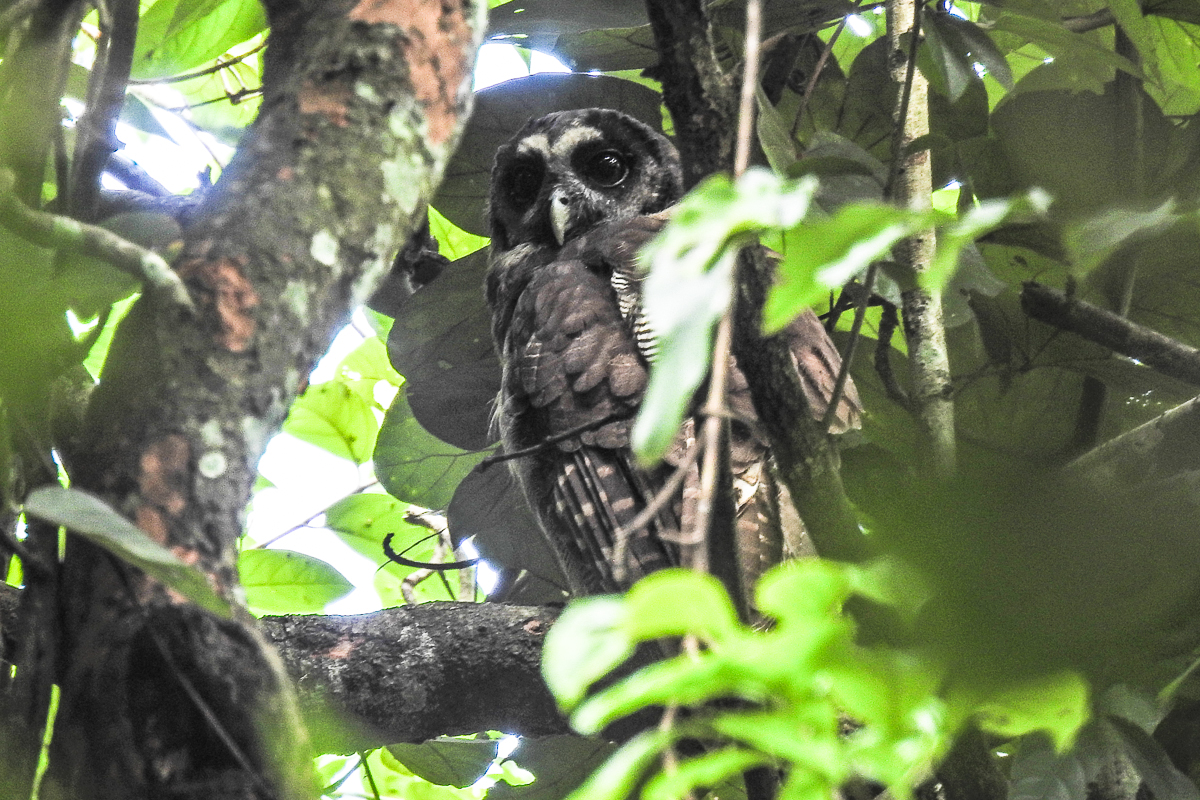
Brown Wood-Owl
- Common Name: Brown Wood-Owl
- Scientific Name: Strix leptogrammica
- Nepali Name(s): चस्मे उलूक (Chasme Uluk)
- IUCN Red List Status: Least Concern (LC)
- National Red List Status (Nepal): Vulnerable (VU)
- CITES Appendix: Appendix II
- CMS Appendix: Not listed
Measurements & Physical Profile
- Body Length: 39–55 cm
- Wing Length: 39.5- 44.2 cm
- Weight: 800–1,100 g
Did You Know?
Belonging to the ancient genus Strix—which stems from an old Latin myth describing a legendary nocturnal bird that was feared as an omen—the Brown Wood-Owl is an absolute master of deep-forest camouflage. It sports a smooth, completely earless round head, a striking creamy-white "throat-badge", and huge, intense dark-brown eyes set within a soft, rufous facial disc. It is extremely reclusive during the day, sitting so perfectly still against thick tree trunks that human eyes rarely spot it before it vanishes like a shadow into the canopy.
Distribution & Habitat
Global Distribution
The Brown Wood-Owl is native to the dense forest zones of South and Southeast Asia. Its breeding range forms a wide arc stretching from the Indian Subcontinent and the lower Himalayan belt eastward into southern China and Taiwan, and south across Myanmar, Thailand, Indochina, the Malay Peninsula, Sumatra, Borneo, and Java.
Geographic Subspecies
This highly adaptable owl has split into several distinct regional subspecies across its vast range:
- Strix leptogrammica newarensis: Occupies the Himalayan foothills, Nepal, northeastern India, and parts of mainland Southeast Asia. It stands out due to its deep chestnut-tinged upperparts and distinct underpart barring.
- Strix leptogrammica indranee: Restricted to central and southern India. It has a slightly distinct, highly resonant vocal pattern.
- Strix leptogrammica ochrogenys: Endemic to Sri Lanka, showing noticeably paler cheeks and distinctive egg dimensions.
- Strix leptogrammica ticehursti: Found in south China and Hong Kong, well-studied for its specific post-fledging behaviors.
- Island Subspecies (bartelsi, caligata, etc.): Varied forms limited to specific island environments like Java, Borneo, and Sumatra.
Distribution within Nepal
In Nepal, it is an uncommon resident breeder. It lives across the lowland Tarai plains, the Churia (Siwalik) hills, and mid-elevation forest valleys. It maintains steady breeding populations inside major conservation strongholds, including Chitwan National Park, Bardia National Park, and the lower subtropical reaches of the Annapurna Conservation Area and Shivapuri Nagarjun National Park.
Preferred Habitats
It is a strict deep-forest interior specialist. It thrives in dense, undisturbed primary tropical evergreen, semi-evergreen, and moist deciduous forests (particularly old-growth Sal Shorea robusta forests). It actively avoids open agricultural plains, modern urban areas, and heavily logged forest fragments with high human activity.
Elevational Range
Typically ranges from lowland plains at 250 meters up into mid-elevation temperate broadleaf forests around 2,000 meters above sea level.
Seasonal Occurrence
A strict, non-migratory sedentary resident. Mated pairs establish and defend permanent territories, staying in the same deep-forest patches throughout their lives.
Behavior & Ecology
Vocalizations & Nocturnal Rhythms
The Brown Wood Owl is highly nocturnal, waiting until complete darkness before leaving its daytime roosts. It is most easily detected by its unmistakable, booming, musical vocalizations. The primary territorial call is a deep, resonant, multi-syllabic hoot: "too-whoo-hoo" or a low, rhythmic four-syllable hoot with a bouncing cadence, often performing duets with its mate across the dark canopy.
Roosting & Defense
During the daytime, individuals or pairs roost cryptically high up in the sub-canopy, choosing trees covered in dense creepers, old epiphytes, or thick foliage next to the trunk. When confronted by potential predators or humans at its roost, it stretches its body into an elongated posture and closes its eyes to narrow slits, mimicking a broken tree branch to perfection.
Diet & Ecosystem Role
Diet Breakdown
The Brown Wood Owl is an opportunistic apex predator of the forest sub-canopy, shifting its diet depending on local prey cycles:
- Small Mammals (Primary): Forest rodents (rats, mice), shrews, and tree-dwelling squirrels.
- Birds: Roosting songbirds, small barbets, and occasional fruit bats caught on the wing.
- Reptiles & Amphibians: Tree frogs, forest skinks, and small geckos taken from tree bark.
- Insects & Invertebrates: Large nocturnal beetles, cicadas, and grasshoppers.
- Aquatic Prey: Sporadic records show them taking small freshwater fish from shallow forest streams.
Ecological Role
As a powerful canopy hunter, it serves as a critical regulator of small mammal and wood-boring insect populations. By keeping rodent numbers in check, it protects the natural seed regeneration cycles of dominant forest trees like Sal.
Breeding Biology
Seasonality
In the Himalayas and Nepal, the active breeding window spans from February to April, coinciding with the dry spring months before the arrival of the heavy summer monsoons.
Nest Sites & Architecture
It is a dedicated cavity nester, requiring large, natural hollows in ancient, large-diameter forest trees. It will also occasionally nest on high, sheltered rock ledges inside deep forest ravines or take over old, abandoned stick platforms built by larger raptors. No nesting material is added; eggs are laid directly onto the soft, decaying wood dust at the bottom of the hollow.
Incubation & Fledging
- Clutch Size: Usually 1 to 2 oval, glossy white eggs.
- Incubation Duration: Lasts approximately 28 to 30 days, managed entirely by the female while the male hunts and feeds her.
- Fledging Phase: Chicks stay in the safety of the nest hollow for 30 to 35 days. Once they leave the nest, the fledglings display unique climbing abilities, using their sharp talons and beak to scramble up vines into the high canopy well before they can fly properly. They remain completely dependent on their parents for food for up to two months after leaving the nest.
Population Status
Globally, the Brown Wood-Owl remains secure and is listed as Least Concern (LC) due to its wide footprint across multiple Asian countries. Locally in Nepal, it is secure but highly vulnerable to localized extinctions because it completely relies on undisturbed, old-growth forests.
Threats
- Loss of Ancient Canopy Trees: High-value logging of old-growth timber directly removes the massive, hollow-bearing trees that these owls need to breed.
- Forest Fragmentation: Roads, transmission lines, and farming developments slice large forests into isolated patches. This cuts off the continuous canopy cover these reclusive owls need to forage and move safely.
- Disturbance at Nesting Cavities: Because they are highly sensitive to human presence during the breeding cycle, increased livestock grazing and firewood collection near nest trees can cause them to abandon their eggs.
Conservation Actions
Existing Measures
- Trade Controls: Listed on CITES Appendix II to prevent illegal international capture and trade.
- Protected Habitats: Key breeding populations are protected inside Nepal's protected areas.
Recommended Measures
- Preserving Old-Growth Stands: Creating specific rules within Community Forest User Groups (CFUGs) to map and leave large, hollow-bearing trees untouched during timber harvests.
- Canopy Corridor Restorations: Planting native trees to bridge gaps between isolated forest blocks, allowing young owls to disperse safely into new territories.
- Nocturnal Acoustic Mapping: Using automated recording units (ARUs) in unexplored mid-hill forests to track territorial calls, helping conservationists map their true national population baseline.
References
- BirdLife International (2024). Species factsheet: Brown Wood-owl Strix leptogrammica. Downloaded from https://datazone.birdlife.org/species/factsheet/brown-wood-owl-strix-leptogrammica on 07/08/2026
- Holt, D. W., R. Berkley, C. Deppe, P. L. Enríquez, J. L. Petersen, J. L. Rangel Salazar, K. P. Segars, K. L. Wood, and J. S. Marks (2020). Brown Wood-Owl (Strix leptogrammica), version 1.0. In Birds of the World (J. del Hoyo, A. Elliott, J. Sargatal, D. A. Christie, and E. de Juana, Editors). Cornell Lab of Ornithology, Ithaca, NY, USA. https://doi.org/10.2173/bow.brwowl1.01
- Inskipp C., Baral H. S., Phuyal S., Bhatt T. R., Khatiwada M., Inskipp, T, Khatiwada A., Gurung S., Singh P. B., Murray L., Poudyal L. and Amin R. (2016). The status of Nepal’s Birds: The national red list series. Zoological Society of London, UK.