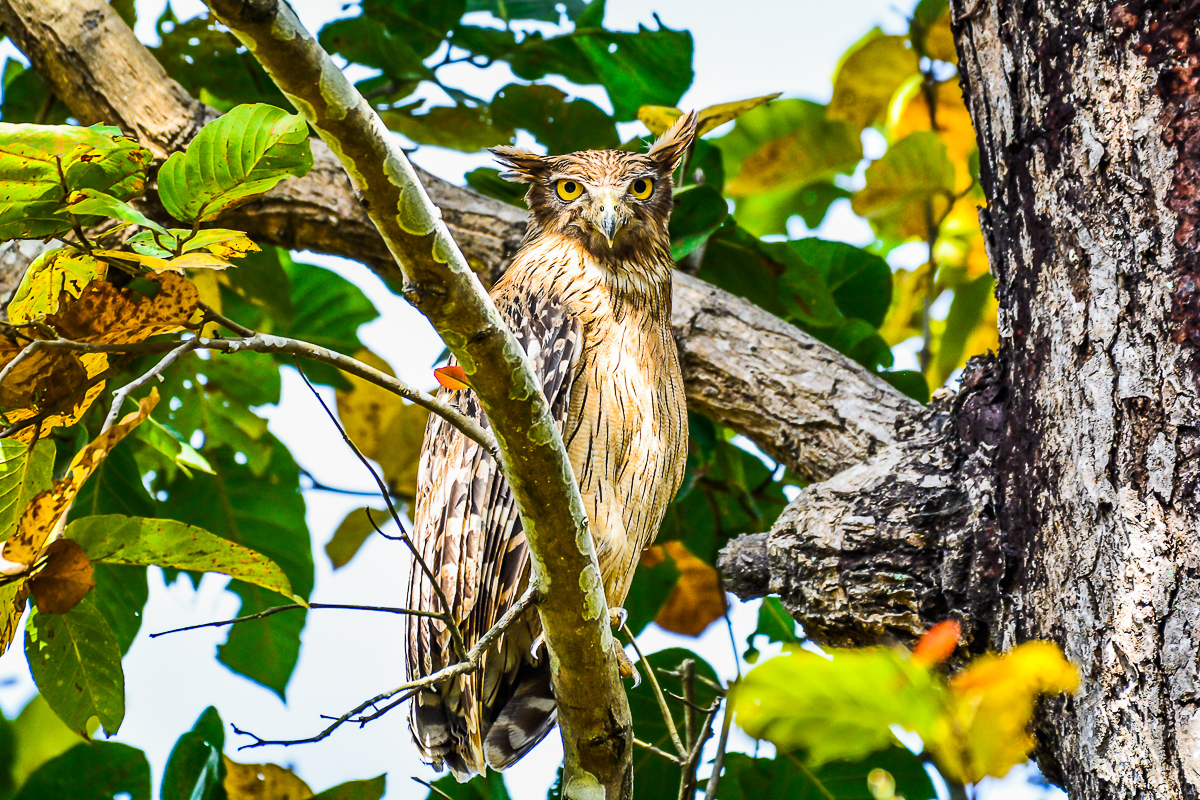
Brown Fish-Owl
- Common Name: Brown Fish-Owl
- Scientific Name: Ketupa zeylonensis
- Nepali Name(s): मलाहा हुचिल (Malaha Huchil)
- IUCN Red List Status: Least Concern (LC)
- National Red List Status (Nepal): Vulnerable (VU)
- CITES Appendix: Appendix II
- CMS Appendix: Not listed
Measurements & Physical Profile
- Body Length: 48–58 cm
- Wing Length: 37–43 cm
- Weight: 1,105–1,308 g
Did You Know?
Unlike terrestrial owls that rely on silent flight to ambush mammals, the Brown Fish Owl lacks the soft, velvety comb-like fringes on its primary wing feathers. This makes its flight noticeably noisy, but silence isn't necessary when hunting fish! To adapt to its aquatic lifestyle, its legs and toes are completely unfeathered, and the soles of its feet are covered in sharp, rough, prickly scales (spicules). This specialized texture acts like avian sandpaper, allowing the owl to grip wet, slippery fish right out of the water!
Distribution & Habitat
Global Distribution
The Brown Fish-Owl has a massive distribution range across the warm-temperate and tropical regions of Asia. Its range extends from Turkey, the Middle East, and Iran, eastward across the entire Indian Subcontinent (including India, Pakistan, Sri Lanka, Bangladesh, and Nepal), and through southern China and Southeast Asia down to the Malay Peninsula.
Distribution within Nepal
In Nepal, it is a localized and uncommon resident breeder. It is found primarily across the lowland Tarai plains, the Churia (Sivalik) foothills, and the broad inner Tarai valleys. It is closely tied to the country's major river systems, including the Koshi, Narayani, and Karnali river basins, with a significant portion of its population protected within lowland national parks.
Preferred Habitats
Lowland riverine forests, heavily wooded banks of deep slow-moving rivers, margins of large lakes, and shaded streams running through rocky ravines. Mature mangrove swamps, deep irrigation canals, old well-wooded village tanks, and flooded agricultural fields or fish farms bordering intact forest fragments. It strictly requires large, old trees with dense canopies near permanent open water.
Elevational Range
Predominantly a lowland and foothill specialist, operating most frequently from plains level at 75 meters up to roughly 800 meters above sea level. It is rarely recorded in the higher mountain streams of the mid-hills, keeping below 1,500 meters.
Seasonal Occurrence
Observed year-round across its permanent wetland territories in Nepal. It is a strictly non-migratory sedentary resident that defends its riverine hunting grounds throughout its lifespan.
Behavior and Ecology
Activity & Vocalization
While predominantly nocturnal and crepuscular, the Brown Fish-Owl is frequently semi-diurnal. It can often be seen flying actively or sitting quietly in the open during dull, overcast days, or hunting along shaded riverbanks late in the afternoon. Its voice is deep, booming, and carrying—producing a hollow, rhythmic, multi-syllabic call: "tu-whoo-tu" or a dismal, booming "boomb-o-boomb", typically uttered from a prominent perch over water at dusk.
Hunting Tactics & Roosting Habits
It hunts primarily from a low, overhanging branch, tree root, or large rock protruding from a river or lakebed. It watches the water intently, then swoops down in a shallow glide to snatch surface-swimming fish or crabs with its bare feet. It will also wade directly into shallow water to catch frogs and invertebrates. During the bright midday heat, it roosts in dense foliage, often choosing ancient mango trees, large figs (Ficus), or steep, shaded rocky crevices near waterholes.
Diet & Ecosystem Role
Diet Breakdown
The Brown Fish-Owl is a highly versatile aquatic as well as terrestrial carnivore:
- Aquatic Prey (Primary): Large freshwater fish (such as carp and catfish) and freshwater crabs or crayfish.
- Amphibians & Reptiles: Frogs, large toads, water snakes, monitor lizards, and juvenile marsh crocodiles (Crocodylus palustris).
- Mammals & Birds: Small rodents, shrews, waterbirds (such as moorhens and egrets), and occasionally bats or domestic poultry if foraging near villages.
- Carrion: Uniquely among owls, it will occasionally feed on dead mammalian carcasses near water margins.
Ecological Role
As a top-tier avian predator of riverine ecosystems, it bridges the gap between aquatic and terrestrial food webs. By feeding heavily on fish, crabs, and amphibians, it regulates local aquatic populations and acts as a key bioindicator of river system health, water clarity, and riparian forest structure.
Breeding Biology
The breeding season in Nepal and the wider Indian subcontinent spans from November to April, timed specifically so that chicks hatch when river levels are lowest and clearest, making fish and crabs easiest to catch.
It does not build its own nest. Instead, it utilizes large natural forks or hollows in ancient trees, or takes over the abandoned, bulky stick nests of large raptors like eagles or vultures. It also commonly nests on steep, inaccessible dirt cliffs or rocky river ledge crevices. The nest site is almost always situated directly over or within a few meters of permanent water. The female lays a clutch of 1 to 3 large, round, textured white eggs. Incubation lasts for approximately 34 to 38 days and is performed entirely by the female, while the male provides all food. The young are altricial and heavily dependent on both parents; they remain in the nest for about 45 to 50 days before fledging, and continue to stay with the parents for several months to master the art of fishing.
Population Status
Globally, the Brown Fish Owl is categorized as Least Concern (LC) due to its vast Asian range. However, within Nepal, it is listed as Vulnerable (VU) due to its highly fragmented population, narrow habitat specialization, and accelerating riverine degradation. Global population of this species is not estimated.
Threats
- Destruction of Riparian Canopies: The cutting of old-growth riverine forests and large trees (Ficus, Bombax) removes critical nesting sites and day-roosts.
- River Pollution & Overfishing: Water pollution from agricultural runoff and industrial effluents kills off surface fish and crabs. Unregulated local overfishing reduces the owl's primary food source.
- Disturbance from Sand & Gravel Mining: Heavy mechanical extraction of sand, boulders, and gravel along riverbeds disrupts their foraging territories, muddies the water, and drives owls away from nesting cliffs.
- Human Persecution: Like many large owls in the region, they face risks from illegal trapping, hunting for traditional medicine, or retaliatory killing around commercial fish-farming ponds.
Conservation Actions
Existing Measures
- International Control: Listed on CITES Appendix II, strictly regulating any international capture or commercial trade.
- Habitat Safety: Found within well-monitored aquatic habitats inside lowland reserves, such as Koshi Tappu Wildlife Reserve, Chitwan National Park and Bardia National Park.
Recommended Measures
- Riparian Buffer Zones: Enforcing strict legal protection for old-growth trees within 100 meters of major riverbanks to safeguard nesting sites.
- Regulating Riverbed Mining: Restricting destructive sand and gravel mining in critical river stretches known to support breeding pairs.
- Fish-Farmer Engagement: Working with commercial fish-pond owners in the Tarai to promote non-lethal deterrents (such as netting) rather than shooting or trapping foraging owls.
- Water Quality Monitoring: Integrating owl population trends into larger wetland conservation initiatives as a metric for checking the health of freshwater ecosystems.
References
- BirdLife International (2025). Species factsheet: Brown Fish-owl Ketupa zeylonensis. Downloaded from https://datazone.birdlife.org/species/factsheet/brown-fish-owl-ketupa-zeylonensis on 07/08/2026
- Holt, D. W., R. Berkley, C. Deppe, P. L. Enríquez, J. L. Petersen, J. L. Rangel Salazar, K. P. Segars, K. L. Wood, G. M. Kirwan, and J. S. Marks (2020). Brown Fish-Owl (Ketupa zeylonensis), version 1.0. In Birds of the World (J. del Hoyo, A. Elliott, J. Sargatal, D. A. Christie, and E. de Juana, Editors). Cornell Lab of Ornithology, Ithaca, NY, USA. https://doi.org/10.2173/bow.brfowl1.01
- Inskipp C., Baral H. S., Phuyal S., Bhatt T. R., Khatiwada M., Inskipp, T, Khatiwada A., Gurung S., Singh P. B., Murray L., Poudyal L. and Amin R. (2016). The status of Nepal’s Birds: The national red list series. Zoological Society of London, UK.