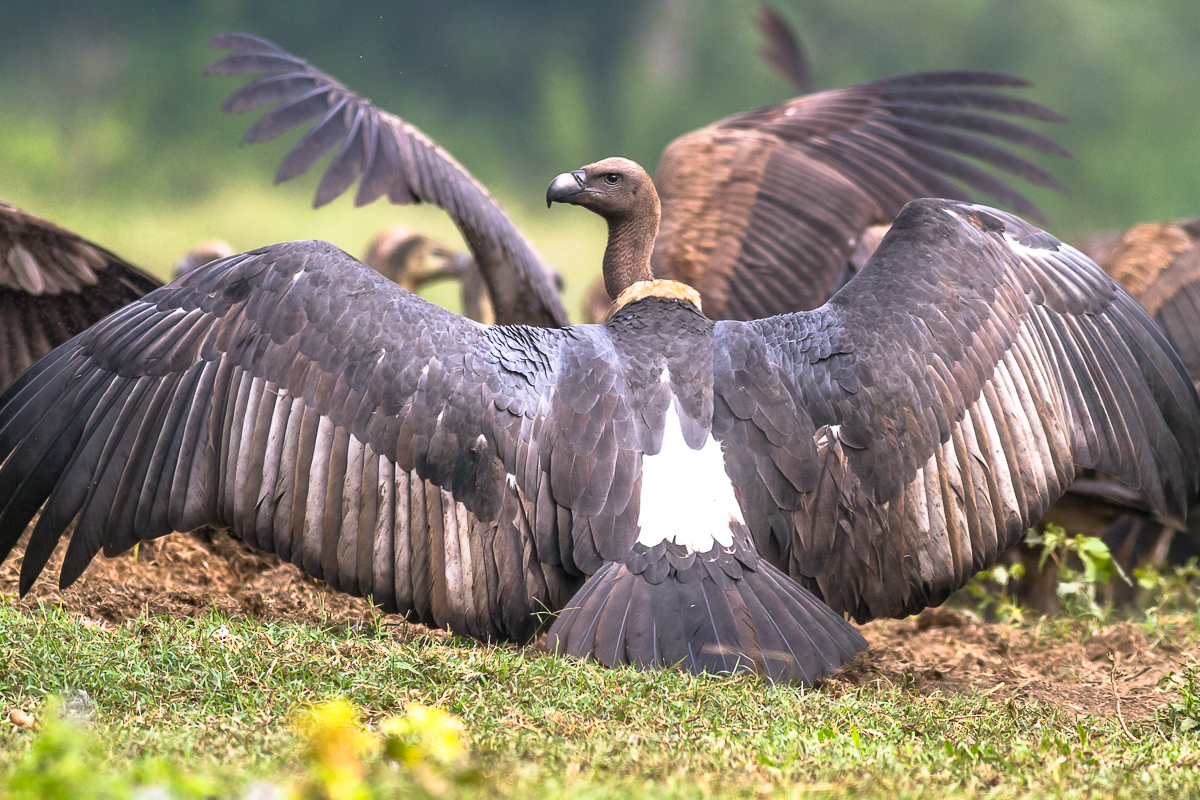
White-rumped Vulture
- Common Name: White-rumped Vulture
- Scientific Name: Gyps bengalensis
- Nepali Name(s): डंगर गिद्ध (Dangar Giddha)
- IUCN Red List Status: Critically Endangered (CR)
- National Red List Status: Critically Endangered (CR)
- CITES Appendix: Appendix II
Measurements & Physical Profile
- Body Length: 75–85 cm
- Wingspan: 190–220 cm
- Weight: 3.5–7.5 kg
Did You Know?
The White-rumped Vulture was once the most abundant large bird of prey in the world. It is named for the conspicuous white patch on its lower back, which is clearly visible when the bird is in flight. It is a highly social vulture, often seen in large, noisy groups when feeding at a carcass or roosting in clusters on large, mature trees.
Distribution & Habitat
Global Distribution
Historically widespread across South and Southeast Asia. Currently, it exists as a fragmented, remnant population across India, Pakistan, Nepal, Bangladesh, and Myanmar.
Distribution within Nepal
A rare resident, currently restricted to the lowland Tarai and inner valleys. Key populations are carefully monitored in the western and mid-western Tarai, where community-based conservation initiatives have been focused.
Preferred Habitats
Open country, agricultural landscapes, and savannas with scattered large, mature trees. They require tall trees (often Simal or Kapok) for nesting and roosting, and typically forage in open areas near human settlements.
Elevational Range
Primarily inhabits the lowlands and foothills of the Himalayas, below 2,000 meters.
Seasonal Occurrence
Year-round resident. They do not migrate, though they travel significant distances within their home range to track food sources.
Behavior & Ecology
Flight & Foraging Behavior
A social scavenger that uses soaring flight to patrol large areas. They often gather in groups to feed, with individuals watching each other for signs of a carcass.
Social & Roosting Habits
Highly colonial. They nest and roost in groups, often selecting the same clusters of large trees year after year.
Diet & Ecosystem Role
Diet Breakdown
- Carrion (Primary): Feeds almost exclusively on the carcasses of dead livestock and wild animals.
Ecological Role
As the primary "nature’s cleanup crew" in South Asia, they consume animal carcasses efficiently. Their decline has had severe knock-on effects, including increased risks of rabies and anthrax outbreaks due to the buildup of rotting waste in the environment.
Breeding Biology
The breeding season is typically from October to March. Pairs build large, bulky stick nests in the high branches of mature trees. Only one egg is laid per breeding season. The incubation period lasts approximately 50 to 55 days, and the chick remains in the nest for about 3–4 months.
Migration
- Status: Sedentary (non-migratory).
- Movement: Remains within a local home range, though individuals can cover substantial distances while searching for food.
Population Status
- Global Population Estimate: 4,000 - 6,000 mature individuals.
- National Population Estimate (Nepal): 1,000–2,000 mature individuals.
- Monitoring & Surveys: Extensively monitored their population and breeding through national vulture censuses, nest monitoring, and vulture restaurants.
Threats
- NSAID Poisoning: Similar to other Gyps vultures, the catastrophic decline (over 99%) was driven by the ingestion of the veterinary drug diclofenac, which is highly toxic to these birds.
- Alternative Toxic Drugs: Other anti-inflammatory drugs like ketoprofen and aceclofenac remain significant threats.
- Habitat Loss: The loss of large, mature nesting trees due to development and changes in forestry practices.
Conservation Actions
Existing Measures
- Vulture Safe Zones: The establishment of "Vulture Safe Zones" (VSZ) that encompass vast areas surrounding core breeding colonies, providing food free from toxic drugs.
- Legal Protections: Nepal has taken international leadership in banning veterinary diclofenac, nimesulide, ketoprofen and aceclofenac.
- Captive Breeding: Maintaining "safety-net" captive breeding centers to prevent total extinction.
- Researches: Monitoring breeding ecology and success, GPS transmitters based study to study habitats, movements and threats.
Recommended Measures
- Pharmacy Enforcement: Continued strict regulation and monitoring of veterinary pharmacies to eliminate toxic drugs.
- Nesting Site Protection: Continued community involvement in the legal protection of nesting trees within Community Forests.
References
- BirdLife International (2021). Species factsheet: White-rumped Vulture Gyps bengalensis. Downloaded from https://datazone.birdlife.org/species/factsheet/white-rumped-vulture-gyps-bengalensis on 05/08/2026
- Clark, W. S., D. A. Christie, and G. M. Kirwan (2020). White-rumped Vulture (Gyps bengalensis), version 1.0. In Birds of the World (J. del Hoyo, A. Elliott, J. Sargatal, D. A. Christie, and E. de Juana, Editors). Cornell Lab of Ornithology, Ithaca, NY, USA. https://doi.org/10.2173/bow.whrvul1.01
- Ferguson-Lees, J., & Christie, D. A. (2001). Raptors of the World. Christopher Helm, London.
- Inskipp C., Baral H. S., Phuyal S., Bhatt T. R., Khatiwada M., Inskipp, T, Khatiwada A., Gurung S., Singh P. B., Murray L., Poudyal L. and Amin R. (2016). The status of Nepal’s Birds: The national red list series. Zoological Society of London, UK.
- Naoroji, R. (2006). Birds of Prey of the Indian Subcontinent. Om Books International, New Delhi.
- The Peregrine Fund (2026) White-rumped Vulture. Available at: https://peregrinefund.org/explore-raptors-species/vultures/white-rumped-vulture (Accessed: 5 August 2026).