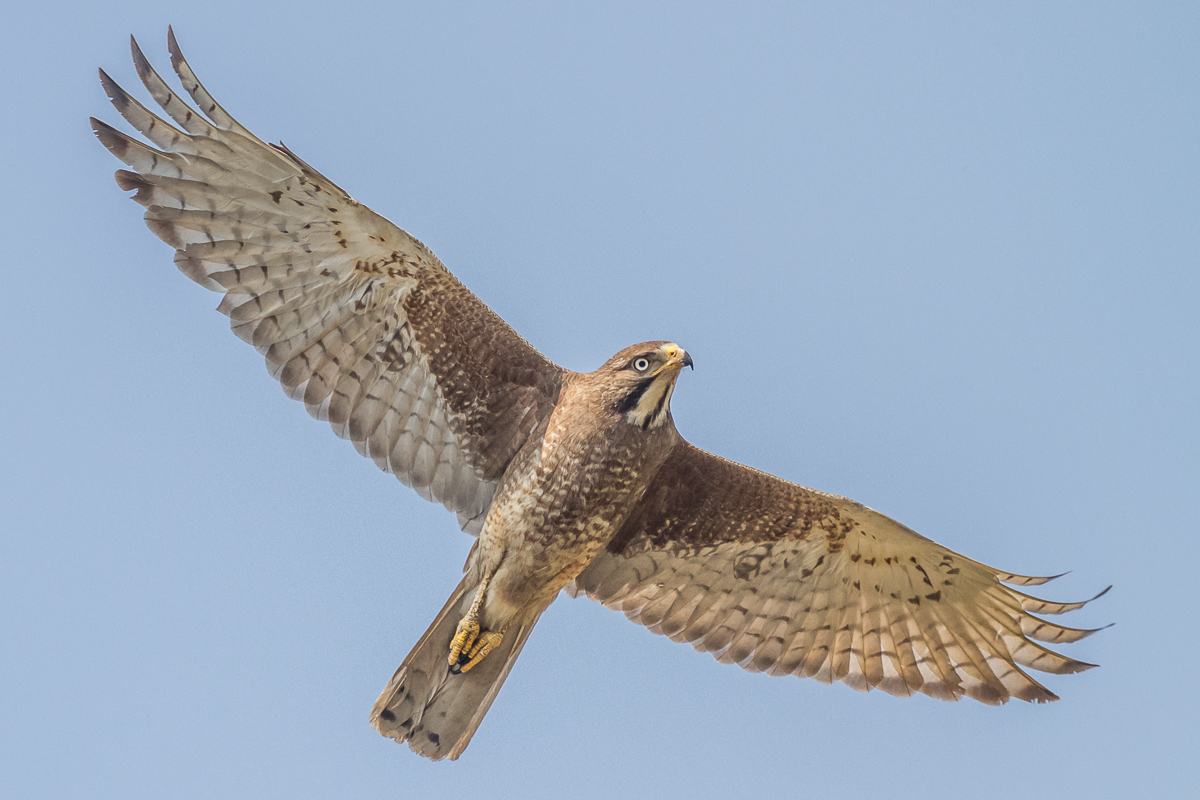
White-eyed Buzzard
- Common Name: White-eyed Buzzard
- Scientific Name: Butastur teesa
- Nepali Name(s): जमल श्येनबाज (Jamal Shyenbaaz)
- IUCN Red List Status: Least Concern (LC)
- National Red List Status: Least Concern (LC)
- CITES Appendix: Appendix II
Measurements & Physical Profile
- Body Length: 36–43 cm
- Wingspan: 86–100 cm
- Weight: 300–450 g
Did You Know?
Despite its name, the "white-eyed" buzzard doesn't actually have white eyes; its irises are a striking, bright yellow or pale straw-color. It is a compact, rather vocal raptor often identified by its habit of perching on exposed branches or fence posts in open country, where it remains quite unbothered by human activity.
Distribution & Habitat
Global Distribution
Widely distributed across the Indian subcontinent, covering most of India, Pakistan, Nepal, and parts of Bangladesh and Myanmar.
Distribution within Nepal
A common resident, primarily found in the lowlands and the inner valleys (Tarai and Siwalik). It is a bird of open landscapes, often seen in the vicinity of human settlements, farmlands, and sparse woodlands.
Preferred Habitats
Open deciduous woodland, scrublands, agricultural mosaics, and dry grasslands. It is highly adaptable and thrives in semi-arid regions where trees are scattered.
Elevational Range
Typically found in the lowlands and foothills, generally below 1,000 meters, though it occasionally strays into lower mountain valleys.
Seasonal Occurrence
Year-round resident; non-migratory. Pairs generally stay within their home range throughout the year.
Behavior & Ecology
Flight & Foraging Behavior
Exhibits a steady, direct flight style. It is a "sit-and-wait" predator, typically perching on exposed vantage points (like trees, utility poles, or rocks) to scan for prey on the ground.
Social & Roosting Habits
Generally seen singly or in pairs. They are quite vocal, especially during the breeding season, when they issue a characteristic, high-pitched "pi-pi-pi" or "tsee-tsee" call while soaring or perched.
Diet & Ecosystem Role
Diet Breakdown
An opportunistic predator with a varied prey items:
- Insects (Primary): Frequently consumes large insects, such as locusts, grasshoppers, and beetles.
- Small Vertebrates: Small rodents, lizards, and occasionally small snakes.
- Other: Sometimes takes small birds or frogs when encountered.
Ecological Role
By consuming large numbers of insects and small mammals in agricultural areas, the White-eyed Buzzard serves as a beneficial natural pest controller in rural landscapes.
Breeding Biology
The breeding season in Nepal typically occurs from February to May. During this time, pairs are highly vocal and exhibit collaborative nesting behavior, working together to construct a new, loose platform of twigs and branches each year. These nests are generally situated in the fork of a tall tree or along a leafy branch, providing ample concealment within the foliage of dry, open forests or cultivated landscapes.
The female typically lays a clutch of 2-4 unspotted white eggs. She takes on the primary responsibility of incubation, which lasts for approximately 19 to 20 days. Once the white-down-covered nestlings hatch, both parents actively participate in provisioning the young. While specific data regarding the exact fledging duration for this species remains limited in scientific literature, the chicks typically remain under parental care in and around the nest until they are ready to transition toward independence.
Migration
- Status: Resident; non-migratory.
- Movement: Established pairs exhibit high site fidelity and remain within their territories year-round.
Population Status
- Global Population Estimate: Unknown.
- Population Trend: Stable.
- National Population Estimate (Nepal): 700 – 1500 individuals.
- Monitoring & Surveys: Monitored through wintering raptor surveys, birding records and biodiversity surveys in lowland areas.
Threats
- Habitat Loss: Clearance of scattered trees in agricultural lands reduces essential perching and nesting sites.
- Pesticide Use: Secondary poisoning through the consumption of insects or rodents that have ingested toxic agricultural chemicals.
- Disturbance: Direct human persecution in some rural areas, though they are generally quite tolerant of humans.
Conservation Actions
Existing Measures
- Legal Protections: Listed under CITES Appendix II.
- Adaptability: The species’ preference for human-modified, open habitats provides a level of natural resilience.
Recommended Measures
- Tree Retention: Encouraging farmers to retain mature trees within their fields to support perching raptors.
- Sustainable Agriculture: Promoting integrated pest management to reduce the reliance on harmful pesticides.
References
- BirdLife International (2024). Species factsheet: White-eyed Buzzard Butastur teesa. Downloaded from https://datazone.birdlife.org/species/factsheet/white-eyed-buzzard-butastur-teesa on 07/08/2026
- Clark, W. S. and G. M. Kirwan (2020). White-eyed Buzzard (Butastur teesa), version 1.0. In Birds of the World (J. del Hoyo, A. Elliott, J. Sargatal, D. A. Christie, and E. de Juana, Editors). Cornell Lab of Ornithology, Ithaca, NY, USA. https://doi.org/10.2173/bow.whebuz1.01
- Ferguson-Lees, J., & Christie, D. A. (2001). Raptors of the World. Christopher Helm, London.
- Inskipp C., Baral H. S., Phuyal S., Bhatt T. R., Khatiwada M., Inskipp, T, Khatiwada A., Gurung S., Singh P. B., Murray L., Poudyal L. and Amin R. (2016). The status of Nepal’s Birds: The national red list series. Zoological Society of London, UK.
- The Peregrine Fund. (2026). White-eyed Buzzard. Available at: https://peregrinefund.org/explore-raptors-species/hawks/white-eyed-buzzard (Accessed: 7 August 2026).