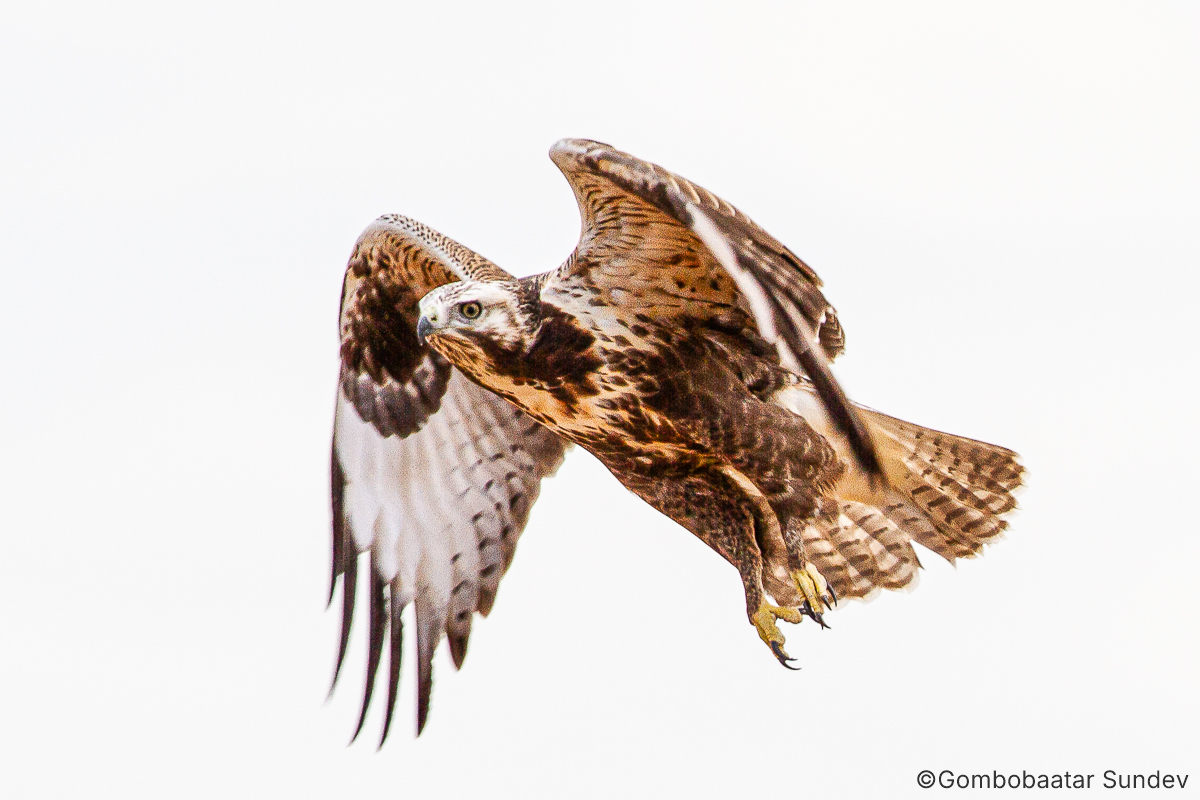
Upland Buzzard
- Common Name: Upland Buzzard
- Scientific Name: Buteo hemilasius
- Nepali Name(s): पहाडी श्येनबाज (Pahadi Shyenbaaz)
- IUCN Red List Status: Least Concern (LC)
- National Red List Status: Least Concern (LC)
- CITES Appendix: Appendix II
Measurements & Physical Profile
- Body Length: 66–71 cm
- Wingspan: 143–161 cm
- Weight: 950–2,050 g
Did You Know?
The Upland Buzzard is the largest member of the Buteo genus. It is a robust, powerful raptor often seen in high-altitude, open landscapes. It exhibits significant color variation, from pale, almost cream-colored individuals to dark, chocolate-brown morphs, making it a challenging species to identify for inexperienced observers.
Distribution & Habitat
Global Distribution
Breeds in the vast, high-altitude steppes and mountains of Central and East Asia, including Mongolia, southern Siberia, and the Tibetan Plateau. It winters across parts of northern China, the Korean Peninsula, and the Himalayas.
Distribution within Nepal
A rare winter visitor and passage migrant. Records are primarily concentrated in the high-altitude regions, including the trans-Himalayan zones (such as Mustang and Dolpa) and open, high-elevation alpine meadows.
Preferred Habitats
High-altitude open country, alpine steppes, plateaus, and rolling grassy hills. It prefers vast, treeless landscapes where it can scan for prey from the ground or low perches like rocks.
Elevational Range
Primarily found at high elevations, ranging from 3,000 to over 5,000 meters, especially during the breeding season. In winter, they may descend to lower mountain valleys.
Seasonal Occurrence
Winter visitor and passage migrant; individuals move south from the high Tibetan Plateau to escape the harshest winter conditions.
Behavior & Ecology
Flight & Foraging Behavior
A slow, soaring flyer that spends much of its time gliding over open terrain. It is a ground-focused hunter, often seen sitting on the ground (unlike many other buzzards that prefer tall trees) while waiting for prey to emerge.
Social & Roosting Habits
Usually solitary or seen in pairs. It is very tolerant of humans in some parts of its range, often perching on fence posts or low rocks near human settlements in the remote highlands.
Diet & Ecosystem Role
Diet Breakdown
- Mammals (Primary): Specializes in high-altitude rodents like pikas, voles, and ground squirrels.
- Birds & Reptiles: Opportunistically takes small ground birds and lizards.
- Carrion: Frequently scavenges on carcasses during the winter months when live prey is scarce.
Ecological Role
Serves as a key predator in high-altitude grassland ecosystems, playing an essential role in keeping populations of pikas and other rodents in check, which helps protect highland grazing pastures.
Breeding Biology
The Upland Buzzard does not breed in Nepal. In its northern breeding territories (Tibetan Plateau, Mongolia, and northern China), the breeding season typically commences between April and June. Upland Buzzard exhibits significant flexibility in its nesting site selection. Pairs characteristically construct large, robust stick nests situated on cliffs, rocky outcrops, or steep ridges. In regions where vertical features are scarce, they will readily nest on the ground or within small, low, and isolated trees or shrubs. The female typically lays a clutch of 2-4 eggs, which are incubated primarily by the female for approximately 35 to 38 days while the male focuses on territorial defence and hunting. After hatching, the fledging period lasts between 45 and 55 days. Once the young fledge, they remain dependent on their parents for several additional weeks, during which they refine their hunting skills before dispersing to establish their own territories.
Migration
- Status: Migratory; passage migrant and winter visitor.
- Movement: Performs seasonal migrations between high-altitude breeding grounds and lower, warmer wintering sites in the Himalayas and East Asia.
Population Status
- Global Population Estimate: Unknown.
- Population Trend: Stable.
- National Population Estimate (Nepal): 50 -100 individuals.
- Monitoring & Surveys: Monitored primarily through raptor migration count at Thoolakharka.
Threats
- Habitat Change: Overgrazing by livestock in high-altitude regions can reduce the availability of small mammal prey.
- Poisoning: Secondary poisoning via rodenticides used to control pikas in some high-altitude grazing areas.
- Climate Change: Potential changes in alpine ecosystems may affect the distribution of their preferred rodent prey.
Conservation Actions
Existing Measures
- Legal Protections: Listed under CITES Appendix II.
Recommended Measures
- Rodent Control Management: Ensuring rodenticide use is restricted to prevent harm to raptors.
- Landscape Preservation: Maintaining the ecological integrity of high-altitude alpine grasslands.
References
- BirdLife International (2021). Species factsheet: Upland Buzzard Buteo hemilasius. Downloaded from https://datazone.birdlife.org/species/factsheet/upland-buzzard-buteo-hemilasius on 07/08/2026
- Ferguson-Lees, J., & Christie, D. A. (2001). Raptors of the World. Christopher Helm, London.
- Inskipp C., Baral H. S., Phuyal S., Bhatt T. R., Khatiwada M., Inskipp, T, Khatiwada A., Gurung S., Singh P. B., Murray L., Poudyal L. and Amin R. (2016). The status of Nepal’s Birds: The national red list series. Zoological Society of London, UK.
- Orta, J. and G. M. Kirwan (2020). Upland Buzzard (Buteo hemilasius), version 1.0. In Birds of the World (J. del Hoyo, A. Elliott, J. Sargatal, D. A. Christie, and E. de Juana, Editors). Cornell Lab of Ornithology, Ithaca, NY, USA. https://doi.org/10.2173/bow.uplbuz1.01
- The Peregrine Fund. (2026). Upland Buzzard. Available at: https://peregrinefund.org/explore-raptors-species/hawks/upland-buzzard (Accessed: 7 August 2026).