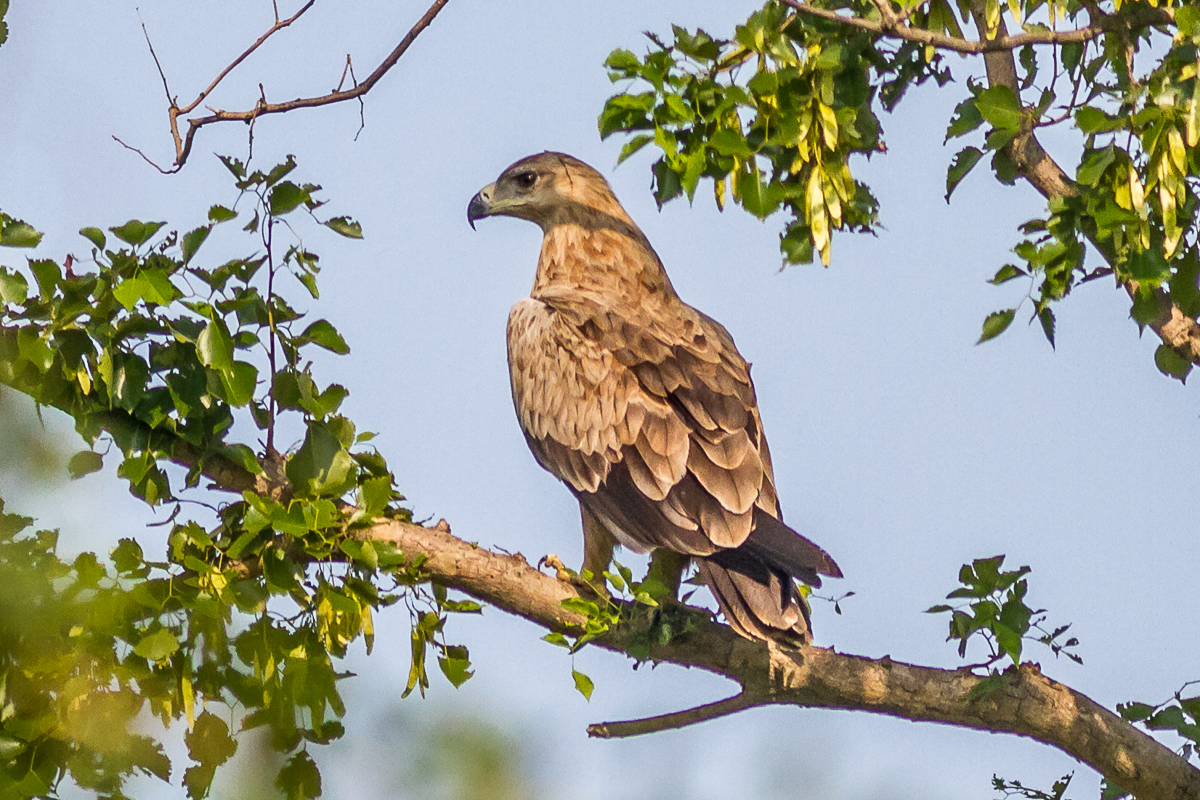
Tawny Eagle
- Common Name: Tawny Eagle
- Scientific Name: Aquila rapax (specifically the subspecies A. r. vindhiana in the South Asian region)
- Nepali Name(s): राग महाचील (Raag Mahachil)
- IUCN Red List Status: Vulnerable (VU)
- National Red List Status: Data Deficient (DD)
- CITES Appendix: Appendix II
Measurements & Physical Profile
- Body Length: 60–75 cm
- Wingspan: 159–183 cm
- Weight: 1,600 –3,100 g
Did You Know?
The Tawny Eagle is highly polymorphic, meaning individuals show significant variation in plumage color, ranging from deep rufous and tawny-brown to pale, buffish-yellow. It is frequently confused with the migratory Steppe Eagle (Aquila nipalensis), but the Tawny Eagle is generally smaller, more compact, and displays a more "neater" silhouette while perched.
Distribution & Habitat
Global Distribution
The Tawny Eagle (Aquila rapax) is widely distributed across the African continent and significant portions of the Indian subcontinent, including Pakistan, India, southern Nepal, and Myanmar.
Distribution within Nepal
In Nepal, it is classified as a rare resident. Its presence is primarily restricted to the southern Tarai region, where it occupies open landscapes and dry, scrubby areas near forest interfaces. Despite its historical range, sightings remain infrequent and localized.
Preferred Habitats
This species favors open, arid environments, such as semi-deserts, open savannahs, and cultivated plains. It is highly dependent on structural landscape features—specifically scattered mature trees or electrical poles—which serve as essential vantage points for hunting and nesting.
Elevational Range
Typically found in the lowland plains and foothills, the Tawny Eagle generally remains below 1,000 meters, though individuals may occasionally venture into higher elevations when pursuing prey or responding to resource scarcity.
Seasonal Occurrence
The population in Asia is largely sedentary and non-migratory. However, the species can exhibit irruptive behavior, undertaking local movements in response to fluctuating food availability or environmental conditions.
Behavior & Ecology
Flight and Foraging Behavior
The Tawny Eagle relies heavily on thermal soaring to traverse its territory. As an opportunistic predator, it spends a significant portion of its day perched on high vantage points, scanning the ground for movement. A notable aspect of its behavioral ecology is its propensity for kleptoparasitism; it is a notorious thief, frequently harassing other raptors to steal their captured prey.
Social & Roosting Habits
The species is typically territorial and monogamous, often maintaining life-long pair bonds. They are usually solitary or observed in pairs, though they may congregate in larger numbers around concentrated, abundant food sources, such as carrion sites or areas experiencing rodent outbreaks.
Diet & Ecosystem Role
Diet Breakdown
- Mammals (Primary): The bulk of their diet consists of small-to-medium-sized mammals, including rodents, hares, and ground squirrels.
- Carrion: They are opportunistic scavengers and will frequently feed on animal carcasses.
- Birds & Reptiles: The eagle will opportunistically hunt ground-dwelling birds and large reptiles when these prey items are seasonally abundant.
Ecological Role
As a mid-to-large predator, the Tawny Eagle plays a vital role in regulating rodent populations, thereby mitigating agricultural damage. Additionally, as a scavenger, it contributes to the sanitary maintenance of its habitat by removing carrion that might otherwise harbor disease.
Breeding Biology
The breeding season in Nepal typically spans from February to April. Pairs exhibit strong, long-term territorial and site fidelity, often repairing and reusing the same large, bulky stick nests in subsequent years. These nests are constructed in the crowns of tall, isolated trees, providing a commanding view of the surrounding foraging landscape. The female typically lays a clutch of one to three eggs, which are incubated primarily by the female for approximately 45 days, while the male remains responsible for guarding the territory and provisioning the pair. Chicks are cared for by both parents, remaining in the nest for a fledging time of approximately 76 to 85 days (about 11 to 12 weeks). Even after taking their first flights, the young continue to rely on their parents for an additional six weeks until they attain full independence.
Migration
- Status: Largely resident and non-migratory.
- Movement: Unlike the Steppe Eagle, which performs extensive long-distance migrations, the Tawny Eagle remains sedentary, dispersing only locally to track shifting food supplies.
Population Status
- Global Population Estimates: 100,000 – 500,000 mature individuals.
- Population Trend: Decreasing.
- National Population Estimates (Nepal): Unknown.
- Monitoring: No specific monitoring activities.
Threats
- Poisoning: A major threat is secondary poisoning resulting from the consumption of carcasses treated with toxic veterinary drugs or baits intended for other predators.
- Habitat Loss: The conversion of open grasslands and scrublands into intensive agricultural zones or urban infrastructure destroys critical foraging and nesting territory.
- Infrastructure: Collisions with power lines and electrocution on transmission towers present a continuous mortality risk.
Conservation Actions
Existing Measures
- Legal Protection: Listed under CITES Appendix II, which provides a mechanism to monitor and regulate international trade.
- Protected Area Foothold: Established populations exist within various national parks across the Tarai, which serve as core safe zones.
Recommended Measures
- Toxin Regulation: Continued, rigorous advocacy for the phase-out of toxic veterinary medications in favor of non-toxic alternatives.
- Landscape Conservation: Prioritize the maintenance of open habitat corridors that retain scattered large trees, ensuring the availability of suitable nesting and perching sites.
References
- BirdLife International (2021). Species factsheet: Tawny Eagle Aquila rapax. Downloaded from https://datazone.birdlife.org/species/factsheet/tawny-eagle-aquila-rapax on 05/08/2026
- Ferguson-Lees, J., & Christie, D. A. (2001). Raptors of the World. Christopher Helm, London.
- Inskipp C., Baral H. S., Phuyal S., Bhatt T. R., Khatiwada M., Inskipp, T, Khatiwada A., Gurung S., Singh P. B., Murray L., Poudyal L. and Amin R. (2016). The status of Nepal’s Birds: The national red list series. Zoological Society of London, UK.
- Kemp, A. C. and G. M. Kirwan (2020). Tawny Eagle (Aquila rapax), version 1.0. In Birds of the World (J. del Hoyo, A. Elliott, J. Sargatal, D. A. Christie, and E. de Juana, Editors). Cornell Lab of Ornithology, Ithaca, NY, USA. https://doi.org/10.2173/bow.taweag1.01
- Naoroji, R. (2006). Birds of Prey of the Indian Subcontinent. Om Books International, New Delhi.