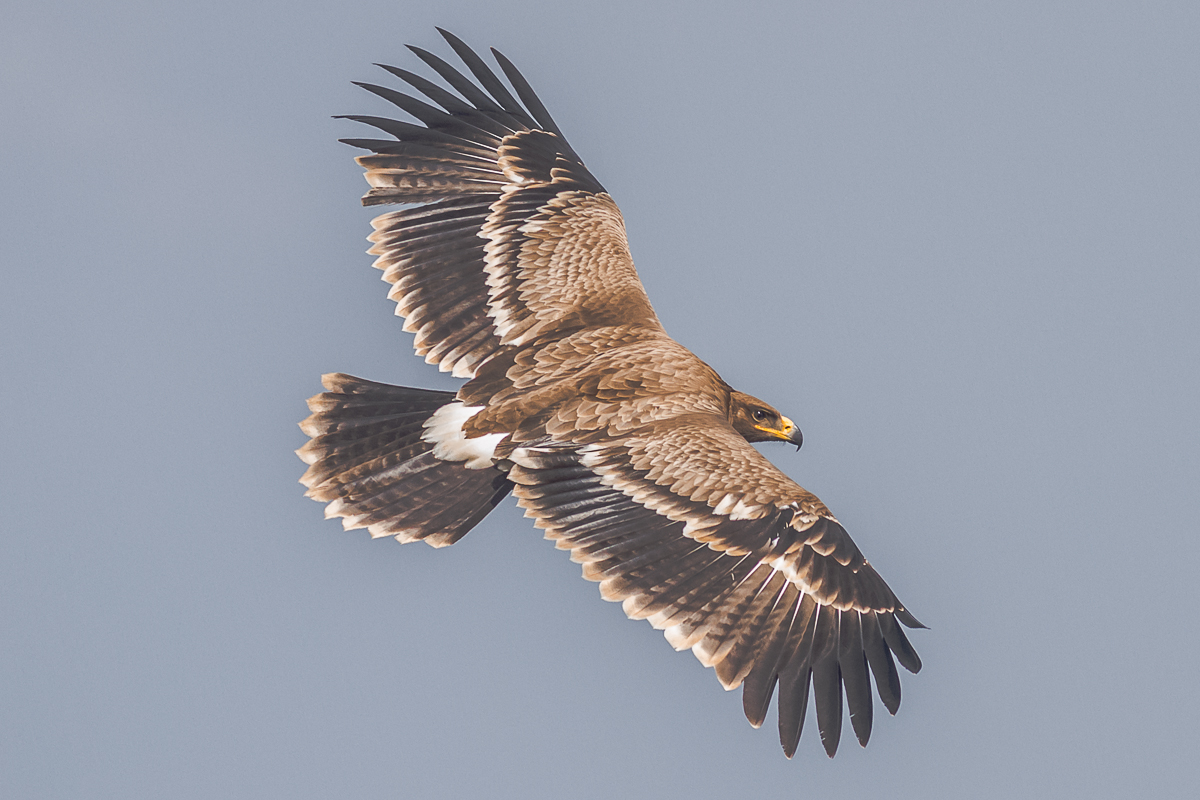
Steppe Eagle
- Common Name: Steppe Eagle
- Scientific Name: Aquila nipalensis
- Nepali Name(s): गोमायु महाचिल (Gomayu Mahachil)
- IUCN Red List Status: Endangered (EN)
- National Red List Status: Vulnerable (VU)
- CITES Appendix: Appendix I
- CMS Appendix: Appendix I
Measurements & Physical Profile
- Body Length: 60–81 cm
- Wingspan: 165–214 cm
- Weight: 2,000 –4,900 g
Did You Know?
Despite being a massive, powerful boot-legged eagle, the Steppe Eagle has an unusually wide, deep-set yellow gape (the fleshy corner of its mouth) that extends all the way back past its eye. This distinct facial feature gives it a permanent "frown" and allows it to swallow massive chunks of meat and entire rodents whole. Remarkably, it is highly gregarious; during migration and wintering, hundreds of these majestic eagles will cast aside their solitary nature to gather on the ground at landfill sites, processing dumps, and carcass hot-spots to feed alongside vultures!
Distribution & Habitat
Global Distribution
The Steppe Eagle breeds across a vast steppe belt stretching from Romania, Moldova, and Ukraine, eastward through the Russian Federation, Kazakhstan, and Mongolia, into northern China. It is a long-distance migrant; western populations winter in East and Southern Africa, while eastern populations travel across the Himalayas to winter throughout the Indian Subcontinent and parts of Southeast Asia.
Distribution within Nepal
In Nepal, the Steppe Eagle is a highly conspicuous and common autumn passage migrant and winter visitor. It is distributed broadly along the mid-hill ridges, wide mountain valleys, and the lowland Tarai plains. It is famous for concentrated seasonal occurrences around major urban hubs, including the Pokhara and Kathmandu Valleys, and around landfill sites in Central-West Nepal.
Preferred Habitats
- Migration & Wintering: Open landscapes, semi-arid plains, savanna grasslands, agricultural fields, and heavily modified areas like municipal dump sites, landfills, and carcass disposal hotspots.
- Breeding Grounds (Global): Open, flat dry steppes, desert margins, and low rocky hillsides. It entirely avoids dense, contiguous interior forest tracts.
Elevational Range
Regularly found foraging and roosting from the lowlands at 100 meters up to 2,200 meters in mid-hill valleys. During its grueling autumn migration, thousands are recorded soaring over high mountain passes and trans-Himalayan ridges well above 3,000 to 5,000 meters above sea level.
Seasonal Occurrence
Primarily present in Nepal from October through April. Outbound autumn passage peaks sharply between October and November, after which a substantial wintering population settles in the country until early spring before returning north.
Behavior & Ecology
Flight & Foraging Behavior
The flight of the Steppe Eagle is heavy, powerful, and majestic, characterized by long, broad wings with deeply "fingered" primary feathers and a slightly rounded tail. When soaring, it typically holds its wings flat or slightly drooped at the tips. It is a highly opportunistic hunter and scavenger. While it can capture live prey by low-altitude quartering or walking along the ground to raid rodent burrows, it heavily relies on scavenging animal carcasses and pirating food (kleptoparasitism) from other raptors.
Social & Roosting Habits
Remarkably social for an Aquila eagle, it routinely aggregates in large loose flocks where food is abundant. Hundreds can gather at a single landfill site or carcass dump. They form large communal roosts at night, perched on tall trees, sand dunes, or high-voltage electricity pylons bordering agricultural fields. They are non-territorial during the wintering phase, focusing almost entirely on energy conservation and foraging efficiency.
Diet & Ecosystem Role
Diet Breakdown
The Steppe Eagle adapts its diet significantly based on seasonal availability:
- Carrion & Refuse (Primary in Winter): Livestock carcasses, slaughterhouse offal, and discarded organic kitchen waste at municipal dump sites.
- Mammals: Ground squirrels, sousliks, pikas, voles, and hares (the mainstay of their Palearctic breeding diet).
- Birds & Reptiles: Ground-dwelling birds, nestlings, lizards, and snakes taken opportunistically.
- Insects: Swarming termites and locusts, which they eagerly hop along the ground to catch during massive insect irruptions.
Ecological Role
As a high-volume scavenger and rodent predator, the Steppe Eagle provides indispensable ecosystem cleanup services. In its wintering grounds, it accelerates carcass removal alongside vultures, which severely suppresses the spread of soil and water-borne pathogens like anthrax. In agricultural areas, its predation on rodents acts as a vital biological check against field pests.
Breeding Biology
(Note: The Steppe Eagle does not breed within Nepal; the following describes its northern breeding biology).
The breeding season occurs in the Palearctic steppes from April to August. Courtship features heavy, soaring duets, steep power dives, and mutual circling over the open plains, accompanied by occasional hoarse barking calls.
Because they nest in vast, treeless landscapes, they build large, bulky platform nests primarily on the ground, on low rocky outcrops, small mounds, haystacks, or low bushes. Nests are made of sticks, twigs, and weed stalks, heavily lined with old camel dung, rags, wool, paper, and skin fragments. The female lays a clutch of 1 to 3 chalky-white eggs, spotted with brown. Incubation lasts approximately 39 to 45 days and is performed primarily by the female, while the male provisions the nest. The chicks grow quickly to maximize the short steppe summer, reaching their fledging stage and leaving the nest roughly 55 to 65 days after hatching.
Migration
- Status: Fully migratory passage migrant and winter visitor.
- Routes: Eastern Palearctic populations fly south-southwest, funneling across the Himalayan mountain chain along a broad front. A massive, world-famous migratory bottleneck occurs along the mid-hill ridges of Nepal, where eagles slide westward along the Himalayas before dropping into wintering valleys.
- Timing: Autumn migration peaks through Nepal between mid-October and late November; the return spring migration northward occurs between March and May.
- Important Stopover Sites: High-altitude ridge watch sites—such as the Thoolakharka watch site near Pokhara—serve as critical monitoring points where thousands of migrating Steppe Eagles are counted annually.
Population Status
- Global Population Estimate: 50,000 - 75,000 mature individuals.
- Population Trend: Decreasing.
- National Population Estimate (Nepal): 10,000 – 20,000 individuals.
- Monitoring & Surveys: Rigorously monitored through autumn raptor migration counts along the mid-hill ridges (Thoolakharka Nepal) and via targeted counts at landfill monitoring sites in Western and Central Nepal.
Threats
- Electrocution & Pylon Collisions: The rapid expansion of uninsulated high-voltage transmission lines across open steppes and mid-hill ridges is a leading cause of mortality; eagles frequently get electrocuted when using pylons as roosts.
- Poisoning: Highly vulnerable to secondary poisoning from agricultural pesticides, veterinary drugs in livestock carcasses, and rodenticides targeting field pests.
- Habitat Loss & Agricultural Transformation: Conversion of virgin steppe grasslands into intensive monoculture agricultural tracts destroys their primary rodent prey base.
- Landfill Hazards: Ingestion of hazardous plastics, glass fragments, and chemical toxins while foraging at poorly managed open municipal waste dumps.
Conservation Actions
Existing Measures
- Highest Global Safeguards: Upgraded to CITES Appendix I and listed under Appendix I of the Convention on Migratory Species (CMS), granting it maximum international legal protection against trade and persecution.
- Flyway Monitoring: Long-term migration counts in Nepal provide critical annual population index data for global raptor databases.
Recommended Measures
- Insulating Energy Infrastructure: Mandating the insulation of electrical crossarms and retrofitting bird-safe configurations on utility poles along known raptor migratory corridors and landfill zones.
- Safe Waste Disposal Management: Upgrading open municipal dumps near raptor hubs (like Pokhara) into covered, eco-safe waste processing plants to prevent toxic ingestion.
- Carcass Safety Programs: Expanding Vulture Safe Zone principles to monitor and eliminate toxic NSAIDs and poisons from open livestock carcass disposal sites where eagles feed.
- Transboundary Conservation Policy: Enhancing international coordination between breeding nations (Russia, Kazakhstan, Mongolia) and wintering nations (India, Nepal) to secure unhindered flyway corridors.
References
- BirdLife International (2021). Species factsheet: Steppe Eagle Aquila nipalensis. Downloaded from https://datazone.birdlife.org/species/factsheet/steppe-eagle-aquila-nipalensis on 05/08/2026
- Ferguson-Lees, J., & Christie, D. A. (2001). Raptors of the World. Christopher Helm, London.
- Inskipp C., Baral H. S., Phuyal S., Bhatt T. R., Khatiwada M., Inskipp, T, Khatiwada A., Gurung S., Singh P. B., Murray L., Poudyal L. and Amin R. (2016). The status of Nepal’s Birds: The national red list series. Zoological Society of London, UK.
- Meyburg, B.-U., P. F. D. Boesman, J. S. Marks, and C. J. Sharpe (2020). Steppe Eagle (Aquila nipalensis), version 1.0. In Birds of the World (J. del Hoyo, A. Elliott, J. Sargatal, D. A. Christie, and E. de Juana, Editors). Cornell Lab of Ornithology, Ithaca, NY, USA. https://doi.org/10.2173/bow.steeag1.01
- Naoroji, R. (2006). Birds of Prey of the Indian Subcontinent. Om Books International, New Delhi.