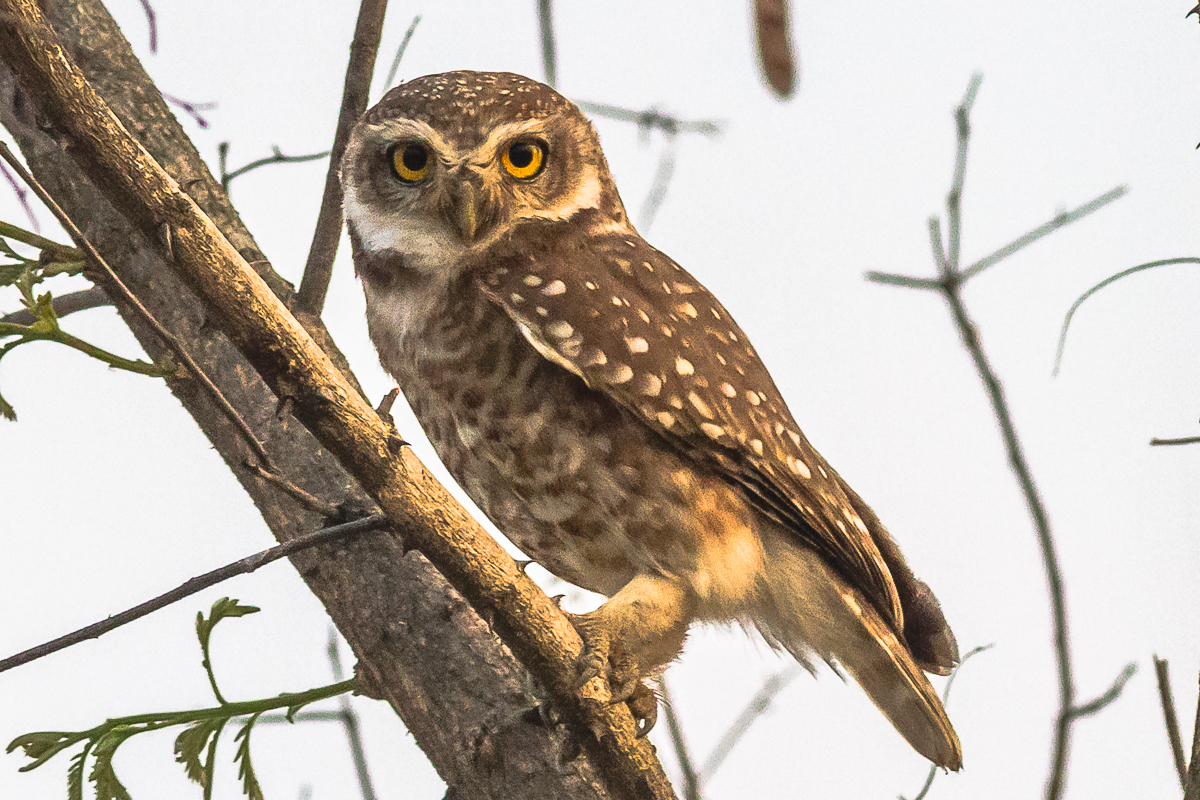
Spotted Owlet
- Common Name: Spotted Owlet
- Scientific Name: Athene brama
- Nepali Name(s): कोचलगाँडे लाटोकोसेरो (Kochalgande Latokosero)
- IUCN Red List Status: Least Concern (LC)
- National Red List Status: Least Concern (LC)
- CITES Appendix: Appendix II
Measurements & Physical Profile
- Body Length: 19–21 cm
- Wingspan: 40–50 cm
- Weight: 110–115 g
Did You Know?
The Spotted Owlet is perhaps the most familiar owl in Nepal, often seen perched on electric wires or buildings in villages and towns after dusk. Unlike many other owls, it is quite social and can often be seen in small groups, frequently engaging in animated displays of head-bobbing and chattering.
Distribution & Habitat
Global Distribution
The Spotted Owlet (Athene brama) is widely distributed across tropical South and Southeast Asia. Its range extends from Iran and Pakistan east through India, Nepal, Bangladesh, Bhutan, Myanmar, Cambodia, Laos, Thailand, and Vietnam. The species is highly adaptable and thrives in both natural and human-modified landscapes, making it one of the most common owls across its range.
Distribution within Nepal
The Spotted Owlet is a common and widespread resident throughout Nepal's Terai, Siwalik foothills, and lower mid-hills. It is frequently encountered in agricultural landscapes, villages, urban parks, orchards, and forest edges, where suitable nesting cavities are available. The species is particularly common in densely populated lowland districts and is often one of the most frequently observed owls around human settlements. Although most records are below 1,500 m, it occasionally occurs at higher elevations in suitable valleys.
Preferred Habitats
The Spotted Owlet inhabits open woodlands, farmland, orchards, scrublands, village groves, urban parks, and human settlements. It prefers landscapes with scattered mature trees, old buildings, rocky outcrops, or other structures that provide nesting and roosting cavities. Dense forests are generally avoided, whereas agricultural mosaics and suburban environments often support high population densities because of abundant prey and nesting sites.
Elevational Range
The species commonly occurs from sea level to about 1,500 m, although it has been recorded up to 2,300–2,400 m in parts of its range. In Nepal, it is most abundant in the lowlands and lower hills, with occasional records from higher mountain valleys where suitable habitats exist.
Seasonal Occurrence
The Spotted Owlet is a year-round resident throughout Nepal and does not undertake seasonal migrations. Adults occupy permanent territories and remain close to their nesting sites throughout the year. Seasonal changes mainly influence breeding activity rather than distribution, with courtship beginning in late winter and breeding continuing through spring.
Behavior & Ecology
Flight & Foraging Behavior
The Spotted Owlet is primarily crepuscular and nocturnal, although it is frequently active during daylight, especially on cloudy days or when disturbed. It hunts from exposed perches such as fence posts, utility poles, and tree branches before making short, undulating flights to capture prey on the ground or in the air. Its diet and hunting behavior make it highly adaptable to both rural and urban environments.
Social & Roosting Habits
Unlike most owls, the Spotted Owlet is relatively social, often occurring in pairs or small family groups. During the day, individuals roost communally in tree hollows, cavities in old buildings, rock crevices, or abandoned woodpecker holes. They are highly territorial during the breeding season and communicate using a variety of whistles, chattering calls, and harsh alarm notes.
Diet & Ecosystem Role
Diet Breakdown
The Spotted Owlet is an opportunistic predator with a varied diet consisting mainly of:
- Insects (primary): beetles, grasshoppers, crickets, moths, termites, and other large insects.
- Small mammals: mice, rats, and shrews.
- Reptiles and amphibians: lizards, geckos, frogs, and small snakes.
- Birds and other prey: small birds, nestlings, earthworms, and occasionally bats.
Ecological Role
The Spotted Owlet provides important ecosystem services by controlling populations of agricultural pests, particularly insects and rodents around croplands and villages. Its adaptability to human-dominated landscapes makes it an effective natural biological control agent, reducing reliance on chemical pesticides. The species also serves as an indicator of healthy agroecosystems with adequate nesting trees and prey resources.
Breeding Biology
Breeding generally occurs between November and May, with peak nesting from February to April. The species is a cavity nester, utilizing natural tree hollows, abandoned woodpecker or barbet holes, rock crevices, and cavities in buildings. Females usually lay 2–5 white eggs, incubating them for about 28–32 days, while males provide food. Both parents care for the chicks, which fledge in 30–32 days after hatching but remain dependent on adults for 3 weeks after fledging. Pairs often reuse the same nesting cavity in successive years.
Migration
- Status: Resident (non-migratory).
- Movement: Adults are highly sedentary, maintaining permanent territories throughout the year. Juveniles disperse short distances after fledging to establish their own breeding territories, but no long-distance seasonal migration occurs.
Population Status
- Global Population: Unknown.
- Population Trend: Stable.
- National Population Estimates (Nepal): Unknown.
- Monitoring: Frequently recorded in bird surveys, urban biodiversity assessments, and citizen-science platforms, making it one of Nepal's best-documented owl species.
Threats
- Loss of Nesting Sites: Removal of mature hollow-bearing trees, renovation of old buildings, and urban expansion reduce available nesting and roosting cavities.
- Pesticides and Rodenticides: Intensive pesticide use decreases insect prey and exposes owls to secondary poisoning through contaminated rodents.
- Human Persecution and Illegal Trade: Although generally tolerated, Spotted Owlets are sometimes captured for the illegal pet trade or persecuted because of superstitions and their use in traditional rituals.
- Road Mortality: Increasing traffic in urban and rural areas results in occasional collisions with vehicles, particularly during nocturnal foraging.
Conservation Actions
Existing Measures
- Legal Protection: Listed under CITES Appendix II, regulating international trade.
- Protected Areas: Occurs in numerous protected areas throughout Nepal but also thrives outside reserves due to its adaptability.
- National Conservation: Included in Nepal's Owl Conservation Action Plan (2020–2029), which addresses threats from illegal trade and persecution.
Recommended Measures
- Protect Nesting Cavities: Retain mature cavity-bearing trees and preserve old structures suitable for nesting in agricultural and urban landscapes.
- Reduce Pesticide Use: Promote integrated pest management to minimize secondary poisoning and maintain insect prey populations.
- Public Awareness: Increase education to dispel myths about owls, reduce persecution, and discourage illegal capture and trade.
- Long-term Monitoring: Encourage citizen-science monitoring and regular surveys to track population trends and breeding success. References
References
- BirdLife International (2024). Species factsheet: Spotted Owlet Athene brama. Downloaded from https://datazone.birdlife.org/species/factsheet/spotted-owlet-athene-brama on 09/08/2026
- Holt, D. W., R. Berkley, C. Deppe, P. L. Enríquez, J. L. Petersen, J. L. Rangel Salazar, K. P. Segars, K. L. Wood, E. de Juana, and J. S. Marks (2020). Spotted Owlet (Athene brama), version 1.0. In Birds of the World (J. del Hoyo, A. Elliott, J. Sargatal, D. A. Christie, and E. de Juana, Editors). Cornell Lab of Ornithology, Ithaca, NY, USA. https://doi.org/10.2173/bow.spoowl1.01
- Inskipp C., Baral H. S., Phuyal S., Bhatt T. R., Khatiwada M., Inskipp, T, Khatiwada A., Gurung S., Singh P. B., Murray L., Poudyal L. and Amin R. (2016). The status of Nepal’s Birds: The national red list series. Zoological Society of London, UK.