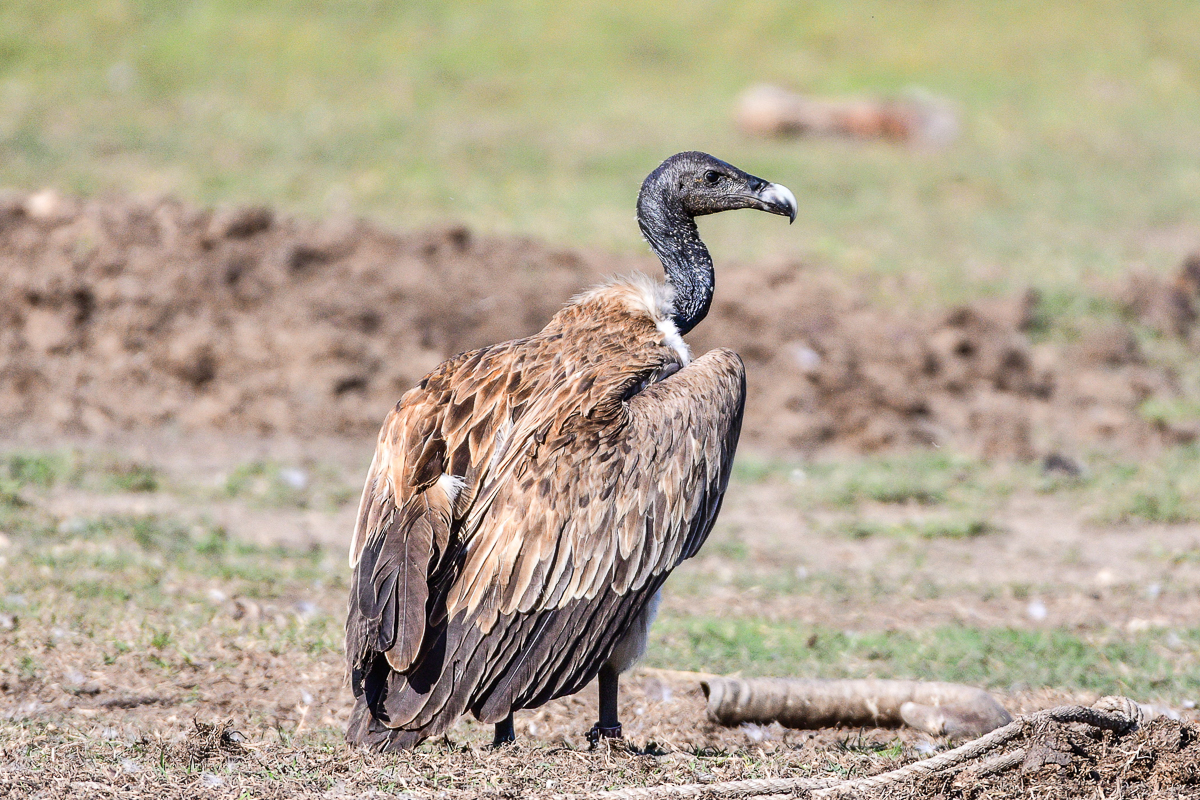
Slender-billed Vulture
- Common Name: Slender-billed Vulture
- Scientific Name: Gyps tenuirostris
- Nepali Name(s): सानो खैरो गिद्ध (Sano Thunde Giddha)
- IUCN Red List Status: Critically Endangered (CR)
- National Red List Status: Critically Endangered (CR)
- CITES Appendix: Appendix II
Measurements & Physical Profile
- Body Length: 80–103 cm
- Wingspan: 196–258 cm
- Weight: 4-7 kg
Did You Know?
The Slender-billed Vulture is a mid-sized, "scruffy-looking" vulture known for its long, thin, bare black neck and head. It is visually distinct from its sister species, the Indian Vulture, by its angular, narrow head and finer bill. It is a tree-nesting specialist, preferring to build its nests in tall, mature trees rather than on the cliffs favored by many other Gyps species.
Distribution & Habitat
Global Distribution
The Slender-billed Vulture is native to the sub-Himalayan regions and Southeast Asia. Once widespread, it now persists as critically endangered, with remaining wild populations restricted to northern and eastern India, southern Nepal, Bangladesh, and a small, isolated population in Myanmar and Combodia.
Distribution within Nepal
In Nepal, this species is a very rare resident, primarily restricted to the lowland Tarai and inner valleys. Recent status assessments indicate that the population is highly fragmented, with sightings largely limited to specific western and mid-western districts where intensive in-situ conservation efforts—such as vulture safe feeding zones—are currently being implemented.
Preferred Habitats
The species favors open country, arid savannas, and areas characterized by scattered woodland patches at lower elevations. They historically relied on carrion found near slaughterhouses and small rural settlements; however, they generally exhibit a preference for quieter, semi-natural landscapes and typically avoid the dense, high-activity environments of major urban centers.
Elevational Range
The Slender-billed Vulture is an inhabitant of the lowlands and foothills of the Tarai region, generally remaining within an elevational range below 1,000 meters.
Seasonal Occurrence
The species is a year-round resident. While they do not undertake long-distance seasonal migrations, individuals may travel moderate distances across their home range when scouting for food or locating stable nesting territories.
Behavior & Ecology
Flight and Foraging Behavior
The Slender-billed Vulture exhibits the powerful, majestic soaring flight characteristic of Gyps vultures, skillfully utilizing thermal updraughts to gain altitude and survey expansive landscapes. As an obligate scavenger, it relies on its exceptionally keen eyesight to detect carcasses from great heights. Once a food source is identified, it descends to join other scavengers, utilizing its slender beak—a distinct adaptation—to access soft tissues from carcass parts that bulkier vulture species may struggle to reach.
Social and Roosting Habits
Unlike the colonial, cliff-nesting behavior observed in some other vulture species, the Slender-billed Vulture is a solitary nester. They construct large, compact, and sturdy stick nests situated high in the canopy of tall, mature trees, typically at heights ranging from 7 to 25 meters. These nesting sites are chosen for their concealment and accessibility, allowing the birds to maintain vigilance over their immediate surroundings while resting or tending to their single offspring.
Diet & Ecosystem Role
Diet Breakdown
- Carrion (Primary): Almost exclusively feeds on the carcasses of dead livestock and wild animals.
Ecological Role
Acts as "nature’s clean-up crew." By efficiently disposing of rotting carcasses, they prevent the spread of diseases (such as anthrax and rabies) to humans and other wildlife, playing a vital role in ecosystem hygiene.
Breeding Biology
The Slender-billed Vulture typically begins its breeding season in the late autumn, with egg-laying occurring between November and March. Unlike colonial nesters, this species is solitary, constructing a bulky, well-concealed platform nest high in the canopy of large, mature trees like Bombax ceiba. A single egg is laid, which both parents incubate for approximately 45 to 50 days. The chick remains in the nest for a prolonged fledging period of about 90 to 120 days, during which time the parents provide intensive care before the young finally venture out to forage.
Migration
- Status: Sedentary (non-migratory).
- Movement: Individuals generally stay within a local home range, although they may traverse borders in search of food.
Population Status
- Global Population Estimate: 730 - 870 mature individuals.
- National Population Estimate (Nepal): 50–75 individuals.
- Monitoring & Surveys: Extensively monitored by different organizations through "vulture restaurants," satellite tracking, and population counts in key districts like Nawalparasi, Dang, and Kapilvastu.
Threats
- Diclofenac Poisoning: The primary cause of the catastrophic >99% population decline across South Asia. The use of the non-steroidal anti-inflammatory drug (NSAID) diclofenac in livestock causes fatal kidney failure in vultures.
- Alternative Toxic Drugs: Other NSAIDs like ketoprofen and nimesulide remain threats despite the ban on diclofenac.
- Habitat Loss: The loss of tall, mature trees suitable for nesting and the decline in traditional livestock rearing practices.
Conservation Actions
Existing Measures
- Vulture Safe Zones: Establishment of "vulture restaurants" (safe feeding sites) that provide carcass-free diclofenac.
- Legal Protections: The government of Nepal has banned veterinary diclofenac and declared most districts "diclofenac-free."
- Captive Breeding: Ongoing national and regional efforts to maintain a safety-net population.
- Research and Monitoring: GPS transmitters based study to study habitats, movements and threats, breeding ecology and success study, population monitoring.
Recommended Measures
- Community Stewardship: Continued support for Community Forest User Groups (CFUGs) to protect nesting trees.
- Drug Monitoring: Rigorous enforcement and monitoring of veterinary pharmacy stock to ensure toxic alternatives are replaced with meloxicam.
References
- BirdLife International (2021). Species factsheet: Slender-billed Vulture Gyps tenuirostris. Downloaded from https://datazone.birdlife.org/species/factsheet/slender-billed-vulture-gyps-tenuirostris on 05/08/2026
- del Hoyo, J., N. Collar, and J. S. Marks (2020). Slender-billed Vulture (Gyps tenuirostris), version 1.0. In Birds of the World (J. del Hoyo, A. Elliott, J. Sargatal, D. A. Christie, and E. de Juana, Editors). Cornell Lab of Ornithology, Ithaca, NY, USA. https://doi.org/10.2173/bow.slbvul1.01
- Ferguson-Lees, J., & Christie, D. A. (2001). Raptors of the World. Christopher Helm, London.
- Inskipp C., Baral H. S., Phuyal S., Bhatt T. R., Khatiwada M., Inskipp, T, Khatiwada A., Gurung S., Singh P. B., Murray L., Poudyal L. and Amin R. (2016). The status of Nepal’s Birds: The national red list series. Zoological Society of London, UK.
- Naoroji, R. (2006). Birds of Prey of the Indian Subcontinent. Om Books International, New Delhi.
- The Peregrine Fund (2026) Slender-billed Vulture. Available at: https://peregrinefund.org/explore-raptors-species/vultures/slender-billed-vulture (Accessed: 5 August 2026).