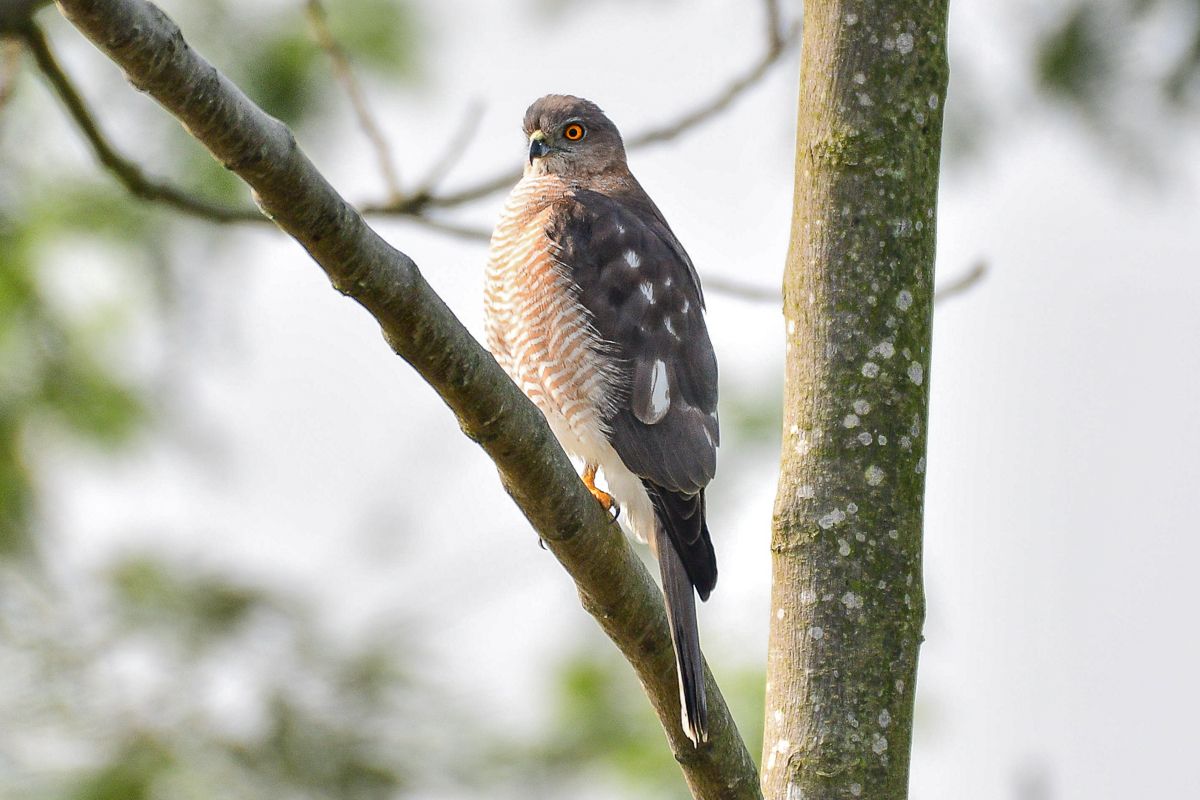
Shikra
- Common Name: Shikra
- Scientific Name: Tachyspiza badia
- Nepali Name(s): शिक्रा (Shikra)
- IUCN Red List Status: Least Concern (LC)
- National Red List Status: Least Concern (LC)
- CITES Appendix: Appendix II
- CMS Appendix: Not listed
Measurements & Physical Profile
- Body Length: 25–44.5 cm
- Wingspan: 48–68 cm
- Weight: 100–266 g
Did You Know?
The Shikra is the most commonly seen member of the Accipiter genus in Nepal, often found in human-altered landscapes. It is a bold and aggressive predator, well-known for its distinctive "chi-chi-chi" call and its ability to hunt in small, fragmented garden patches or urban groves where other raptors would shy away.
Distribution & Habitat
Global Distribution
Widely distributed across South and Southeast Asia, and throughout much of sub-Saharan Africa.
Distribution within Nepal
A common resident breeder throughout the lowlands, inner valleys, and lower hill regions of Nepal. It is frequently observed in open woodlands, forest fringes, and even suburban areas.
Preferred Habitats
Open deciduous woodlands, orchards, plantations, suburban gardens, and agricultural landscapes with scattered mature trees. It is highly adaptable and thrives in environments where forest patches are interspersed with open areas.
Elevational Range
Primarily occurs in the tropical and subtropical belts, ranging from the lowlands up to approximately 1,500 meters above sea level.
Seasonal Occurrence
Year-round resident. They are non-migratory and maintain small, permanent territories throughout the year.
Behavior & Ecology
Flight & Foraging Behavior
Exhibits the typical Accipiter flight style: short, rapid bursts of wingbeats followed by a graceful, flat glide. It is a highly agile hunter, often darting through trees to surprise prey.
Social & Roosting Habits
Typically seen in pairs during the breeding season and solitary otherwise. They are generally bold and vocal, often advertising their presence from a high, exposed perch.
Diet & Ecosystem Role
Diet Breakdown
The Shikra is a versatile, opportunistic predator:
- Insects (Primary): Frequently hunts large insects, including locusts, beetles, and cicadas.
- Small Vertebrates: Small birds, rodents, lizards, and even small snakes are regularly taken.
- Other: Occasionally feeds on small chicks of birds found in rural or semi-urban areas.
Ecological Role
As a common predator in human-influenced landscapes, the Shikra plays a vital role in natural pest control, helping to regulate populations of insects and small rodents that may impact agricultural crops or local garden health.
Breeding Biology
The breeding season in Nepal occurs from March to June. Pairs construct small stick nests in the forks of trees, often using mango, Acacia, or other common village trees. The female lays 3 to 5 bluish-white eggs. Incubation lasts approximately 28 to 30 days, and the chicks fledge after 30 to 35 days.
Migration
- Status: Resident; non-migratory.
- Movement: Established pairs stay within their home territories year-round, showing high site fidelity.
Population Status
- Global Population Estimate: 500,000 – 1,000,000 mature individuals.
- Population Trend: Stable.
- National Population Estimate (Nepal): Unknown.
- Monitoring & Surveys: Monitored through birding records and systematic counts in urban and rural forest-edge habitats.
Threats
- Pesticide Use: Secondary poisoning through the consumption of insects or rodents that have ingested insecticides and rodenticides.
- Habitat Fragmentation: While the Shikra is adaptable, the excessive loss of mature trees in suburban areas reduces essential nesting sites.
- Disturbance: Direct human persecution or nest disturbance in rural areas remains an occasional threat.
Conservation Actions
Existing Measures
- Legal Protection: The species is listed under CITES Appendix II, which provides a framework for regulating international trade to ensure that commercial activities do not threaten the viability of wild populations.
- Protected Area Network: A significant portion of the species’ range is encompassed within Nepal’s national protected area system. These areas provide vital habitat security by enforcing strict anti-poaching measures.
Recommended Measures
- Organic Practices: Encouraging reduction of pesticides in gardens and agricultural areas to protect prey health.
- Nest Protection: Promoting awareness among local communities to preserve nesting trees in rural settings.
References
- BirdLife International (2021). Species factsheet: Shikra Accipiter badius. Downloaded from https://datazone.birdlife.org/species/factsheet/shikra-accipiter-badius on 06/08/2026
- Ferguson-Lees, J., & Christie, D. A. (2001). Raptors of the World. Christopher Helm, London.
- Inskipp C., Baral H. S., Phuyal S., Bhatt T. R., Khatiwada M., Inskipp, T, Khatiwada A., Gurung S., Singh P. B., Murray L., Poudyal L. and Amin R. (2016). The status of Nepal’s Birds: The national red list series. Zoological Society of London, UK.
- Kemp, A. C. and G. M. Kirwan (2024). Shikra (Tachyspiza badia), version 1.1. In Birds of the World (J. del Hoyo, A. Elliott, J. Sargatal, D. A. Christie, and E. de Juana, Editors). Cornell Lab of Ornithology, Ithaca, NY, USA. https://doi.org/10.2173/bow.shikra1.01.1
- Naoroji, R. (2006). Birds of Prey of the Indian Subcontinent. Om Books International, New Delhi.