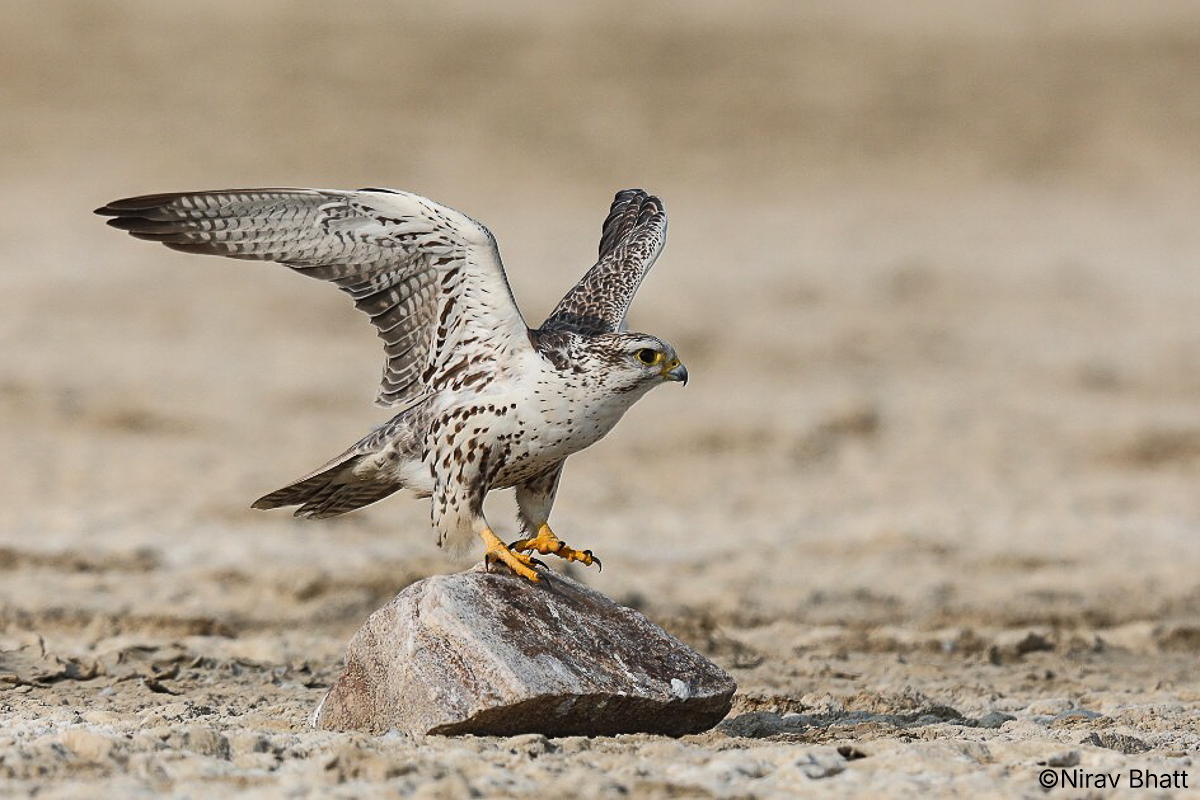
Saker Falcon
- Common name: Saker Falcon
- Scientific Name: Falco cherrug
- Nepali Name(s): तोप बाज (Top Baaz)
- IUCN Red List Status: Endangered (EN)
- National Red List Status: Endangered (EN)
- CITES Appendix: Appendix II
- CMS Appendix: Not listed
Measurements & Physical Profile
- Body Length: 45–57 cm
- Wingspan: 97–126 cm
- Weight: 730–1,300 g
Did You Know?
The Saker Falcon is a formidable "universal hunter" capable of striking prey both in the air and on the ground. Renowned for its speed and precision, it often targets small mammals like ground squirrels and gerbils in Asian steppes, though it is equally adept at taking down avian prey like pigeons.
Distribution & Habitat
Global Distribution
Widely distributed across the steppes, grasslands, and semi-deserts of Eastern Europe and Asia, ranging from the Czech Republic through Central Asia to the Far East.
Distribution within Nepal
A rare passage migrant and winter visitor. Sightings are sporadic, with records from diverse locations including Chitwan National Park and high-altitude regions near Mount Everest, Annapurna Conservation Area demonstrating the species' remarkable adaptability.
Preferred Habitats
Open country, including vast steppes, deserts, semi-deserts, and agricultural mosaics. They favor areas with unobstructed views that allow for high-speed hunting.
Elevational Range
Highly variable, ranging from lowland plains during winter to high-altitude mountain passes during migration.
Seasonal Occurrence
Passage migrant and occasional winter visitor.
Behavior & Ecology
Flight & Foraging Behavior
Possesses a powerful, direct flight style. It is a versatile predator that hunts head-on, often seizing prey with its talons after a high-speed aerial attack or a swift ground strike.
Social & Roosting Habits
Generally solitary outside of the breeding season. During the breeding season, pairs perform elaborate aerial displays and vocalizations to reinforce their bond. They typically nest on cliffs or repurpose old nests of other large birds, though they have increasingly adapted to nesting on high-voltage electricity pylons in some regions.
Diet & Ecosystem Role
Diet Breakdown
- Mammals (Primary): In many parts of its Asian range, it relies heavily on small rodents such as ground squirrels and gerbils.
- Birds: Opportunistically hunts avian prey including pigeons and various passerines.
- Insects: Occasionally consumes large insects.
Ecological Role
As a top predator in steppe and open-country ecosystems, it regulates rodent populations, contributing to the health of its habitat.
Breeding Biology
The Saker Falcon does not breed in Nepal. Breeding season typically begins in the early spring, with egg-laying occurring between March and April. A highly territorial species, they exhibit strong site fidelity and often reuse the existing stick nests of other raptors—such as buzzards or eagles—on cliffs, trees, or even human-made structures like electricity pylons. They do not build their own nests, instead adapting available platforms to suit their needs. The female typically lays a clutch of 3-5 eggs. The incubation period lasts approximately 30 to 35 days, performed primarily by the female while the male provides food. Following hatching, the chicks grow rapidly and fledge in about 40 to 45 days. Even after their first flight, the juveniles remain dependent on their parents for an additional four to six weeks to master the hunting skills necessary for independence.
Migration
- Status: Migratory.
- Movement: Undertakes seasonal movements between northern breeding grounds and southern wintering areas.
Population Status
- Global Population Estimate: Estimated between 12,200–29,800 mature individuals.
- Population Trend: Decreasing.
- National Population Estimate (Nepal): Less than 100 individuals.
- Monitoring & Surveys: Monitored via migration count of raptors and opportunistic observations.
Threats
- Illegal Trade: The unsustainable capture of wild falcons for the international falconry trade—particularly in the Arabian Peninsula—has been a primary driver of population collapse in Asia.
- Habitat Loss: The conversion of steppes and grasslands for agriculture reduces foraging and nesting opportunities.
- Disturbance: Human interference at nesting sites and the risk of electrocution on power lines remain significant threats.
Conservation Actions
Existing Measures
- Legal Protections: Classified as Endangered on the IUCN Red List and protected under CITES Appendix II.
- Artificial Nesting: In some regions, conservationists provide nest boxes on power poles to reduce human disturbance and improve nesting success.
- Threats mitigation: Retrofitting of powerlines and insulation of wires in Mongolia and some other range countries.
Recommended Measures
- Trade Regulation: Strengthening enforcement against illegal trapping and the black-market trade.
- Habitat Protection: Preserving large, contiguous tracts of steppe and grassland habitat.
- Power Line Safety: Implementing bird-safe designs on high-voltage power lines to prevent electrocution.
References
- BirdLife International (2021). Species factsheet: Saker Falcon Falco cherrug. Downloaded from https://datazone.birdlife.org/species/factsheet/saker-falcon-falco-cherrug on 07/08/2026
- Ferguson-Lees, J., & Christie, D. A. (2001). Raptors of the World. Christopher Helm, London.
- Inskipp C., Baral H. S., Phuyal S., Bhatt T. R., Khatiwada M., Inskipp, T, Khatiwada A., Gurung S., Singh P. B., Murray L., Poudyal L. and Amin R. (2016). The status of Nepal’s Birds: The national red list series. Zoological Society of London, UK.
- Naoroji, R. (2006). Birds of Prey of the Indian Subcontinent. Om Books International, New Delhi.
- Orta, J., P. F. D. Boesman, C. J. Sharpe, and J. S. Marks (2020). Saker Falcon (Falco cherrug), version 1.0. In Birds of the World (J. del Hoyo, A. Elliott, J. Sargatal, D. A. Christie, and E. de Juana, Editors). Cornell Lab of Ornithology, Ithaca, NY, USA. https://doi.org/10.2173/bow.sakfal1.01
- The Peregrine Fund. (2026). Saker Falcon. Available at: https://peregrinefund.org/explore-raptors-species/falcons/saker-falcon (Accessed: 7 August 2026).