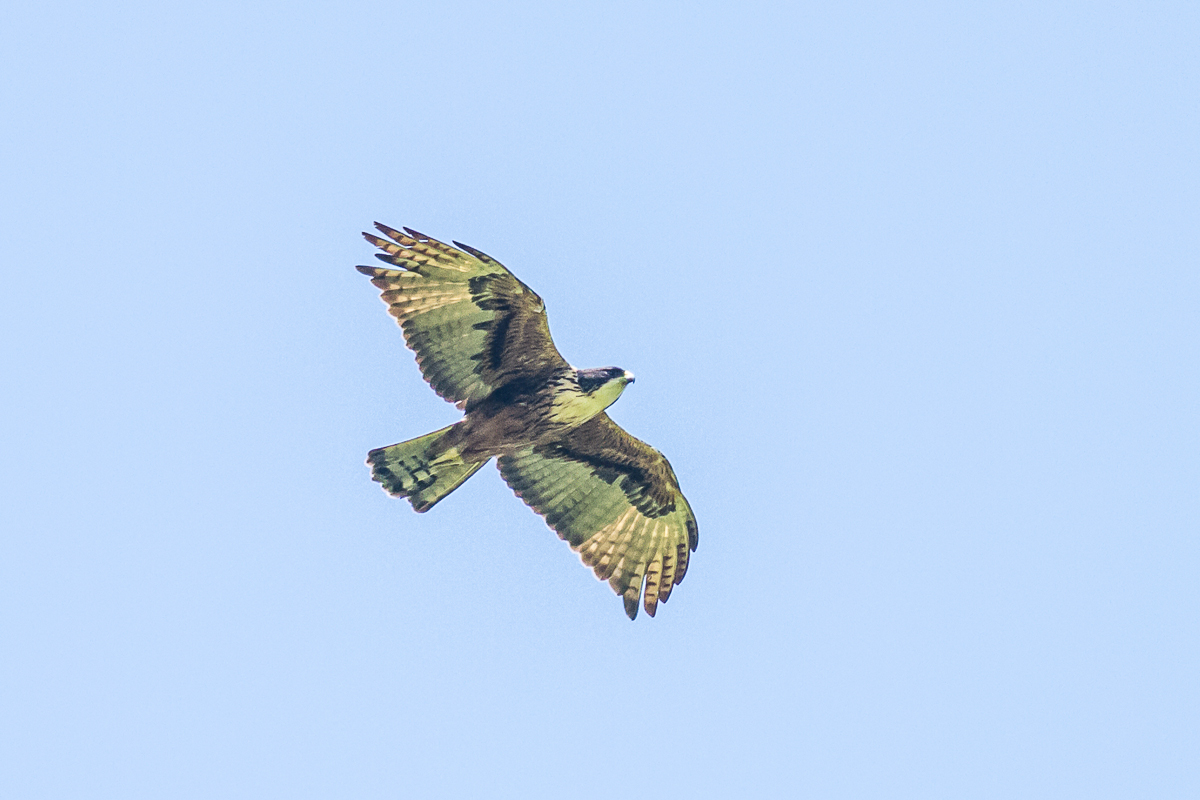
Rufous-bellied Eagle
- Common Name: Rufous-bellied Eagle
- Scientific Name: Lophotriorchis kienerii
- Nepali Name: सेतो कन्ठे चिल (Seto Kanthe Chil)
- IUCN Red List Status: Near Threatened (NT)
- National Red List Status: Critically Endangered (CR)
- CITES Appendix: Appendix II
Measurements & Physical Profile
- Body Length: 46–61 cm
- Wingspan: 105–140 cm
- Weight: 733–800 g
Did You Know?
The Rufous-bellied Eagle is a striking, agile raptor known for its distinctively bold, rufous-colored underparts that contrast sharply with its blackish upperparts. It is a powerful forest hunter, often performing high-speed, acrobatic chases through the canopy to snatch birds or small mammals.
Distribution & Habitat
Global Distribution
Native to the montane and tropical regions of Southern and Southeastern Asia, extending from the Himalayan foothills and India through Myanmar, Thailand, and the Malay Peninsula to Indonesia.
Distribution within Nepal
A rare resident in the mid-hills of Nepal. It is sparsely recorded in the forested valleys and slopes, maintaining highly localized territories in pristine mountain forests.
Preferred Habitats
Primary, mature, untamed montane evergreen forests and broadleaved hillsides. It prefers deep valleys and steep, forested ridges where the canopy remains intact.
Elevational Range
Primarily found in the mid-mountain belts, nesting and foraging extensively from 600 meters up to 2,500 meters above sea level.
Seasonal Occurrence
Year-round permanent resident. They maintain strict site fidelity to their chosen forested valleys throughout the year.
Behavior & Ecology
Flight & Foraging Behavior
Features slender, long, and pointed wings, optimized for high-speed, agile flight. It is an aggressive, active hunter, frequently using an aerial "search-and-stoop" strategy to surprise prey within or near the forest canopy.
Social & Roosting Habits
Exclusively solitary or found in bonded, lifelong monogamous pairs. They are secretive raptors that spend most of their day roosting cryptically within the deep, heavily shaded inner branches of old-growth trees.
Diet & Ecosystem Role
Diet Breakdown
The Rufous-bellied Eagle is a powerful, high-tier carnivore:
- Birds (Primary): Overwhelmingly focuses on forest birds, including junglefowl, pheasants, and various species of pigeons.
- Mammals: Small arboreal mammals, such as squirrels and occasionally juvenile monkeys, are taken when encountered.
Ecological Role
As a top-tier predator of the mid-mountain forest canopy, the Rufous-bellied Eagle plays an essential regulatory role in montane biodiversity by managing the populations of forest birds and small mammals. It serves as a direct indicator of healthy, old-growth forest continuity.
Breeding Biology
The breeding season in Nepal occurs from January through May. Pairs construct large, structurally complex stick nests high in the forks of old-growth trees on steep, inaccessible slopes. The female typically lays 1 to 2 eggs. Incubation lasts approximately 30 to 35 days, and the surviving chick fledge after a prolonged nestling phase of 50 to 60 days.
Migration
- Status: Permanent resident.
- Movement: The species does not engage in long-distance migrations; established breeding pairs remain within their home valleys year-round.
Population Status
- Global Population Estimate: Unknown.
- Population Trend: Decreasing.
- National Population Estimate (Nepal): Less than 50 individuals.
- Monitoring & Surveys: Monitoring and surveys is not conducted for this species, however it is occasionally recorded during raptor survey activities.
Threats
- Deforestation & Forest Fragmentation: The clearing of old-growth montane forests destroys their core hunting and nesting canopies.
- Loss of Ancient Nesting Trees: Selective logging and community firewood collection deplete the large-diameter trees required for their heavy stick nests.
- Human Intrusion: Increasing infrastructure development and disturbance in deep-valley forests cause high stress, leading to nest failure.
Conservation Actions
Existing Measures
- Legal Protections: Fully protected under global frameworks, listed internationally under CITES Appendix II.
- Protected Area Foothold: Territories are preserved within Nepal's mountain national park network and surrounding conservation area buffer zones.
Recommended Measures
- Old-Growth Canopy Sanctuaries: Establishing "no-logging" micro-sanctuaries within Community Forests where active nests are located.
- Eco-Zoning for Mountain Roads: Mandating rigorous Environmental Impact Assessments (EIAs) for infrastructure to avoid splitting contiguous deep-valley forests.
- Targeted Breeding Registries: Creating a community-vetted registry of active nest-trees to ensure monitoring and protection during the breeding season.
References
- BirdLife International (2018). Species factsheet: Rufous-bellied Eagle Lophotriorchis kienerii. Downloaded from https://datazone.birdlife.org/species/factsheet/rufous-bellied-eagle-lophotriorchis-kienerii on 05/08/2026
- Clark, W. S., P. F. D. Boesman, G. M. Kirwan, and J. S. Marks (2020). Rufous-bellied Eagle (Lophotriorchis kienerii), version 1.0. In Birds of the World (J. del Hoyo, A. Elliott, J. Sargatal, D. A. Christie, and E. de Juana, Editors). Cornell Lab of Ornithology, Ithaca, NY, USA. https://doi.org/10.2173/bow.rubeag2.01
- Ferguson-Lees, J., & Christie, D. A. (2001). Raptors of the World. Christopher Helm, London.
- Inskipp C., Baral H. S., Phuyal S., Bhatt T. R., Khatiwada M., Inskipp, T, Khatiwada A., Gurung S., Singh P. B., Murray L., Poudyal L. and Amin R. (2016). The status of Nepal’s Birds: The national red list series. Zoological Society of London, UK.
- Naoroji, R. (2006). Birds of Prey of the Indian Subcontinent. Om Books International, New Delhi.
- The Peregrine Fund (2026) Rufous-bellied Eagle. Available at: https://peregrinefund.org/explore-raptors-species/eagles/rufous-bellied-eagle (Accessed: 5 August 2026).