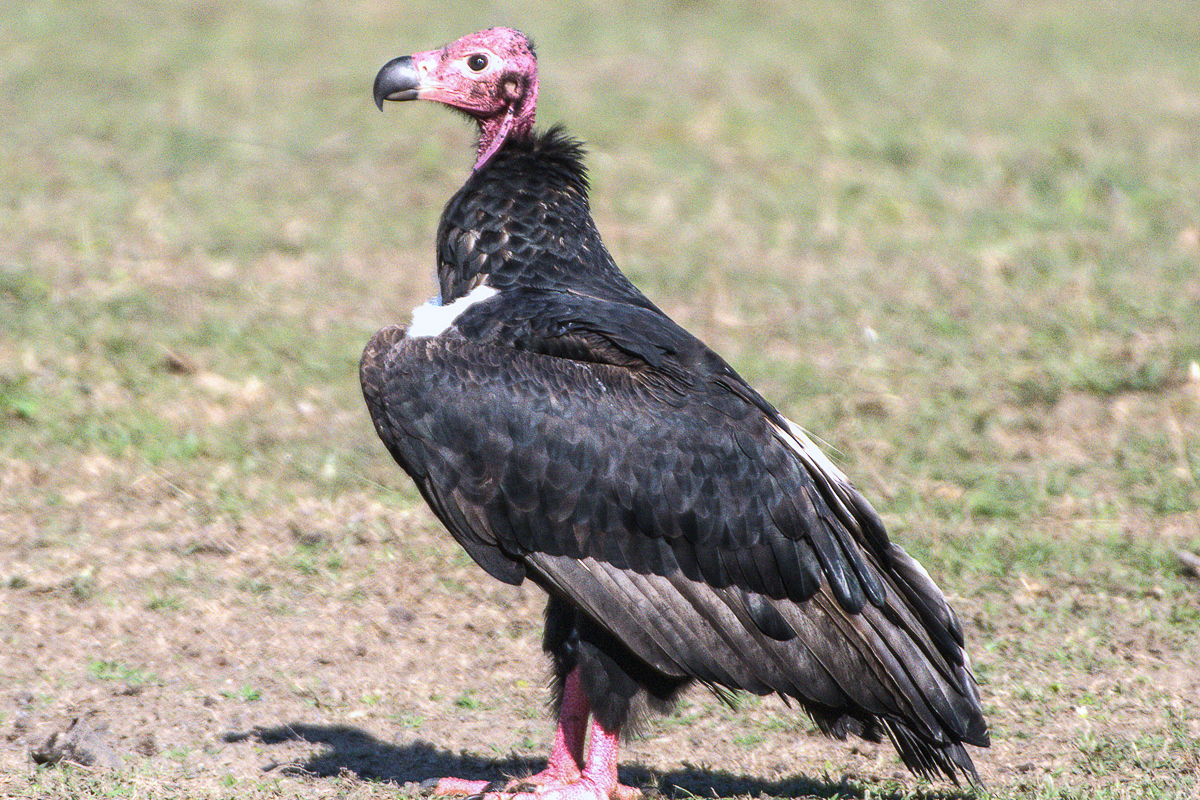
Red-headed Vulture
- Common Name: Red-headed Vulture (also King Vulture or Asian King Vulture)
- Scientific Name: Sarcogyps calvus
- Nepali Name(s): सुन गिद्ध (Sun Giddha)
- IUCN Red List Status: Critically Endangered (CR)
- National Red List Status: Endangered (EN)
- CITES Appendix: Appendix II
- CMS Appendix: Appendix II
Measurements & Physical Profile
- Body Length: 76–86 cm
- Wingspan: 199–230 cm
- Weight: 3,500–5,400 g
Did You Know?
Unlike the social Gyps vultures that congregate in large "heaps" at carcasses, the Red-headed Vulture is a solitary, high-strung, and remarkably dominant scavenger. It is easily recognized by its striking, naked, deep-red head and neck, which lack the downy feathers found on other vultures. Despite its relatively smaller size compared to some counterparts, it is often aggressive and assertive at feeding sites, frequently displacing larger vultures from a carcass due to its bold disposition.
Distribution & Habitat
Global Distribution
The species has a broad but increasingly fragmented range across South and Southeast Asia. It is found in northern India, Nepal, Bangladesh, Myanmar, Thailand, Laos, Cambodia, and Vietnam.
Distribution within Nepal
In Nepal, it is a rare, localized resident. Once more widespread, its range is now largely restricted to the western and mid-western mid-hills and the inner Terai regions. Key sightings and nesting records have been documented in districts such as Palpa, Kaski, and Jajarkot. It is virtually absent from much of eastern Nepal.
Preferred Habitats
It favors open country, including semi-desert, cultivated agricultural lands, and river valleys, but is also frequently found in open deciduous forests and foothills. Unlike obligate flocking species, it utilizes a wider variety of semi-open landscapes, often nesting in tall, solitary trees on the edges of forests or near human settlements.
Elevational Range
Primarily observed from the lowland Terai and inner valleys up to the mid-mountain belts, typically ranging from 100 meters to 2,000 meters above sea level.
Seasonal Occurrence
A year-round permanent resident across its established home ranges. It does not undertake long-distance migrations, though individuals may wander locally in search of food.
Behavior & Ecology
Flight & Foraging Behavior
The Red-headed Vulture is a soaring specialist, often seen gliding at great heights, though it frequently perches on high, prominent tree branches to scan the landscape. It locates carcasses primarily by sight. Unlike social vultures that rely on "following" others to find food, the Red-headed Vulture often finds its own meals and descends quickly and aggressively, usually alone or in pairs.
Social & Roosting Habits
Generally solitary or found in bonded pairs. They are highly territorial, defending their chosen nesting and foraging areas from other vultures. They roost in tall, isolated trees, often using the same favorite perches habitually.
Diet & Ecosystem Role
- Diet: An obligate scavenger feeding on carrion of medium to large mammals (cattle, goats, wild ungulates).
- Ecological Role: As a "cleaner of the wilderness," this species performs the critical ecosystem service of carrion removal. By efficiently disposing of carcasses, it helps suppress the spread of diseases (such as anthrax and rabies) that would otherwise thrive in decaying organic matter.
Breeding Biology
The breeding season in Nepal spans from December to April. Unlike many other vultures that nest in colonies, this species is a solitary nester. The pair constructs a large, sturdy platform of sticks and twigs, usually placed high in the canopy of a large, isolated tree (such as Pinus roxburghii or Adina cordifolia).
The female lays a single white egg with faint speckling. Both parents participate in nest defense and chick rearing. Incubation lasts for approximately 45 to 50 days, and the chick reaches fledgling stage after roughly 80 to 90 days. The species exhibits high nest site fidelity, often returning to the same tree or vicinity year after year.
Migration
- Status: Permanent resident.
- Movement: Non-migratory. Adults maintain strict year-round residency within their established territories.
Population Status
- Global Population Estimate: Estimated at 2,500–9,999 mature individuals; declining rapidly across its entire range.
- Population Trend: Decreasing globally.
- National Population Estimate (Nepal): The population is critically small and fragmented, estimated at fewer than 400 individuals.
- Monitoring & Surveys: Monitored through national vulture surveys, opportunistic sightings, and localized nesting site monitoring. Himalayan Raptors is monitoring their movement and key areas through the use of GPS transmitters.
Threats
- NSAID Poisoning: The use of veterinary drugs like diclofenac, which is highly toxic to vultures, remains the primary cause of population collapse.
- Food Scarcity: Reduction in the availability of safe, "vulture-friendly" carcasses due to changes in livestock disposal practices.
- Habitat Loss: The destruction of large, tall trees required for nesting and roosting due to infrastructure development and deforestation.
- Electrocution: Collisions and electrocution on poorly designed power lines.
Conservation Actions
Existing Measures
- International Conventions: Protected under CITES Appendix II and included in the CMS Raptors MOU.
- Protected Areas: Network of protected areas supports conservation of their breeding and foraging areas.
- Community Engagement: The development of "Vulture Safe Feeding Sites" (Jatayu Restaurants) in Nepal has been a landmark initiative to provide poison-free food.
Recommended Measures
- Strict Drug Regulation: Enforcement of bans on toxic veterinary NSAIDs (e.g., diclofenac, ketoprofen, nimesulide) and promotion of safe alternatives like meloxicam.
- Nesting Tree Protection: Legal protection of identified nesting trees and surrounding "buffer" vegetation to ensure undisturbed breeding.
- Safe Food Provisioning: Expansion of the Vulture Safe Feeding Site network to cover identified, isolated breeding pairs in the mid-hills.
- Public Awareness: Educational programs for cattle farmers on the ecological importance of vultures and the risks of using toxic pharmaceuticals.
- Insulating High-Risk Power Lines: Working with national energy grids to maps and retrofit electrical pylons and crossarms located near known raptor ridge-lines and nesting areas, use flight diverters on along the high-tension powerlines.
References
- BirdLife International (2021). Species factsheet: Red-headed Vulture Sarcogyps calvus. Downloaded from https://datazone.birdlife.org/species/factsheet/red-headed-vulture-sarcogyps-calvus on 05/08/2026
- Clark, W. S., G. M. Kirwan, and D. A. Christie (2020). Red-headed Vulture (Sarcogyps calvus), version 1.0. In Birds of the World (J. del Hoyo, A. Elliott, J. Sargatal, D. A. Christie, and E. de Juana, Editors). Cornell Lab of Ornithology, Ithaca, NY, USA. https://doi.org/10.2173/bow.rehvul1.01
- Ferguson-Lees, J., & Christie, D. A. (2001). Raptors of the World. Christopher Helm, London.
- Inskipp C., Baral H. S., Phuyal S., Bhatt T. R., Khatiwada M., Inskipp, T, Khatiwada A., Gurung S., Singh P. B., Murray L., Poudyal L. and Amin R. (2016). The status of Nepal’s Birds: The national red list series. Zoological Society of London, UK.
- The Peregrine Fund (2026) Red-headed Vulture. Available at: https://peregrinefund.org/explore-raptors-species/vultures/red-headed-vulture-0 (Accessed: 5 August 2026).