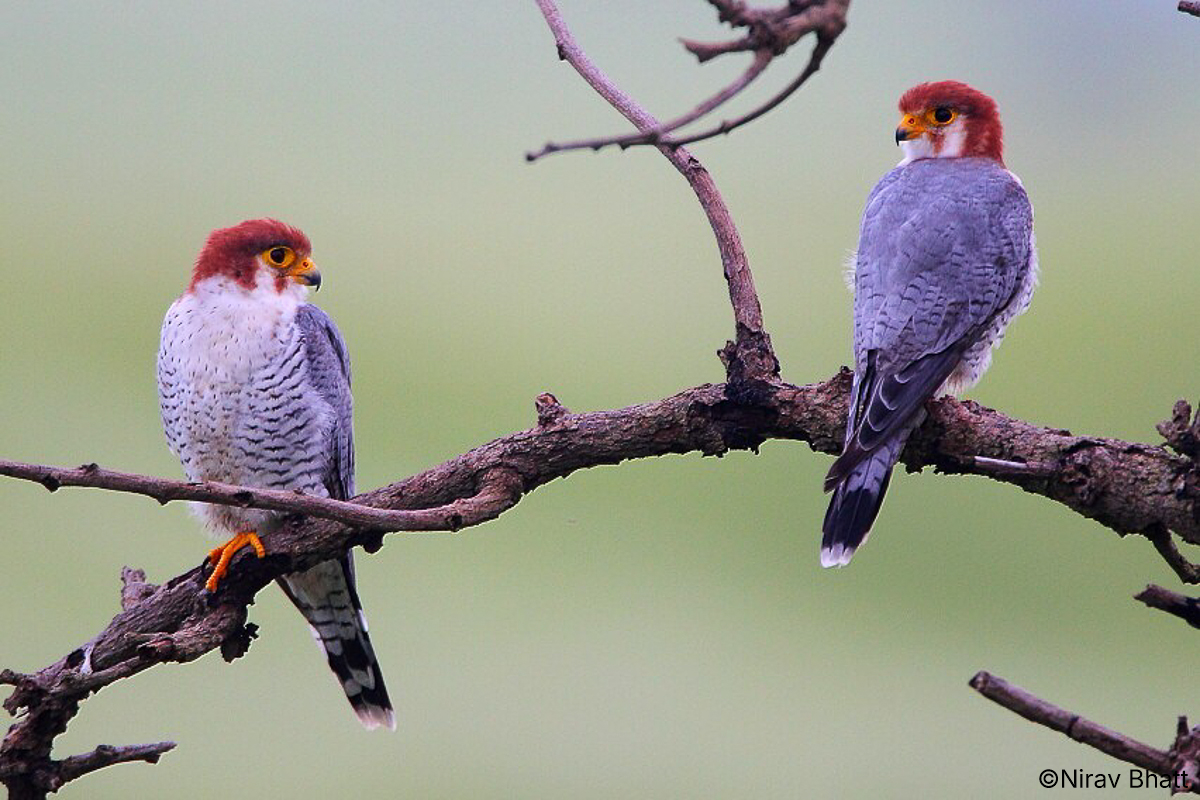
Red-headed Falcon
- Scientific Name: Falco chicquera
- Nepali Name(s): रातोटाउके बौँडाइ (Rato Tauke Baudai)
- IUCN Red List Status: Least Concerned (LC)
- National Red List Status: Endangered (EN)
- CITES Appendix: Appendix II
- CMS Appendix: Not listed
Measurements & Physical Profile
- Body Length: 30–36 cm
- Wingspan: 65–85 cm
- Weight: 150–250 g
Did You Know?
The Red-headed Falcon, often referred to as the Red-necked Falcon, is a strikingly beautiful raptor easily identified by its vibrant, chestnut-red head and nape, which contrast sharply against its slate-grey back. It is a bold, high-speed hunter often seen operating in pairs, and it is uniquely skilled at aerial cooperative hunting—a rare trait among smaller falcons—allowing it to take down prey significantly larger than itself.
Distribution and Habitat
Global Distribution
Native to the Indian subcontinent and parts of sub-Saharan Africa. Its range covers a wide swath across India, Pakistan, and parts of Nepal, with populations extending into distinct regions of the African continent.
Distribution within Nepal
A rare resident of Nepal. It is primarily recorded in the lowland Tarai, where it maintains highly localized, stable territories within open, wooded landscapes and near riverine habitats.
Preferred Habitats
Open country, semi-arid plains, cultivated landscapes with scattered large trees, and palm groves. It favors areas that provide clear sightlines for hunting, such as forest edges, groves, and riverbanks.
Elevational Range
Primarily operates in the lowland plains and river valleys, typically below 500 meters above sea level.
Seasonal Occurrence
Year-round permanent resident. They maintain strict site fidelity to their chosen territories throughout the year.
Behavior and Ecology
Flight & Foraging Behavior
Possesses narrow, pointed wings and a swift, direct flight style typical of the Falco genus. It is a bold hunter that often uses a "perch-and-wait" ambush method, launching high-speed attacks from elevated perches to catch birds in mid-air.
Social & Roosting Habits
Typically seen in bonded, monogamous pairs that often hunt cooperatively. They are highly territorial, patrolling their hunting grounds, and usually roost in the dense foliage of palm trees or other tall, mature trees to remain concealed.
Diet & Ecosystem Role
Diet Breakdown
The Red-headed Falcon is an aggressive, high-speed carnivore:
- Birds (Primary): Overwhelmingly focuses on small birds, such as larks, pipits, finches, and doves, frequently caught in aerial pursuit.
- Other: Occasionally consumes large insects or small rodents when encountered in open clearings.
Ecological Role
As a specialized avian predator of open woodlands and agricultural margins, the Red-headed Falcon regulates the populations of smaller passerine birds, contributing to the balance of local bird communities and serving as an indicator of healthy, open-woodland landscapes.
Breeding Biology
The breeding season in Nepal occurs from January through April. They are known for occupying and repurposing abandoned stick nests built by other raptors or large birds, typically located in the tops of tall trees like palm or Acacia species. The female lays 2 to 4 eggs. Incubation lasts about 30 to 35 days, and the chicks fledge after approximately 35 to 40 days of parental care.
Migration
- Status: Permanent resident; non-migratory.
- Movement: The species does not engage in seasonal migrations. Breeding pairs remain within their established home ranges throughout the year.
Population Status
- Global Population Estimate: Unknown
- Population Trend: Decreasing.
- National Population Estimate (Nepal): 50 – 100 individuals.
- Monitoring & Surveys: Monitored via opportunistic sightings and localized surveys within protected areas of the lowland Terai.
Threats
- Habitat Loss: The clearing of palm groves and mature, large-diameter trees in the Tarai destroys essential nesting sites.
- Prey Depletion: Loss of small-bird habitat due to intensive agricultural practices reduces the falcon's primary food base.
- Human Intrusion: Increasing infrastructure development and disturbance in open woodlands can lead to nest abandonment.
Conservation Actions
Existing Measures
- Legal Protection: The species is listed under CITES Appendix II, which strictly regulates the international trade of live specimens to ensure their survival is not threatened.
- Protected Area Network: Portions of the species' range in Nepal fall within the national protected area system, providing critical habitat security and safeguarding core populations.
Recommended Measures
- Nest-Tree Protection: Preserving large palm and Acacia trees within agricultural landscapes to support nesting pairs.
- Community-Led Conservation: Involving local communities in safeguarding known nesting trees and minimizing disturbance during the breeding season.
- Habitat Restoration: Promoting the retention of scattered large trees in agricultural mosaics to ensure continued hunting and nesting opportunities.
References
- BirdLife International. (2021). Falco chicquera. The IUCN Red List of Threatened Species 2021.
- Ferguson-Lees, J., & Christie, D. A. (2001). Raptors of the World. Christopher Helm, London.
- Grimmett, R., Inskipp, C., & Inskipp, T. (2016). Birds of Nepal. Christopher Helm, London.
- Inskipp, C., et al. (2016). The Status of Nepal’s Birds: The National Red List Series. Royal Zoological Society of London.
- Naoroji, R. (2006). Birds of Prey of the Indian Subcontinent. Om Books International.
- The Peregrine Fund (2026). Global Raptor Information Network. https://www.peregrinefund.org
- White, C. M., et al. (2020). Red-headed Falcon (Falco chicquera). In Birds of the World. Cornell Lab of Ornithology.