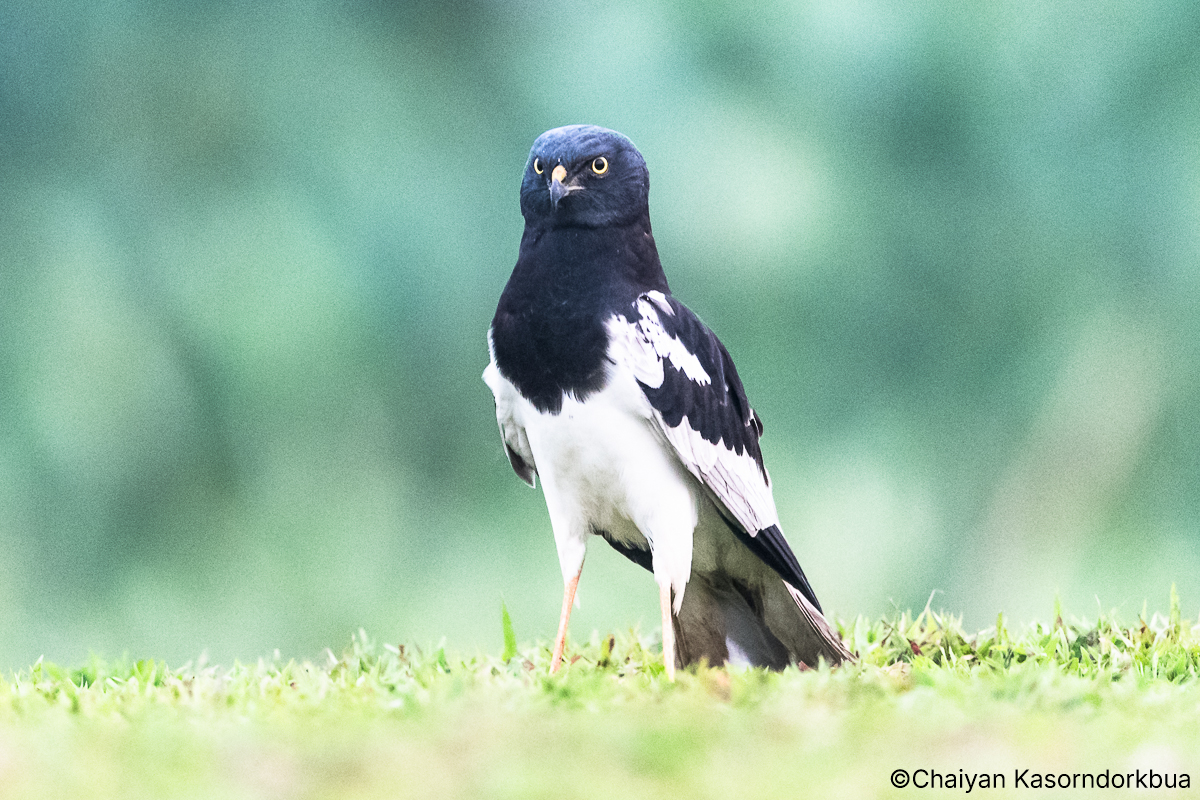
Pied Harrier
- Common Name: Pied Harrier
- Scientific Name: Circus melanoleucos
- Nepali Name(s): आब्लाक पेटाहा भुइँचिल (Aablak Petaahaa Bhuichil)
- IUCN Red List Status: Least Concern (LC)
- National Red List Status: Vulnerable (VU)
- CITES Appendix: Appendix II
- CMS Appendix: Appendix II
Measurements & Physical Profile
- Body Length: 43–50 cm
- Wingspan: 110–125 cm
- Weight: 254–455 g
Did You Know?
The Pied Harrier is one of the most visually striking raptors in its genus, with the adult male boasting a brilliant, high-contrast black-and-white plumage that makes it easily distinguishable from other harriers. Like its relatives, it is a specialized low-altitude hunter, utilizing its long legs and acute hearing to snatch prey from the dense undergrowth of wetlands and grasslands.
Distribution & Habitat
Global Distribution
Breeds in eastern Asia, including southeastern Siberia, northern Mongolia, and northeastern China; winters in southern Asia, including the Indian subcontinent and Southeast Asia.
Distribution within Nepal
A rare winter visitor and passage migrant. Records are sporadic and primarily restricted to the southern Terai plains, specifically in protected wetlands, marshes, and large, undisturbed grassland tracts.
Preferred Habitats
Wetlands, marshes, tall grasslands, and irrigated agricultural lands. It shows a strong affinity for water-logged areas and reedbeds during the winter months.
Elevational Range
Primarily winters in the lowland Terai and river valleys below 500 meters, though birds may be observed passing through mid-hill valleys during seasonal migration.
Seasonal Occurrence
Winter visitor and passage migrant. Individuals reach Nepal in late autumn and typically migrate back to northern breeding grounds by early spring.
Behavior & Ecology
Flight & Foraging Behavior
Exhibits a typical harrier flight pattern: low, graceful, and buoyant, with wings held in a shallow "V". It quarters open ground at low altitudes, often hovering or dropping suddenly into thick vegetation to capture prey.
Social & Roosting Habits
Solitary while hunting, but known to aggregate in communal roosts at night. These roosts are usually located on the ground within dense, tall grass or reedbeds, offering protection from predators and wind.
Diet & Ecosystem Role
Diet Breakdown
The Pied Harrier is an agile ground-level predator:
- Small Mammals (Primary): Feeds largely on small rodents like mice and voles.
- Birds: Opportunistically captures small ground-nesting birds and fledglings.
- Insects & Amphibians: Takes large insects and occasionally small frogs or reptiles found in wet habitats.
Ecological Role
As a predator of small vertebrates in wetlands and grasslands, it helps regulate prey populations and maintains the ecological balance of these sensitive habitats. Its presence is a sign of a productive, healthy marshland ecosystem.
Breeding Biology
The Pied Harrier does not breed in Nepal. In its northern breeding range, it nests on the ground, typically among thick grasses in marshy areas. Breeding season typically initiates from late April through June. Unlike many raptors that nest in trees, this species is a ground-nester, constructing a simple, concealed platform of grasses, reeds, and sedges directly on the ground, often within dense marshlands, tall grass, or agricultural fields. The female typically lays a clutch of 3-5 eggs, which she incubates for approximately 30 to 33 days while the male focuses on hunting and provisioning. Following hatching, the chicks exhibit a rapid development period, with a fledging duration lasting between 35 and 40 days. Once the young leave the nest, they remain dependent on their parents for food for several weeks before dispersing to begin their migration.
Migration
- Status: Migratory; passage migrant and winter visitor.
- Movement: A long-distance migrant that moves between eastern Asian breeding grounds and tropical wintering sites in South and Southeast Asia.
Population Status
- Global Population Estimate: Unknown.
- Population Trend: Decreasing.
- National Population Estimate (Nepal): <500 individuals.
- Monitoring & Surveys: Monitored via regional raptor migration studies and systematic winter wetland bird surveys.
Threats
- Habitat Loss: The conversion of wetlands, marshes, and grasslands into agricultural land or urban zones directly removes key foraging and roosting grounds.
- Pesticide Poisoning: Exposure to rodenticides and insecticides in agricultural areas can lead to secondary poisoning.
- Disturbance: Human activity near wetlands and the burning of grasslands during winter months can displace the owls and reduce their chances of survival.
Conservation Actions
Existing Measures
- Legal Protections: Listed under CITES Appendix II and CMS Appendix II, providing a framework for international conservation efforts.
- Protected Area Foothold: Lowland protected areas supports to protect important wintering habitats.
Recommended Measures
- Wetland Conservation: Protecting and restoring marshy areas and tall-grass meadows in the Terai to support migrant harriers.
- Sustainable Land Use: Encouraging non-toxic agricultural practices near wetlands to protect the harrier's food supply.
- Site Protection: Protecting communal roost sites from fire and human disturbance.
References
- BirdLife International (2021). Species factsheet: Pied Harrier Circus melanoleucos. Downloaded from https://datazone.birdlife.org/species/factsheet/pied-harrier-circus-melanoleucos on 06/08/2026
- Ferguson-Lees, J., & Christie, D. A. (2001). Raptors of the World. Christopher Helm, London.
- Inskipp C., Baral H. S., Phuyal S., Bhatt T. R., Khatiwada M., Inskipp, T, Khatiwada A., Gurung S., Singh P. B., Murray L., Poudyal L. and Amin R. (2016). The status of Nepal’s Birds: The national red list series. Zoological Society of London, UK.
- Orta, J., P. F. D. Boesman, and J. S. Marks (2020). Pied Harrier (Circus melanoleucos), version 1.0. In Birds of the World (J. del Hoyo, A. Elliott, J. Sargatal, D. A. Christie, and E. de Juana, Editors). Cornell Lab of Ornithology, Ithaca, NY, USA. https://doi.org/10.2173/bow.piehar1.01