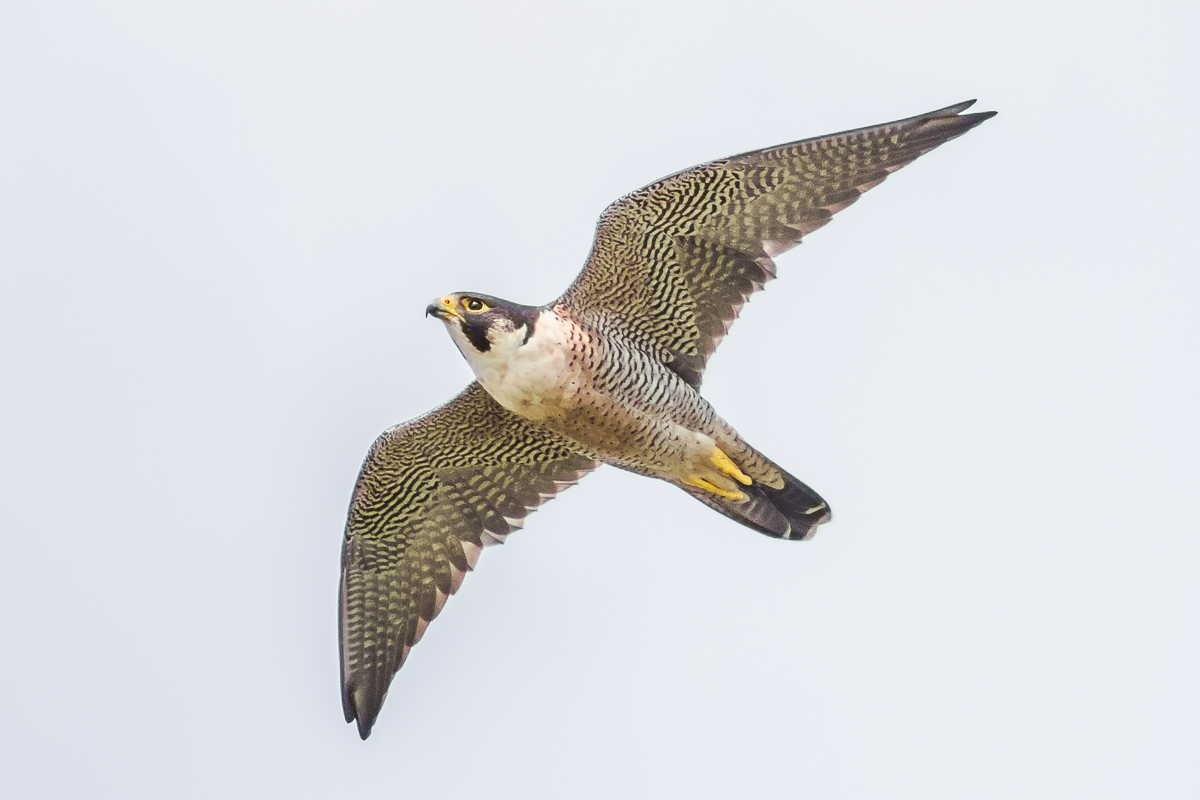
Peregrine Falcon
- Common Name: Peregrine Falcon
- Scientific Name: Falco peregrinus
- Nepali Name(s): शाही बाज (Shahi Baaz)
- IUCN Red List Status: Least Concern (LC)
- National Red List Status: Least Concern (LC)
- CITES Appendix: Appendix I
- CMS Appendix: Appendix I & II
Measurements & Physical Profile
- Body Length: 33–50 cm
- Wingspan: 78–122 cm
- Weight: 410–1,600 g
Did You Know?
The Peregrine Falcon is widely recognized as the fastest animal on the planet, capable of reaching speeds over 320 km/h during its high-velocity "stoop" (hunting dive). It possesses a sophisticated aerodynamic profile and a specialized tooth-like tubercle on its upper mandible, which allows it to dispatch avian prey mid-air with lethal precision.
Distribution & Habitat
Global Distribution
The Peregrine Falcon has a near-cosmopolitan distribution, found on every continent except Antarctica. It is one of the most widely distributed bird species in the world, breeding across diverse latitudes from the Arctic tundra to tropical islands.
Distribution within Nepal
The Peregrine Falcon is a frequent to uncommon resident, partial altitudinal migrant, and passage migrant across Nepal’s, though it remains uncommon elsewhere. The species is sporadically recorded across the country; has three subspecies: the resident F. p. peregrinator, the winter visitor F. p. calidus, and the rare vagrant F. p. babylonicus. It has been recorded from the far west in Sukla Phanta to the far east in Panchthar, including most major national parks and conservation areas. While documented across diverse landscapes—from high-altitude zones to the lowlands—post-1990 records show its overall distribution has remained relatively stable. Recent observations continue to confirm its presence in both remote corridors and urban environments.
Preferred Habitats
Diverse habitats, including coastal cliffs, mountain ridges, and open country. In Nepal, they are often found near wetlands, river valleys, and cliff-faces that provide excellent vantage points for hunting.
Elevational Range
Highly adaptable, ranging from lowland plains during winter to high-altitude mountain passes up to 4,000 meters or more during seasonal migration.
Seasonal Occurrence
Winter visitor and passage migrant. Individuals pass through or winter in Nepal as they travel between northern breeding grounds and southern wintering areas.
Behavior & Ecology
Flight & Foraging Behavior
Features powerful, long, pointed wings optimized for high-speed flight. It hunts primarily by soaring at great heights, spotting prey from a distance, and then initiating a rapid, steep dive to strike prey in mid-air.
Social & Roosting Habits
Typically solitary outside of the breeding season. They are highly territorial and often use prominent, high-elevation perches or cliffs for roosting, which provide security and visibility.
Diet & Ecosystem Role
Diet Breakdown
The Peregrine Falcon is an expert aerial predator:
- Birds (Primary): Almost exclusively feeds on other birds, ranging in size from small passerines to larger species like pigeons, ducks, and waders.
- Other: Occasionally takes small mammals or bats if they are caught in flight.
Ecological Role
As a supreme aerial apex predator, it plays a vital role in maintaining the health of avian populations by selectively preying on weak or diseased individuals. Its presence acts as a bio-indicator for the environmental health of open landscapes and wetland ecosystems.
Breeding Biology
The breeding season for the Peregrine Falcon in Nepal typically runs from December through April, aligning with the cool, dry winter and spring months. Pairs demonstrate strong, long-term territorial fidelity, often utilizing traditional nesting sites on high, secure cliff ledges or occasionally occupying large stick nests built by other raptors. These sites are generally situated in rugged terrain or near forest edges, providing a commanding view of the surrounding landscape.
The female typically lays a clutch of 3-5 eggs. Incubation lasts approximately 30 to 35 days, performed primarily by the female, while the male remains responsible for provisioning the pair. Once hatched, the chicks remain in the nest for a fledging period of about 35 to 42 days. After taking their first flights, the juveniles typically remain dependent on their parents for several weeks as they develop the hunting skills necessary for independence.
Migration
- Status: Resident as well as migratory; passage migrant and winter visitor.
- Movement: Famous for some of the longest migrations in the animal kingdom, with individuals traveling thousands of kilometers from Arctic breeding grounds to temperate wintering sites.
Population Status
- Global Population Estimate: 100,000 – 500,000 mature individuals
- Population Trend: Stable or increasing.
- National Population Estimate (Nepal): Unknown.
- Monitoring & Surveys: Monitored via raptor migration counts and opportunistic sightings.
Threats
- Pesticide Use: Historical and modern exposure to organochlorine pesticides can lead to eggshell thinning and reduced reproductive success.
- Habitat Disturbance: Development and human activity near cliff-nesting sites or major migration corridors can disrupt their behavior.
- Illegal Trade: Despite being listed under CITES Appendix I, illegal collection for falconry remains a persistent threat in some regions.
Conservation Actions
Existing Measures
- Legal Protections: Strictly protected internationally under CITES Appendix I, banning commercial trade, and CMS Appendix I & II.
- Protected Area Foothold: Nepal’s national park network provides important stopover sites for migratory individuals.
Recommended Measures
- Pesticide Regulation: Continued monitoring and restriction of harmful pesticides that impact raptor reproduction.
- Migratory Corridor Protection: Identifying and preserving key stopover points along major river systems in Nepal.
- Falconry Regulation: Enforcing strict national laws to prevent the illegal trade and capture of falcons.
References
- BirdLife International (2021). Species factsheet: Peregrine Falcon Falco peregrinus. Downloaded from https://datazone.birdlife.org/species/factsheet/peregrine-falcon-falco-peregrinus on 06/08/2026
- Ferguson-Lees, J., & Christie, D. A. (2001). Raptors of the World. Christopher Helm, London.
- Inskipp C., Baral H. S., Phuyal S., Bhatt T. R., Khatiwada M., Inskipp, T, Khatiwada A., Gurung S., Singh P. B., Murray L., Poudyal L. and Amin R. (2016). The status of Nepal’s Birds: The national red list series. Zoological Society of London, UK.
- The Peregrine Fund. (2026) Peregrine Falcon. Available at: https://peregrinefund.org/explore-raptors-species/falcons/peregrine-falcon (Accessed: 6 August 2026).
- White, C. M., N. J. Clum, T. J. Cade, and W. G. Hunt (2024). Peregrine Falcon (Falco peregrinus), version 1.1. In Birds of the World (S. M. Billerman and M. G. Smith, Editors). Cornell Lab of Ornithology, Ithaca, NY, USA. https://doi.org/10.2173/bow.perfal.01.1