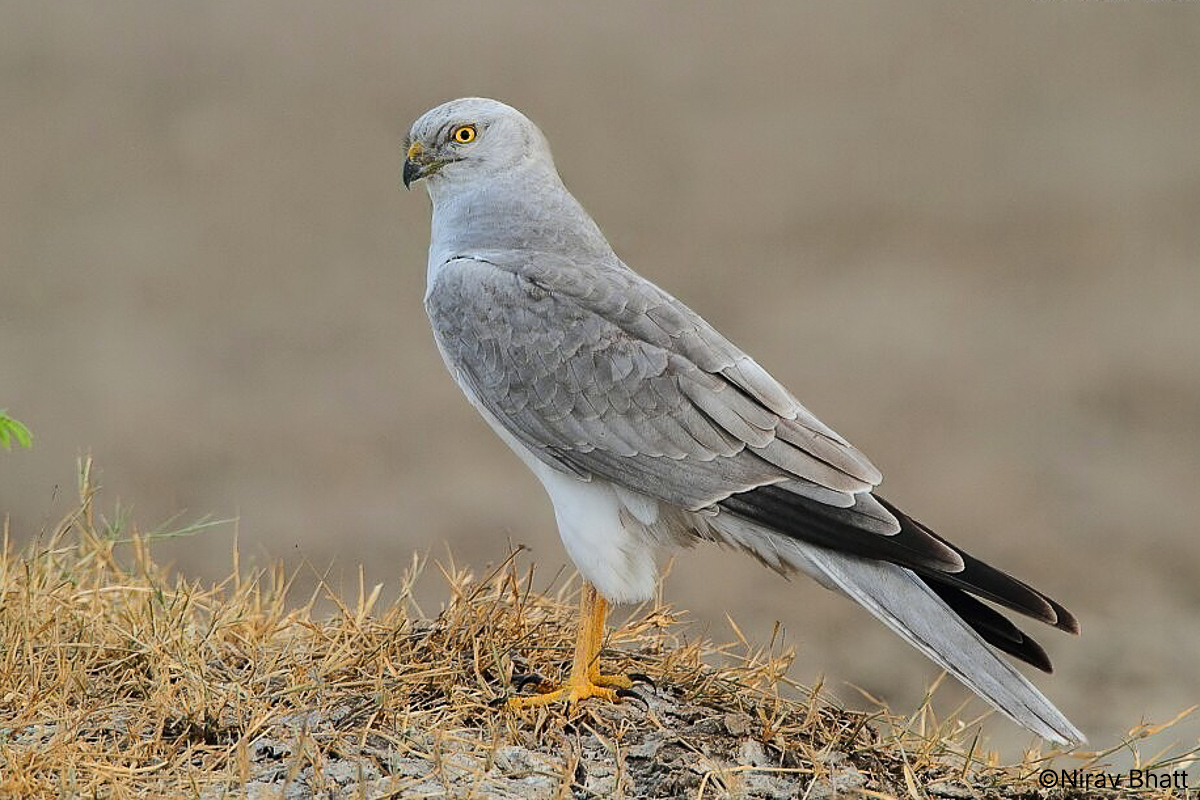
Pallid Harrier
- Common Name: Pallid Harrier
- Scientific Name: Circus macrourus
- Nepali Name(s): श्वेत भुइँचिल (Swet Bhuichil)
- IUCN Red List Status: Near Threatened (NT)
- National Red List Status: Vulnerable (VU)
- CITES Appendix: Appendix II
- CMS Appendix: Appendix I & II
Measurements & Physical Profile
- Body Length: 40–48 cm
- Wingspan: 100–121 cm
- Weight: 235–550 g
Did You Know?
The Pallid Harrier is a highly elegant, slender raptor that is primarily a ground-hunter. It is well-known for its characteristic "low-level quartering" flight, where it glides just a few meters above the ground, using its keen hearing and eyesight to detect small prey moving through tall grass and reeds.
Distribution & Habitat
Global Distribution
Breeds in the steppes of Central Asia, ranging from southeastern Europe through Russia to Kazakhstan and northern China, and winters in the Indian subcontinent and parts of Africa.
Distribution within Nepal
A rare winter visitor and passage migrant to the lowlands of Nepal. It is occasionally recorded in the Terai region, particularly in open grasslands, wetlands, and large agricultural fields.
Preferred Habitats
Open country, including steppes, grasslands, marshes, and agricultural landscapes. It generally avoids forested areas and prefers wide, unobstructed views for hunting.
Elevational Range
Primarily occupies the lowlands, typically found in the Terai plains below 500 meters, though individuals may be seen passing through higher valleys during migration.
Seasonal Occurrence
Winter visitor and passage migrant. They arrive in Nepal during late autumn and depart for their northern breeding grounds in early spring.
Behavior & Ecology
Flight & Foraging Behavior
Exhibits a buoyant, slow, and tilting flight pattern. It relies on low-altitude, silent quartering to surprise prey before dropping down with agility.
Social & Roosting Habits
Generally solitary while foraging, but they are known to congregate in communal roosts on the ground, often in dense, tall grasslands or reedbeds, where multiple individuals gather for safety.
Diet & Ecosystem Role
Diet Breakdown
The Pallid Harrier is a ground-focused predator:
- Mammals (Primary): Primarily hunts small rodents, such as field mice and voles.
- Birds: Opportunistically takes small ground-dwelling birds and nestlings.
- Insects: Occasionally eats large insects, particularly during the wintering season.
Ecological Role
Acts as a key predator of small mammals in grassland and agricultural ecosystems. By managing rodent populations, it provides valuable services to agricultural sustainability and reflects the health of open-country habitats.
Breeding Biology
The Pallid Harrier does not breed in Nepal. In its northern breeding range, it breeds primarily in the grasslands and steppe regions of Central Asia, Russia, and parts of Europe, typically during the spring months of April and May. During this period, the female typically lays a clutch of 3-5, which she incubates for approximately 28 to 30 days while the male provides food. Following hatching, the young remain in the nest for a fledging duration of about 35 to 40 days. After successfully fledging, the juveniles remain under parental care for a brief period before beginning their migration to wintering grounds in Africa and South Asia, including Nepal.
Migration
- Status: Migratory; passage migrant and winter visitor.
- Movement: A long-distance migrant that travels thousands of kilometers between breeding sites in Central Asia and wintering grounds in the Indian subcontinent.
Population Status
- Global Population Estimate: 18,000 – 30,000 mature individuals.
- Population Trend: Decreasing globally.
- National Population Estimate (Nepal): 50 -150 individuals.
- Monitoring & Surveys: Monitored through raptor migration watch points and winter bird surveys in the Terai.
Threats
- Habitat Destruction: The conversion of grasslands and marshes into agricultural land or urban developments is the primary threat.
- Pesticide Exposure: Rodenticides used in farming can lead to secondary poisoning, impacting the harriers that hunt on these lands.
- Disturbance: Human activity and the loss of traditional communal roosting sites in grasslands reduce their chances of survival during the winter.
Conservation Actions
Existing Measures
- Legal Protections: Listed under CITES Appendix II and CMS Appendix I & II, offering international protection.
- Protected Area Foothold: Core populations receive some protection within Nepal’s lowland national parks and wildlife reserves.
Recommended Measures
- Grassland Preservation: Maintaining undisturbed grassland and marshland patches in the Terai is crucial for wintering individuals.
- Agricultural Awareness: Promoting responsible rodent control and sustainable farming practices that are safer for raptors.
- Site-Specific Protection: Protecting known communal roosting sites from agricultural encroachment or disturbance.
References
- BirdLife International (2021). Species factsheet: Pallid Harrier Circus macrourus. Downloaded from https://datazone.birdlife.org/species/factsheet/pallid-harrier-circus-macrourus on 06/08/2026
- Ferguson-Lees, J., & Christie, D. A. (2001). Raptors of the World. Christopher Helm, London.
- Inskipp C., Baral H. S., Phuyal S., Bhatt T. R., Khatiwada M., Inskipp, T, Khatiwada A., Gurung S., Singh P. B., Murray L., Poudyal L. and Amin R. (2016). The status of Nepal’s Birds: The national red list series. Zoological Society of London, UK.
- Naoroji, R. (2006). Birds of Prey of the Indian Subcontinent. Om Books International, New Delhi.
- Orta, J., D. A. Christie, and G. M. Kirwan (2020). Pallid Harrier (Circus macrourus), version 1.0. In Birds of the World (J. del Hoyo, A. Elliott, J. Sargatal, D. A. Christie, and E. de Juana, Editors). Cornell Lab of Ornithology, Ithaca, NY, USA. https://doi.org/10.2173/bow.palhar1.01