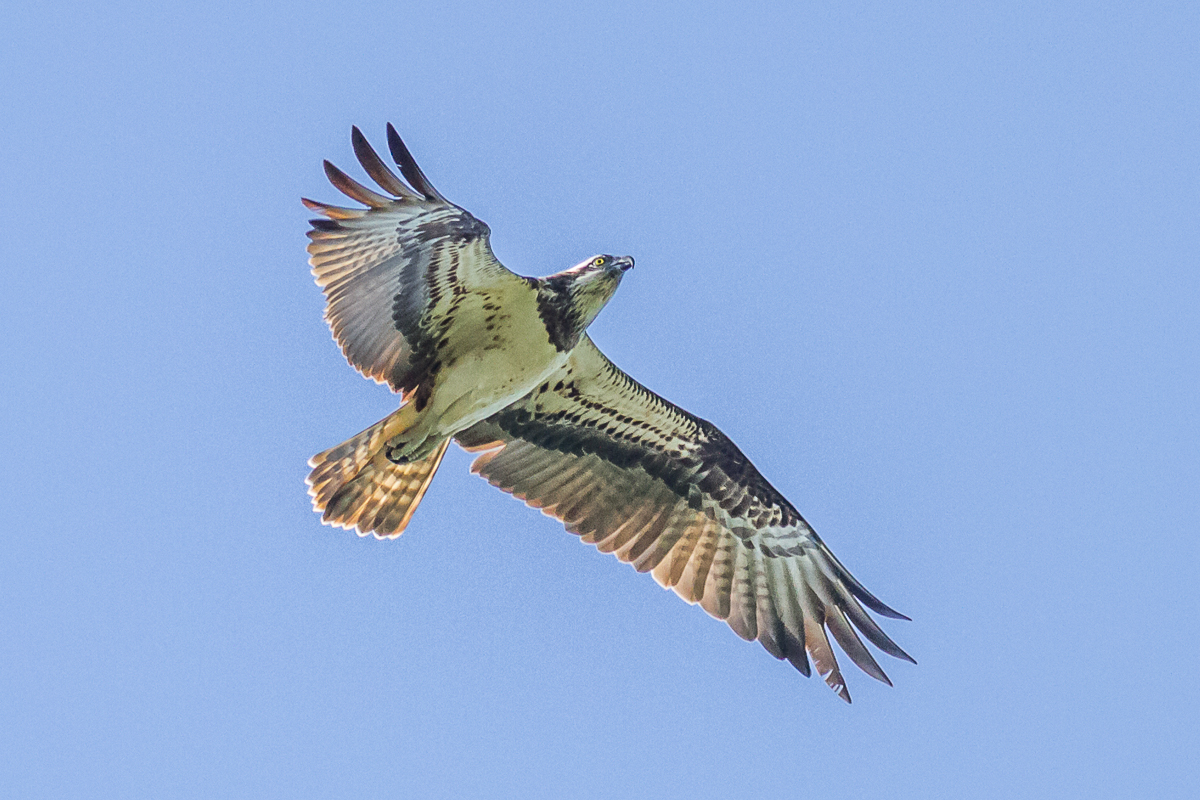
Osprey
- Common Name: Osprey
- Scientific Name: Pandion haliaetus
- Nepali Name(s): मलाहा चिल (Malaha Chil)
- IUCN Red List Status: Least Concern (LC)
- National Red List Status: : Least Concern (LC)
- CITES Appendix: Appendix II
- CMS Appendix: Appendix II
Measurements & Physical Profile
- Body Length: 53–58 cm
- Wingspan: 150–180 cm
- Weight: 1,400–2,000 g
Did You Know?
The Osprey is a highly specialized fish-eating raptor possessing unique physical adaptations, including reversible outer toes that allow it to grasp slippery fish with a two-toed front and back grip. It also features closable nostrils to keep water out during high-speed, dramatic plunges into the water to snatch prey.
Distribution & Habitat
Global Distribution
A cosmopolitan species, Ospreys are found on every continent except Antarctica, breeding in temperate and tropical regions and migrating widely to wintering grounds.
Distribution within Nepal
A rare winter visitor and passage migrant. They are most commonly spotted near large, slow-flowing rivers, artificial lakes, and major wetland sites throughout the Terai and inner valleys, particularly during their migration journeys.
Preferred Habitats
Exclusively associated with large bodies of water, including river systems, large reservoirs, and wetlands that provide clear visibility of surface-swimming fish.
Elevational Range
Primarily occupies lowland riverine systems and wetland basins, typically below 1,000 meters.
Seasonal Occurrence
Winter visitor and passage migrant. Individuals pass through Nepal or stop over during the winter months, traveling between northern breeding regions and southern wintering grounds. Subadults and juveniles remains in Nepal throughout the year.
Behavior & Ecology
Flight & Foraging Behavior
Characterized by a distinct "M-shaped" silhouette when soaring. They forage by flying over water, hovering briefly before executing a spectacular, feet-first dive to submerge and catch fish.
Social & Roosting Habits
Generally solitary outside of the breeding season, though they may congregate near abundant food sources. They are known for returning to the same reliable wintering perches each year.
Diet & Ecosystem Role
Diet Breakdown
The Osprey is almost entirely piscivorous:
- Fish (Primary): Almost exclusively feeds on live fish, including species found in riverine systems and lakes.
Ecological Role
As a top aquatic predator, the Osprey acts as a bio-indicator of water quality. Its presence in river systems often highlights healthy aquatic ecosystems with stable, visible fish populations.
Breeding Biology
The Osprey does not breed in Nepal. In its northern breeding range, breeding season is typically March through May, coinciding with peak local fish availability. Females lay a clutch of 2-4 eggs, which are primarily incubated by the female for a duration of approximately 35 to 42 days while the male handles the majority of foraging. Once hatched, the young remain in the nest for a 49 – 55 days. Even after taking their first flights, the juveniles typically remain dependent on parental provisioning for several weeks before becoming fully independent.
Migration
- Status: Migratory; passage migrant and winter visitor.
- Movement: Ospreys are famous for undertaking long-distance migrations, with individuals traveling thousands of kilometers between northern nesting sites and southern feeding grounds.
Population Status
- Global Population Estimate: 100,000 – 1,200,000 mature individuals.
- Population Trend: Increasing.
- National Population Estimate (Nepal): Unknown.
- Monitoring & Surveys: Monitored via regional wetland bird counts and raptor migration monitoring initiatives.
Threats
- Water Pollution: Contamination of rivers and lakes reduces fish availability and can lead to bioaccumulation of toxins in the birds.
- Habitat Loss: The drainage of wetlands and degradation of riverine ecosystems directly impacts their ability to forage.
- Disturbance: High human activity near riverbanks and fishing sites can drive Ospreys away from essential stopover feeding grounds.
Conservation Actions
Existing Measures
- Legal Protections: Listed under CITES Appendix II and CMS Appendix II to ensure international cooperation and protection.
- Protected Area Foothold: Core wetland habitats in Nepal’s national parks provide critical shelter for passage migrants.
Recommended Measures
- Wetland Protection: Maintaining the ecological health of major river systems and lakes is vital for wintering raptors.
- Sustainable Fishing: Encouraging local fishing practices that maintain healthy fish stocks in raptor-important wetlands.
- Monitoring Programs: Increasing scientific monitoring of wetland stopover sites to track migration trends.
References
- BirdLife International (2021). Species factsheet: Osprey Pandion haliaetus. Downloaded from https://datazone.birdlife.org/species/factsheet/osprey-pandion-haliaetus on 06/08/2026
- Bierregaard, R. O., A. F. Poole, M. S. Martell, P. Pyle, and M. A. Patten (2020). Osprey (Pandion haliaetus), version 1.0. In Birds of the World (P. G. Rodewald, Editor). Cornell Lab of Ornithology, Ithaca, NY, USA. https://doi.org/10.2173/bow.osprey.01
- Ferguson-Lees, J., & Christie, D. A. (2001). Raptors of the World. Christopher Helm, London.
- Inskipp C., Baral H. S., Phuyal S., Bhatt T. R., Khatiwada M., Inskipp, T, Khatiwada A., Gurung S., Singh P. B., Murray L., Poudyal L. and Amin R. (2016). The status of Nepal’s Birds: The national red list series. Zoological Society of London, UK.
- The Peregrine Fund. (2026) Osprey. Available at: https://peregrinefund.org/explore-raptors-species/osprey/osprey (Accessed: 6 August 2026).