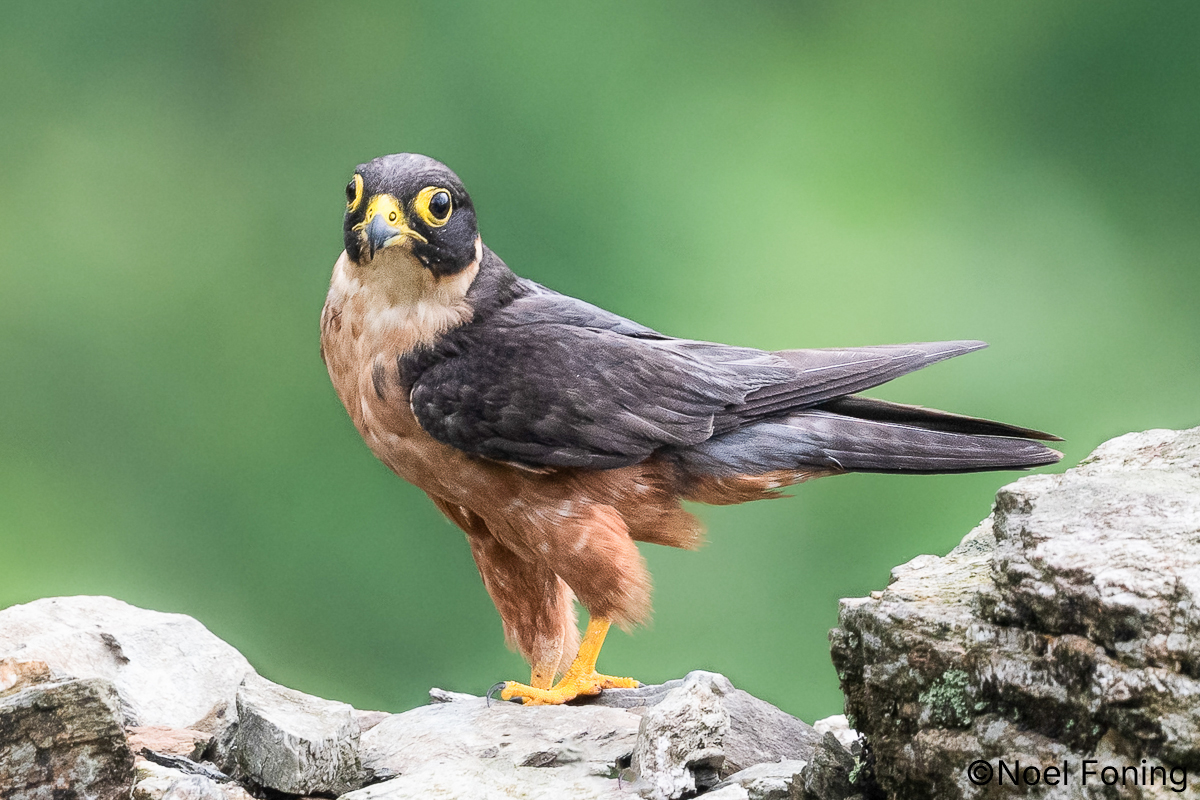
Oriental Hobby
- Common Name: Oriental Hobby
- Scientific Name: Falco severus
- Nepali Name(s): चिरान्तक बाज (Chirantak Baaz)
- IUCN Red List Status: Least Concern (LC)
- National Red List Status: Critically Endangered (CR)
- CITES Appendix: Appendix II
Measurements & Physical Profile
- Body Length: 24–30 cm
- Wingspan: 61–69 cm
- Weight: 168–249 g
Did You Know?
The Oriental Hobby is a sleek, dark-plumaged falcon known for its explosive aerial agility. Unlike other falcons that favor open steppes, this species is a true "forest hobby," adapted for high-speed hunting within and above the canopy of tropical and subtropical woodlands.
Distribution & Habitat
Global Distribution
Widely distributed across South and Southeast Asia, ranging from the Himalayan foothills and India through Myanmar, Thailand, and Indonesia to the Philippines.
Distribution within Nepal
A rare resident and passage migrant in the country. It is primarily sighted in the lowland Tarai, inner valleys, and forest fringes of the mid-hills. Sightings have been sparse and widely scattered, including records from the Kaski, Chitwan, and Makwanpur districts, as well as the Annapurna and Kanchenjunga conservation areas. Current reports are limited to isolated, lone individuals across various lowland and mid-hill regions.
Preferred Habitats
Open woodlands, forest edges, clearings, and plantations, often near water bodies or rivers. It requires scattered tall trees for perching and hunting, avoiding dense, unbroken forest interiors.
Elevational Range
Generally, inhabits lower elevations, ranging from the tropical plains up to approximately 1,500 meters during transit.
Seasonal Occurrence: Rare resident, with some individuals appearing as passage migrants depending on seasonal shifts.
Behavior & Ecology
Flight & Foraging Behavior
Possesses narrow, pointed wings characteristic of the Falco genus, allowing for extremely fast, direct flight and rapid, twisting maneuvers. It is an aggressive aerial hunter, often chasing prey at high speeds and performing spectacular mid-air captures.
Social & Roosting Habits
Typically, solitary or found in pairs. They are secretive during the day, roosting in thick foliage of tall trees to avoid detection, and become most active at dawn and dusk.
Diet & Ecosystem Role
Diet Breakdown
The Oriental Hobby is a specialized avian predator:
- Insects (Primary): Frequently consumes large, swarming insects such as dragonflies, beetles, and cicadas, often caught in mid-air.
- Birds: Hunts small birds, including swifts, swallows, and warblers, showing incredible speed and precision.
Ecological Role
Acts as an important natural regulator of insect populations, particularly those that form large swarms in forest clearings. Its presence also indicates a healthy environment with a diverse avian and insect community.
Breeding Biology
The breeding season typically occurs from March to May. Like many other hobby species, it does not build its own nest but utilizes abandoned stick nests of other birds, such as crows or other raptors, often high in tall trees. A typical clutch consists of 2 to 4 eggs. Incubation lasts about 28–30 days, and the young fledge in approximately 30–35 days.
Migration
- Status: Resident/Passage migrant.
- Movement: While many populations are resident, some individuals participate in regional movements or migration depending on food availability and local weather conditions.
Population Status
- Global Population Estimate: Unknown.
- Population Trend: Decreasing
- National Population Estimate (Nepal): Unknown.
- Monitoring & Surveys: No surveys and monitoring efforts have been conducted; recent records are based on opportunistic observation.
Threats
- Habitat Loss: Deforestation and the clearing of forest edges for agriculture reduce necessary hunting grounds and nesting sites.
- Pesticide Use: Secondary poisoning through the ingestion of insects contaminated by insecticides, which are commonly used in agricultural areas near forest edges.
- Disturbance: Human activity and noise pollution near nesting or foraging areas can lead to nest abandonment.
Conservation Actions
Existing Measures
- Legal Protections: Listed under CITES Appendix II, regulating the international trade of the species.
- Protected Area Foothold: Recorded within various lowland national parks and protected forest areas in Nepal.
Recommended Measures
- Habitat Preservation: Protecting forest edges, clearings, and large trees that provide essential nesting and perching sites.
- Chemical Regulation: Encouraging farmers to minimize broad-spectrum insecticide use in areas adjacent to forest habitats to protect the falcon's prey base.
- Awareness: Promoting scientific monitoring and public awareness of this rare raptor among local forest-dwelling communities.
References
- BirdLife International (2021). Species factsheet: Oriental Hobby Falco severus. Downloaded from https://datazone.birdlife.org/species/factsheet/oriental-hobby-falco-severus on 06/08/2026
- Clark, W. S., P. F. D. Boesman, and J. S. Marks (2020). Oriental Hobby (Falco severus), version 1.0. In Birds of the World (J. del Hoyo, A. Elliott, J. Sargatal, D. A. Christie, and E. de Juana, Editors). Cornell Lab of Ornithology, Ithaca, NY, USA. https://doi.org/10.2173/bow.orihob1.01
- Ferguson-Lees, J., & Christie, D. A. (2001). Raptors of the World. Christopher Helm, London.
- Inskipp C., Baral H. S., Phuyal S., Bhatt T. R., Khatiwada M., Inskipp, T, Khatiwada A., Gurung S., Singh P. B., Murray L., Poudyal L. and Amin R. (2016). The status of Nepal’s Birds: The national red list series. Zoological Society of London, UK.
- Naoroji, R. (2006). Birds of Prey of the Indian Subcontinent. Om Books International, New Delhi.
- The Peregrine Fund. (2026) Oriental Hobby. Available at: https://peregrinefund.org/explore-raptors-species/falcons/oriental-hobby (Accessed: 6 August 2026).