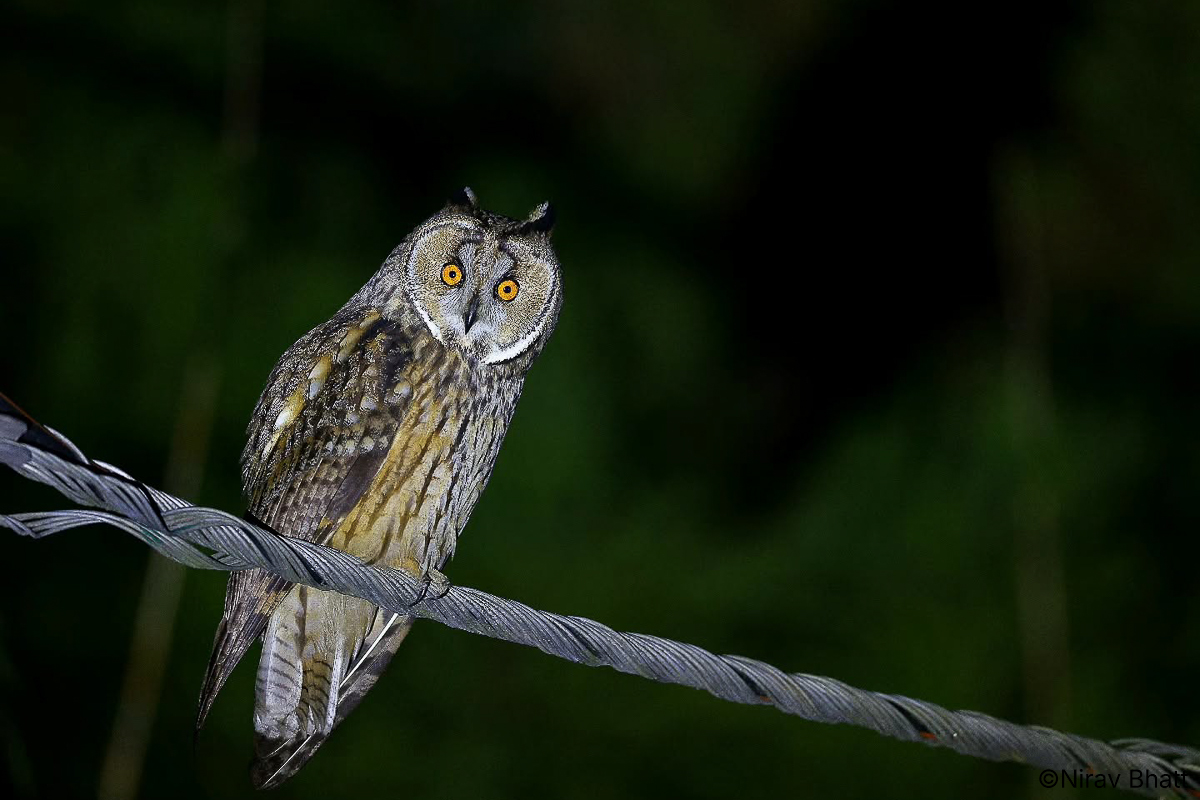
Long-eared Owl
- Common Name: Long-eared Owl
- Scientific Name: Asio otus
- Nepali Name(s): लामकाने लाटोकोसेरो (Lamkaane Latokosero)
- IUCN Red List Status: Least Concern (LC)
- National Red List Status: Least Concern (LC)
- CITES Appendix: Appendix II
- CMS Appendix: Not listed
Measurements & Physical Profile
- Body Length: 35–40 cm
- Wingspan: 90–100 cm
- Weight: 226–453 g
Did You Know?
The Long-eared Owl is famous for its remarkably long, prominent ear tufts, which it can erect to appear larger when threatened or hide flat against its head to become nearly invisible while roosting. It is a master of mimicry, often perching vertically and narrowing its body to resemble a broken tree branch, effectively blending into the surrounding foliage.
Distribution & Habitat
Global Distribution
The Long-eared Owl possesses a vast, widespread range across the Northern Hemisphere. It is extant as a resident or breeding species throughout much of Europe, North America, and parts of Asia, including Russia, China, India, and Japan. Additionally, it is present as a non-breeding or passage migrant across various Middle Eastern and North African nations. The species is also recognized as a vagrant in several regions, including parts of the Caribbean, East Asia, and the Middle East.
Distribution within Nepal
It is a rare vagrant species in Nepal. It is primarily recorded in Annapurna Conservation Area and Mustang. It is primarily recorded in the mid-elevation forest fringes during the winter months, when northern populations migrate south to escape the harshest continental conditions.
Preferred Habitats
Open forests, forest edges, plantations, and dense thickets or groves of trees often adjacent to open agricultural fields or grasslands, which provide ideal hunting grounds. They require dense cover for daytime roosting.
Elevational Range
Primarily recorded in the Himalayan Foothills and trans-Himalayas during migration season, suspected to winter in the lowland plains and lower foothills up to approximately 1,500 meters.
Seasonal Occurrence
Winter visitor. Individuals arrive in Nepal during the late autumn months and remain until early spring before returning to their northern breeding grounds.
Behavior & Ecology
Flight & Foraging Behavior
Exhibits a buoyant, silent, and moth-like flight pattern. It hunts primarily at night, often patrolling low over open fields or along the edges of woods, using its highly developed hearing to detect the slightest rustle of prey in vegetation.
Social & Roosting Habits
Highly gregarious during the winter months, often forming "communal roosts" in dense, leafy trees or conifers, where multiple individuals may cluster together for protection and warmth. They are strictly nocturnal and generally remain silent and inactive in their roosts during the day.
Diet & Ecosystem Role
Diet Breakdown
The Long-eared Owl is a specialized nocturnal predator:
- Mammals (Primary): Overwhelmingly consumes small rodents, particularly voles, mice, and occasionally young rats.
- Birds: Occasionally takes small passerine birds when rodent populations are low or when hunting near roosting flocks.
- Insects: Takes large insects opportunistically during the warmer months of its range.
Ecological Role
Acts as an essential nocturnal predator of small mammals, particularly rodents. By controlling rodent populations in and around agricultural landscapes, it provides significant natural pest-control services, helping to protect crops and maintain the balance of the ecosystem.
Breeding Biology
The Long-eared Owl does not breed in Nepal; it is a winter visitor. In its northern breeding range, the breeding season occurs from March to June. They are known for repurposing abandoned stick nests of other birds, such as crows, magpies, or hawks, rather than building their own. The female lays 5 to 7 pure white eggs, with incubation lasting approximately 26 to 28 days. Young leave the nest in 21 days, but they are still flightless; they are capable of flying in 35 days after incubation. They are fed by the male parent until 10–11 weeks old.
Migration
- Status: Migratory; winter visitor to Nepal.
- Movement: Undertakes significant seasonal migrations from northern breeding latitudes to temperate southern regions. During the winter in Nepal, they remain within specific, locally established winter home ranges before beginning their northward journey in spring.
Population Status
- Global Population Estimate: 2.2 – 3.7 million mature individuals.
- Population Trend: Decreasing.
- National Population Estimate (Nepal): Unknown.
- Monitoring & Surveys: No Monitoring activities conducted.
Threats
- Habitat Loss: The removal of dense tree groves, shelterbelts, and mature hedgerows in agricultural landscapes reduces essential winter roosting and hunting cover.
- Pesticide Use: Secondary poisoning through the consumption of rodents that have ingested rodenticides, a significant threat in agricultural areas.
- Disturbance: Human interference at communal roost sites can cause the owls to abandon safe wintering spots, leaving them exposed to predators or harsh weather.
Conservation Actions
Existing Measures
- Legal Protections: Listed under CITES Appendix II, regulating the international trade of the species.
- Protected Area Foothold: Wintering individuals are occasionally recorded within the boundaries of Nepal's lowland national parks and forest corridors.
Recommended Measures
- Roost Site Protection: Identifying and protecting communal winter roosting groves from logging and land development.
- Integrated Pest Management: Encouraging farmers to minimize the use of rodenticides, which protects the owls from secondary poisoning.
- Awareness: Educating local communities and visitors about the importance of respecting communal roost sites and avoiding disturbance to these winter residents.
References
- BirdLife International (2021). Species factsheet: Long-eared Owl Asio otus. Downloaded from https://datazone.birdlife.org/species/factsheet/long-eared-owl-asio-otus on 09/08/2026
- Inskipp C., Baral H. S., Phuyal S., Bhatt T. R., Khatiwada M., Inskipp, T, Khatiwada A., Gurung S., Singh P. B., Murray L., Poudyal L. and Amin R. (2016). The status of Nepal’s Birds: The national red list series. Zoological Society of London, UK.
- König, C., F. Weick, and J.-H. Becking (2008). Owls of the World. Second edition. Christopher Helm, London, UK.
- Marks, J. S., D. L. Evans, and D. W. Holt (2020). Long-eared Owl (Asio otus), version 1.0. In Birds of the World (S. M. Billerman, Editor). Cornell Lab of Ornithology, Ithaca, NY, USA. https://doi.org/10.2173/bow.loeowl.01
- The Peregrine Fund. (n.d.). Long-eared Owl. Available at: https://peregrinefund.org/explore-raptors-species/owls/long-eared-owl (Accessed: 9 August 2026).