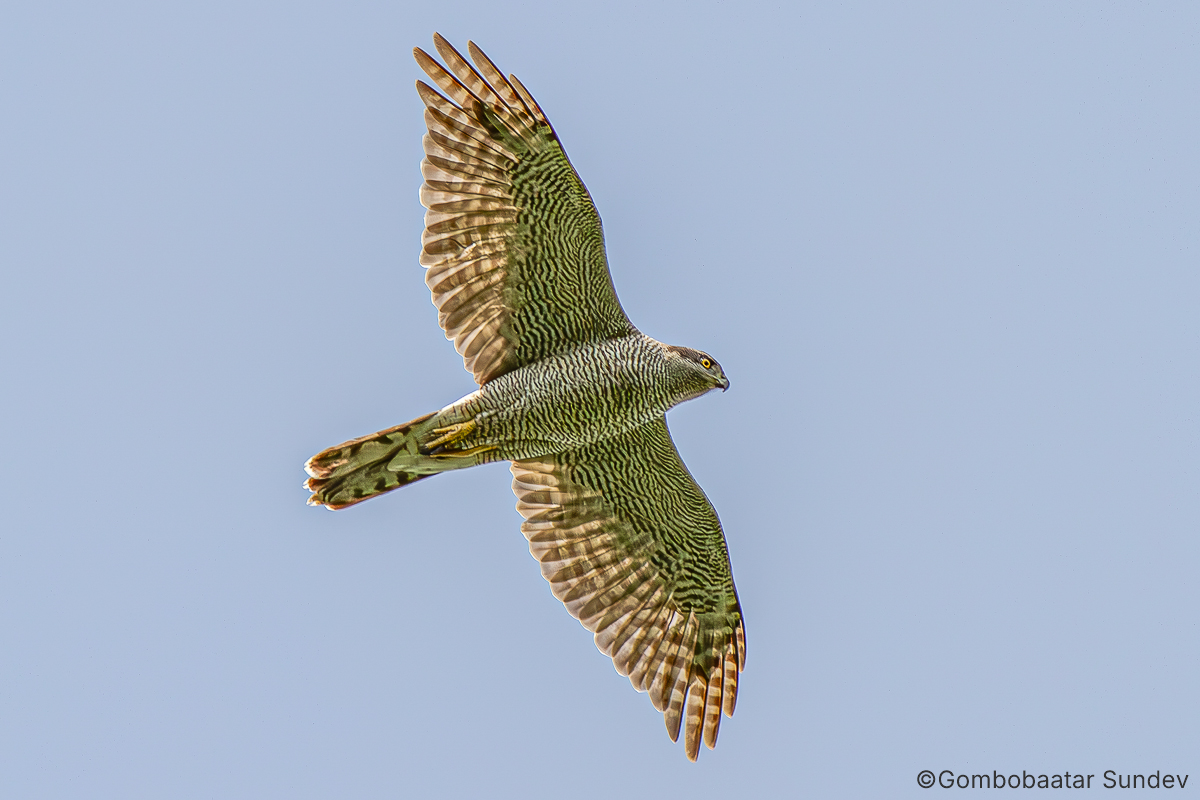
Northern Goshawk
- Common Name: Northern Goshawk
- Scientific Name: Accipiter gentilis
- Nepali Name(s): बलाकाँक्ष बनबाज़ (Balaakaanksha Banbaaz)
- IUCN Red List Status: Least Concern (LC)
- National Red List Status: Least Concern (LC)
- CITES Appendix: Appendix II
- CMS Appendix: Appendix II
Measurements & Physical Profile
- Body Length: 46–63 cm
- Wingspan: 89–122 cm
- Weight: 517–1,850 g
Did You Know?
The Northern Goshawk is often called the "phantom of the forest" due to its incredibly elusive nature and mastery of high-speed flight through dense timber. A powerful, muscular raptor with short, rounded wings and a long tail, it is designed for rapid acceleration and extreme maneuverability, allowing it to weave through thick trees to ambush unsuspecting prey.
Distribution & Habitat
Global Distribution
Widely distributed across the Northern Hemisphere, including Europe, Asia, and North America. Its range extends across the Himalayan chain, through parts of Central Asia, and into northern boreal forests.
Distribution within Nepal
A rare resident breeder and occasional passage migrant in the high-altitude forests of the Himalayas. Sightings are most consistent in the high-elevation zones of the western and central regions, including protected areas like the Annapurna Conservation Area and Langtang National Park.
Preferred Habitats
Prefers mature, dense coniferous forests, mixed woodlands, and alpine forest belts. It requires large, contiguous tracts of old-growth timber with clearings for hunting. It avoids open plains and urbanized environments.
Elevational Range
Typically found at high altitudes, primarily between 2,000 meters and 4,000 meters above sea level.
Seasonal Occurrence
Year-round resident in high-elevation forests. Some populations exhibit altitudinal migration, moving down into lower valleys during severe winter months when snow depth limits prey access.
Behavior & Ecology
Flight & Foraging Behavior
Features broad, rounded wings and a long, rudder-like tail, allowing for swift, agile navigation through dense canopy. It hunts via an ambush strategy, sitting silently on a perch to scan the area before initiating a powerful, low-altitude chase that ends in a sudden, precise strike.
Social & Roosting Habits
Predominantly solitary outside of the breeding season. They are highly territorial, fiercely defending their hunting and nesting grounds. They roost deep within dense foliage or high in the canopy to remain concealed from potential rivals and human disturbance.
Diet & Ecosystem Role
Diet Breakdown
The Northern Goshawk is a highly aggressive and versatile predator:
- Birds (Primary): Frequently targets forest birds, including grouse, pheasants, pigeons, and crows.
- Mammals: Hunts small-to-medium-sized mammals, including hares, squirrels, and marmots.
- Other: Opportunistically takes reptiles or larger insects when other prey is scarce.
Ecological Role
Acts as an apex predator in high-altitude forest ecosystems. By managing populations of medium-sized forest herbivores and birds, it helps maintain the balance of the forest community and acts as a biological indicator of old-growth forest integrity.
Breeding Biology
The breeding season in Nepal occurs from March through July. Pairs perform dramatic aerial displays, featuring steep glides and circular flights. They build large, bulky stick nests high in the main fork of tall, mature trees (often conifers). The female lays 2 to 4 eggs. Incubation lasts about 35–38 days, and the young fledge after approximately 40–45 days.
Migration
- Status: Permanent resident; altitudinal migrant.
- Movement: Adults generally remain within their home range year-round. Immature birds engage in nomadic dispersal to establish their own territories. In winter, some individuals migrate to lower valleys when high-altitude hunting grounds become inaccessible.
Population Status
- Global Population Estimate: 1 – 2.5 million mature individuals.
- Population Trend: Unknown.
- National Population Estimate (Nepal): Unknown.
- Monitoring & Surveys: No systematic surveys in Nepal, occasional observations along migratory corridors.
Threats
- Habitat Fragmentation: The loss of large, old-growth forest patches due to road construction and timber extraction destroys necessary breeding and hunting cover.
- Human Disturbance: High-altitude development and trekking tourism can lead to nest desertion.
- Prey Depletion: The reduction of forest bird and mammal populations through local hunting pressure impacts the Goshawk's survival.
Conservation Actions
Existing Measures
- Legal Protections: Listed under CITES Appendix II and CMS Appendix II to ensure international regulatory protection.
- Protected Area Foothold: Core populations are found within Nepal's mountain national park system.
Recommended Measures
- Old-Growth Preservation: Protecting contiguous forest blocks from logging and infrastructure encroachment.
- Disturbance Management: Implementing quiet-zones around active nesting sites during the spring breeding window.
- Research & Awareness: Increasing scientific monitoring of high-altitude populations and engaging local communities in forest biodiversity protection.
References
- BirdLife International (2021). Species factsheet: Northern Goshawk Accipiter gentilis. Downloaded from https://datazone.birdlife.org/species/factsheet/northern-goshawk-accipiter-gentilis on 06/08/2026
- Ferguson-Lees, J., & Christie, D. A. (2001). Raptors of the World. Christopher Helm, London.
- Inskipp C., Baral H. S., Phuyal S., Bhatt T. R., Khatiwada M., Inskipp, T, Khatiwada A., Gurung S., Singh P. B., Murray L., Poudyal L. and Amin R. (2016). The status of Nepal’s Birds: The national red list series. Zoological Society of London, UK.
- Mlodinow, S. G. (2024). Eurasian Goshawk (Astur gentilis), version 1.1. In Birds of the World (N. D. Sly, Editor). Cornell Lab of Ornithology, Ithaca, NY, USA. https://doi.org/10.2173/bow.norgos1.01.1