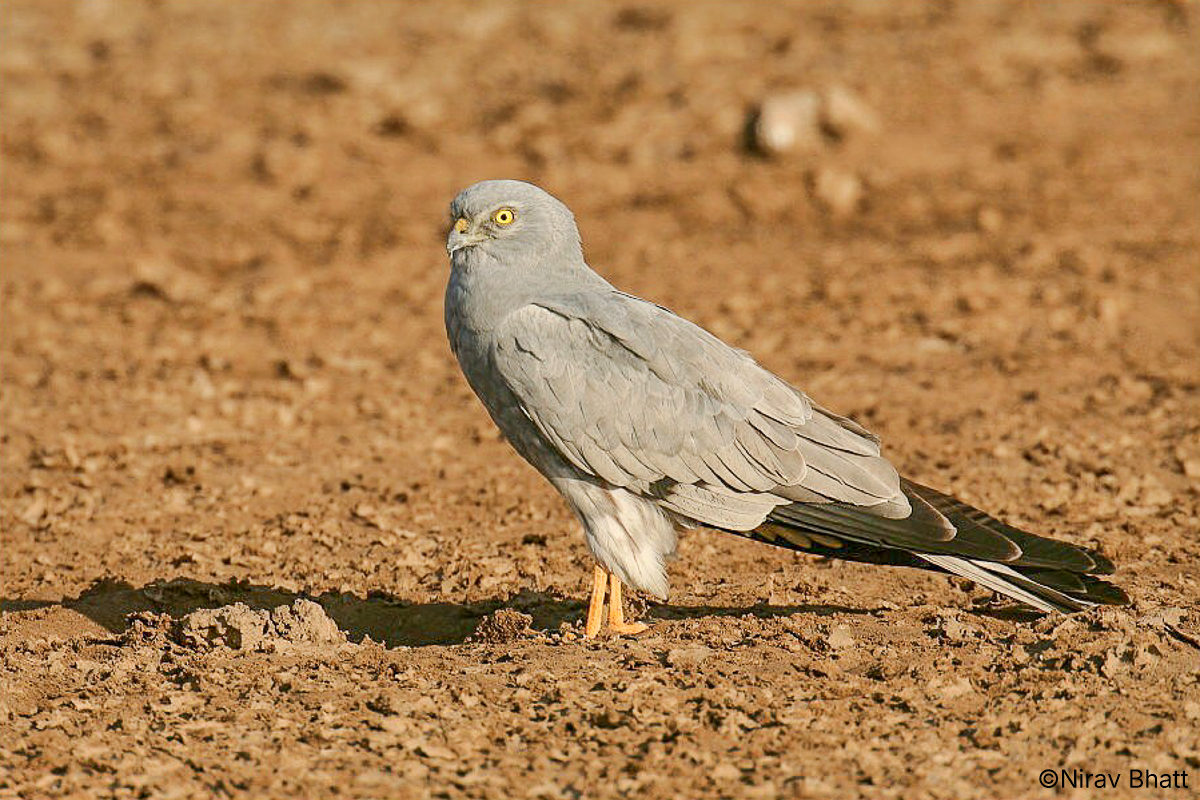
Montagu's Harrier
- Common Name: Montagu's Harrier
- Scientific Name: Circus pygargus
- Nepali Name(s): मोन्टागु भुइँचिल (Montagu Bhuichil)
- IUCN Red List Status: Least Concern (LC)
- National Red List Status (Nepal): Critically Endangered (CR)
- CITES Appendix: Appendix II
- CMS Appendix: Appendix II
Measurements & Physical Profile
- Body Length: 39–49 cm
- Wingspan: 102–123 cm
- Weight: 227–445 g
Did You Know?
Named after the British naturalist George Montagu, this species is one of the most elegant aerial hunters in the Circus genus. It is famous for its intricate "sky-dancing" courtship displays, where the male and female perform acrobatic maneuvers and mid-air food passes. As a long-distance migrant, some individuals travel thousands of kilometers between European breeding grounds and wintering sites in Africa and India.
Distribution & Habitat
Global Distribution
Breeds across Europe and Central Asia; winters in sub-Saharan Africa, the Indian subcontinent, and Southeast Asia.
Distribution within Nepal
A rare passage migrant and winter visitor, primarily sighted in open agricultural plains, wetlands, and grasslands of the southern Tarai and occasionally in river valleys.
Preferred Habitats
Open grasslands, marshes, cereal fields, and wet meadows.
Elevational Range
Ranges from lowland plains up to 1,500 meters during transit.
Behavior & Ecology
Flight & Foraging Behavior
Characterized by low, graceful, gliding flight with wings held in a distinct "V" shape, often hovering momentarily over tall grass to scan for prey. It forages by quartering open ground at low altitudes, relying on acute hearing and vision to detect prey hidden in vegetation.
Diet & Ecosystem Role
- Diet: Primarily insects (grasshoppers, locusts), small mammals (voles, mice), small birds, and occasionally reptiles/amphibians.
- Ecosystem Role: Provides vital pest control services by consuming large quantities of crop-eating insects and rodents in agricultural landscapes.
Breeding Biology
Breeding occurs from May to July, primarily in Europe and Central Asia. Pairs build nests on the ground within dense vegetation or cereal crops. A typical clutch size is 3 to 5 eggs. Incubation lasts 28–30 days, performed solely by the female, while the male provides food. Fledging takes approximately 35–40 days. As this species is a migrant in Nepal, nesting does not occur locally.
Migration
- Status: A long-distance, intra-continental migrant.
- Routes & Timing: Migrates from northern breeding grounds to wintering sites in Africa and South Asia, with southward migration beginning in late summer and the northward return happening in early spring.
Population Status
- Global Population: 300,000 – 550,000 mature individuals
- Population Trend: Decreasing.
- National Population (Nepal): 10 – 50 individuals.
Threats
- Habitat Loss: Conversion of grasslands and wetlands to intensive agricultural land and urban development.
- Pesticides: Significant threat due to the heavy use of chemical insecticides reducing their insect prey base.
- Disturbance: Human activity and motorized traffic in key wintering foraging grounds.
Conservation Actions
Existing Measures
- Protected Areas: Migrants utilize protected wetland complexes and grasslands in the Tarai.
Recommended Measures
- Habitat Protection: Protecting tall-grass meadows and wetlands.
- Integrated Pest Management: Promoting integrated pest management to ensure prey availability.
- Ecological Corridors: Maintaining ecological corridors across the Tarai landscape.
References
- BirdLife International (2021). Species factsheet: Montagu's Harrier Circus pygargus. Downloaded from https://datazone.birdlife.org/species/factsheet/montagus-harrier-circus-pygargus on 06/08/2026
- Ferguson-Lees, J., & Christie, D. A. (2001). Raptors of the World. Christopher Helm, London.
- Inskipp C., Baral H. S., Phuyal S., Bhatt T. R., Khatiwada M., Inskipp, T, Khatiwada A., Gurung S., Singh P. B., Murray L., Poudyal L. and Amin R. (2016). The status of Nepal’s Birds: The national red list series. Zoological Society of London, UK.
- Orta, J., E. de Juana, P. F. D. Boesman, J. S. Marks, and E. Garcia (2020). Montagu's Harrier (Circus pygargus), version 1.0. In Birds of the World (J. del Hoyo, A. Elliott, J. Sargatal, D. A. Christie, and E. de Juana, Editors). Cornell Lab of Ornithology, Ithaca, NY, USA. https://doi.org/10.2173/bow.monhar1.01