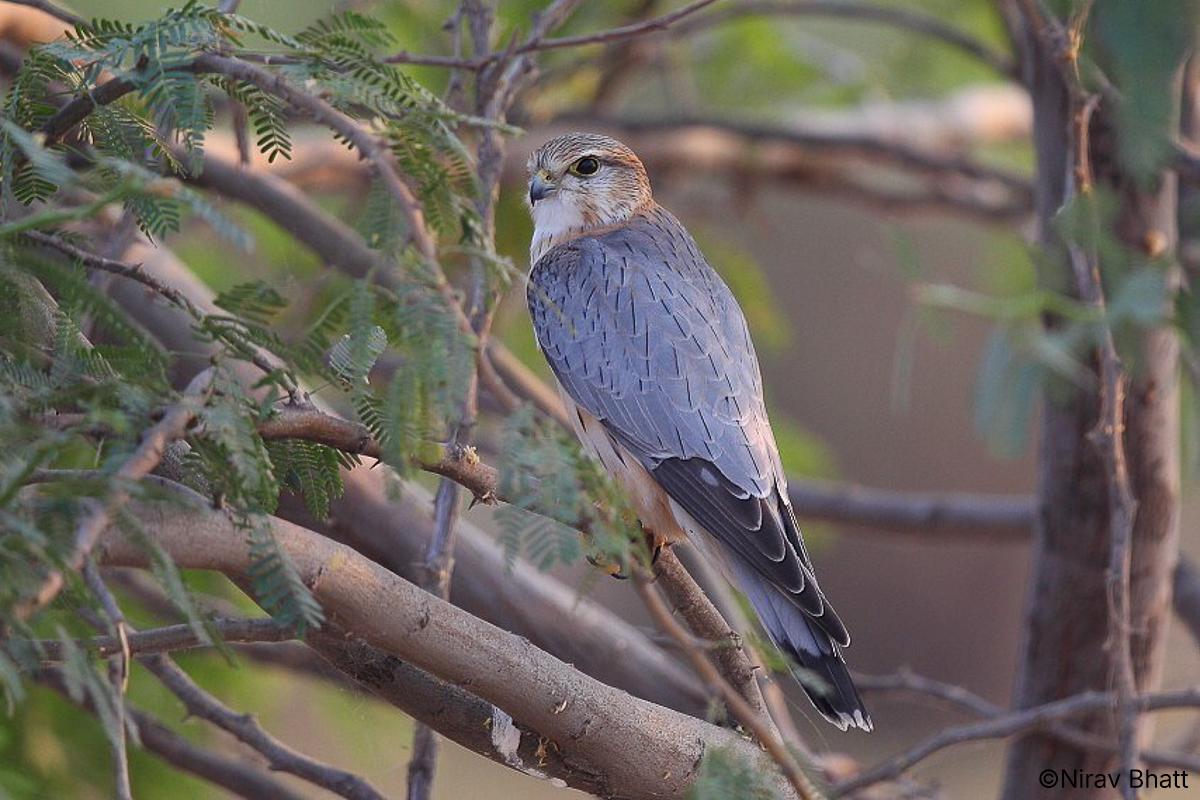
Merlin
- Common Name: Merlin
- Scientific Name: Falco columbarius
- Nepali Name(s): सानो बाज (Sano Baaz)
- IUCN Red List Status: Least Concern (LC)
- National Red List Status (Nepal): Least Concern (LC)
- CITES Appendix: Appendix II
- CMS Appendix: Appendix II
Measurements & Physical Profile
- Body Length: 24–33 cm
- Wingspan: 50–73 cm
- Weight: 165–230 g
Did You Know?
The Merlin is a master of aerial pursuit, often described as a "falcon of the shadows." It is known for its incredibly aggressive hunting style, where it relies on speed and surprise to chase down much larger prey species in mid-air. It is one of the smallest falcons globally, yet it possesses a tenacity that allows it to dominate landscapes across both northern and southern hemispheres.
Distribution & Habitat
Global Distribution
Holarctic distribution; breeds across North America, Europe, and Asia, and winters in southern regions including South America, Africa, and the Indian subcontinent.
Distribution within Nepal
A rare and localized winter visitor, occasionally sighted in open woodlands, forest edges, and agricultural plains of the Tarai and mid-hills.
Preferred Habitats
Open country, grasslands, forest edges, moorlands, and coastal areas.
Elevational Range
Ranges from the lowland plains up to 3,000 meters during migration.
Behavior & Ecology
Flight & Foraging Behavior
Exhibits rapid, agile, and low-level flight, characterized by quick wing beats and sudden bursts of speed. It is a highly aggressive aerial hunter, often chasing prey at high speeds near the ground or through vegetation.
Diet & Ecosystem Role
- Diet Breakdown: Primarily consumes small birds (such as larks, pipits, and sparrows), but also hunts large insects and small mammals.
- Ecosystem Role: Functions as a highly specialized avian predator, helping to regulate small bird populations and acting as an indicator of healthy, open-country insect and bird communities.
Breeding Biology
The breeding season occurs from May to July in northern latitudes. Merlins do not build their own nests; they typically take over the abandoned stick nests of other raptors or corvids located in trees or on cliffs. A clutch usually contains 3 to 6 eggs. Incubation lasts 28–32 days, carried out mostly by the female. Fledging takes approximately 25–30 days. As a winter visitor to Nepal, breeding behavior and nesting are not documented within the country.
Migration
- Status: Long-distance migrant.
- Movement: Migrates from northern breeding grounds (taiga and tundra regions) to wintering areas across the temperate and tropical regions of the world. Southward movement occurs in autumn, and the northward return begins in early spring.
Population Status
- Global Population: 250,000 – 3,200,000 mature individuals
- Population Trend: Stable.
- National Population (Nepal): Unknown.
Threats
- Habitat Loss: Degradation of open grasslands and forest edges due to land-use changes.
- Pesticides: Secondary poisoning from eating birds that have consumed contaminated insects or seeds.
- Disturbance: Human activity in open areas used for foraging during winter months.
Conservation Actions
Existing Measures
- Protected Areas: Migrants occasionally use protected lowland areas, but the species is highly dependent on wider agricultural landscapes.
Recommended Measures
- Habitat Protection: Protecting open grassland patches.
- Monitoring: Monitoring migration corridors.
- Sustainable Agriculture: Promoting sustainable agricultural practices to reduce pesticide use.
References
- BirdLife International (2021). Species factsheet: Merlin Falco columbarius. Downloaded from https://datazone.birdlife.org/species/factsheet/merlin-falco-columbarius on 06/08/2026
- Ferguson-Lees, J., & Christie, D. A. (2001). Raptors of the World. Christopher Helm, London.
- Inskipp C., Baral H. S., Phuyal S., Bhatt T. R., Khatiwada M., Inskipp, T, Khatiwada A., Gurung S., Singh P. B., Murray L., Poudyal L. and Amin R. (2016). The status of Nepal’s Birds: The national red list series. Zoological Society of London, UK.
- Warkentin, I. G., N. S. Sodhi, R. H. M. Espie, A. F. Poole, L. W. Oliphant, and P. C. James (2020). Merlin (Falco columbarius), version 1.0. In Birds of the World (S. M. Billerman, Editor). Cornell Lab of Ornithology, Ithaca, NY, USA. https://doi.org/10.2173/bow.merlin.01