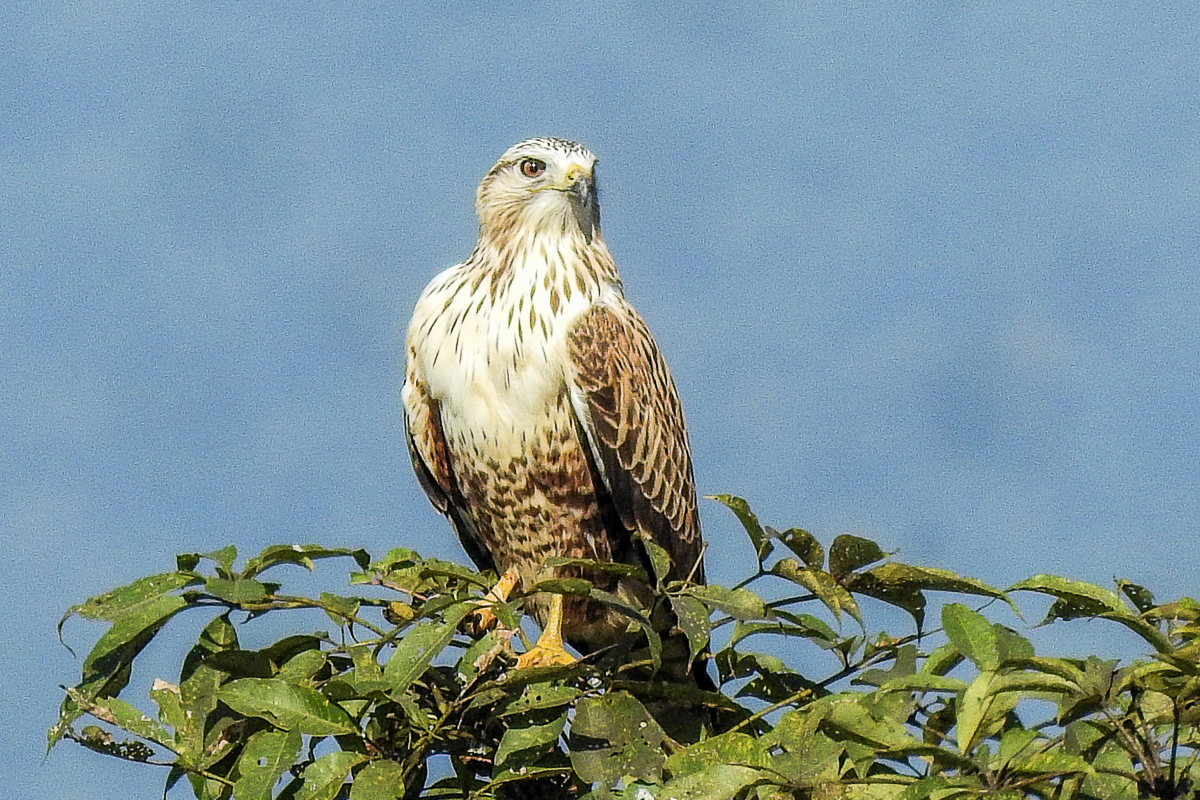
Long-legged Buzzard
- Common Name: Long-legged Buzzard
- Scientific Name: Buteo rufinus
- Nepali Name(s): लामखुट्टे श्येनबाज (Lamkhutte Shyenbaaz)
- IUCN Red List Status: Least Concern (LC)
- National Red List Status (Nepal): Least Concern (LC)
- CITES Appendix: Appendix II
- CMS Appendix: Appendix II
Measurements & Physical Profile
- Body Length: 43–62 cm
- Wingspan: 125–160 cm
- Weight: 590–1,760 g
Did You Know?
True to its name, the Long-legged Buzzard possesses notably longer, more unfeathered tarsi (lower legs) than other Buteo species, an evolutionary adaptation that helps it remain cool while standing on the scorching, arid ground of its native desert and steppe habitats. It is also one of the largest buzzards in the world.
Distribution & Habitat
Global Distribution
Breeds from southeastern Europe across Central Asia and the Middle East, wintering in parts of North Africa, the Arabian Peninsula, and the Indian subcontinent.
Distribution within Nepal
A scarce winter visitor, primarily recorded in the western Tarai, the high-altitude arid regions of the trans-Himalayas (like Mustang and Manang), and open grasslands.
Preferred Habitats
Open, arid, or semi-arid landscapes, including steppes, semi-deserts, agricultural plains, and rocky mountain foothills.
Elevational Range
Ranges from low-lying plains during winter to high-altitude mountain slopes up to 4,000 meters.
Behavior & Ecology
Flight & Foraging Behavior
Soars on thermals with wings held in a distinct "V" shape and often hovers to scan for prey. It is primarily a sit-and-wait predator, perching on elevated posts or patrolling low over open ground to ambush prey.
Diet & Ecosystem Role
- Diet: Primarily consumes small mammals (gerbils, voles, hamsters, and ground squirrels), but also takes small birds, large insects (locusts), and occasionally snakes or lizards.
- Ecosystem Role: Regulates small mammal and insect populations in open, arid environments, preventing local overpopulation of rodent species that can damage agricultural crops.
Breeding Biology
The breeding season occurs from March to May in its northern breeding grounds. Pairs build large, bulky stick nests on cliff ledges or in isolated trees. A typical clutch consists of 2 to 4 eggs. Incubation lasts approximately 28–30 days, performed mostly by the female, and fledging takes about 40–45 days. Breeding behavior and nesting are not documented within Nepal.
Migration
- Status: Either a total or a partial migrant; populations in the northern part of its range move south for the winter.
- Routes & Timing: Migrates from Central Asian and European breeding grounds to wintering sites in South Asia and North Africa, with southward migration occurring in autumn and the return journey beginning in early spring.
Population Status
- Global Population: 100,000 – 500,000 mature individuals
- Population Trend: Stable.
- National Population (Nepal): Unknown.
Threats
- Habitat Loss: Conversion of open grasslands and semi-arid steppes into intensive industrial agriculture.
- Pesticides: Secondary poisoning from eating rodents that have been exposed to rodenticides.
- Electrocution: Risk of injury or death from landing on uninsulated high-voltage power lines.
- Disturbance: Human encroachment in arid mountain regions where they forage during winter.
Conservation Actions
Existing Measures
- Protected Areas: Migrants utilize large-scale protected landscapes and arid zones throughout Nepal.
Recommended Measures
- Habitat Preservation: Retaining natural grassland habitats.
- Chemical Regulation: Reducing the use of rodenticides.
- Infrastructure Safety: Insulating power infrastructure in key wintering hotspots.
References
- BirdLife International (2021). Species factsheet: Long-legged Buzzard Buteo rufinus. Downloaded from https://datazone.birdlife.org/species/factsheet/long-legged-buzzard-buteo-rufinus on 06/08/2026
- Ferguson-Lees, J., & Christie, D. A. (2001). Raptors of the World. Christopher Helm, London.
- Inskipp C., Baral H. S., Phuyal S., Bhatt T. R., Khatiwada M., Inskipp, T, Khatiwada A., Gurung S., Singh P. B., Murray L., Poudyal L. and Amin R. (2016). The status of Nepal’s Birds: The national red list series. Zoological Society of London, UK.
- Naoroji, R. (2006). Birds of Prey of the Indian Subcontinent. Om Books International, New Delhi.
- Orta, J., P. F. D. Boesman, G. M. Kirwan, and J. S. Marks (2020). Long-legged Buzzard (Buteo rufinus), version 1.0. In Birds of the World (J. del Hoyo, A. Elliott, J. Sargatal, D. A. Christie, and E. de Juana, Editors). Cornell Lab of Ornithology, Ithaca, NY, USA. https://doi.org/10.2173/bow.lolbuz1.01