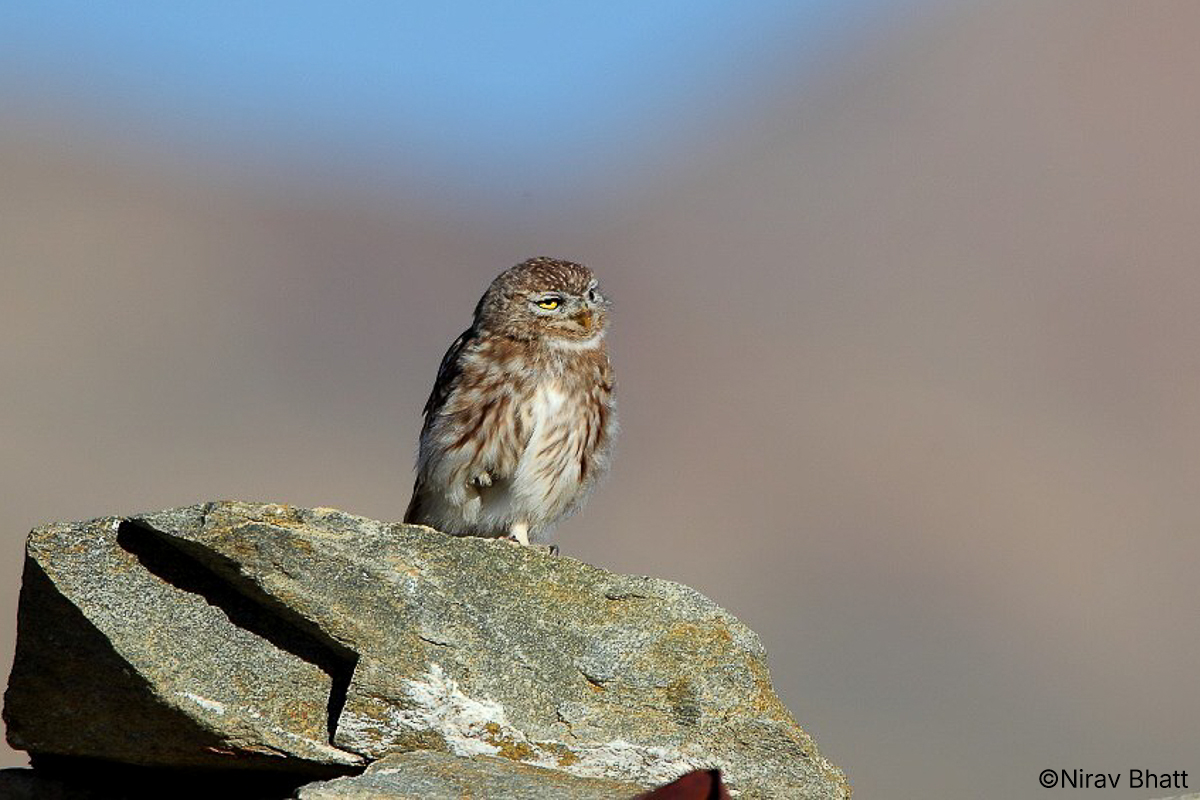
Little Owl
- Common Name: Little Owl
- Scientific Name: Athene noctua
- Nepali Name(s): हिमाली कोचलगाँडे लाटोकोसेरो (Himali Kochalgaande Laatokosero)
- IUCN Red List Status: Least Concern (LC)
- National Red List Status (Nepal): Uncommon Resident
- CITES Appendix: Appendix II
Measurements & Physical Profile
- Body Length: 21–23 cm
- Wingspan: 54–58 cm
- Weight: 162–206 g
Did You Know?
The Little Owl is often seen perched in broad daylight on fence posts or telegraph wires, frequently bobbing its head up and down when agitated or curious. In ancient Greece, this species was considered the symbol of Athena, the goddess of wisdom, which is reflected in its scientific genus name, Athene.
Distribution & Habitat
Global Distribution
Widespread across Europe, North Africa, and temperate Asia, including the Middle East, Central Asia, and the Himalayan region.
Distribution within Nepal
Primarily restricted to the drier, trans-Himalayan, and high-altitude regions of northern Nepal, particularly in Mustang, Manang, and parts of the Dolpo district.
Preferred Habitats
Open landscapes, semi-arid regions, rocky hillsides, old stone walls, ruins, and agricultural lands with scattered trees.
Elevational Range
Occurs from 2,000 meters up to 4,500 meters in the arid trans-Himalayan zones.
Behavior & Ecology
Foraging Behavior
Primarily a "sit-and-wait" predator, watching from a perch and dropping to the ground to snatch prey, or chasing insects on foot.
Diet & Ecosystem Role
- Diet: Primarily insects (beetles, earwigs, grasshoppers), small rodents (voles, mice), and occasionally small birds, reptiles, and earthworms.
- Ecosystem Role: Acts as a key predator of agricultural pests in mountain landscapes, helping to control rodent and insect populations in high-altitude environments where other forest-dwelling owls cannot survive.
Breeding Biology
The breeding season occurs from April to June. Secondary cavity nester; utilizes natural holes in trees, crevices in rocky cliffs, or holes in old stone buildings and ruins. No nest material is used. Lays 3 to 6 white, rounded eggs. Incubation lasts about 28–33 days, performed by the female while the male provides food. Chicks fledge in approximately 30–35 days and remain under parental care for one month after fledging.
Migration
- Status: Sedentary species; it remains within its established territory year-round and does not undertake seasonal migrations.
Population Status
- Global Population: 5 – 10 million mature individuals.
- Population Trend: Stable
- National Population (Nepal): Unknown.
Threats
- Habitat Loss: Loss of traditional agricultural landscapes and destruction of old stone structures that provide nesting sites.
- Pesticides: Secondary poisoning from eating rodents exposed to rodenticides.
- Disturbance: Human disturbance near nesting sites, especially in tourist-frequented trans-Himalayan areas.
Conservation Actions
Existing Measures
- Protected Areas: Populations are monitored within high-altitude protected areas like the Annapurna Conservation Area.
Recommended Measures
- Habitat Preservation: Preservation of traditional stone buildings and ruins.
- Community Education: Educating local communities on the ecological value of these owls for pest control.
References
- BirdLife International (2018). Species factsheet: Little Owl Athene noctua. Downloaded from https://datazone.birdlife.org/species/factsheet/little-owl-athene-noctua on 09/08/2026
- Holt, D. W., R. Berkley, C. Deppe, P. L. Enríquez, J. L. Petersen, J. L. Rangel Salazar, K. P. Segars, K. L. Wood, G. M. Kirwan, D. A. Christie, and J. S. Marks (2020). Little Owl (Athene noctua), version 1.0. In Birds of the World (J. del Hoyo, A. Elliott, J. Sargatal, D. A. Christie, and E. de Juana, Editors). Cornell Lab of Ornithology, Ithaca, NY, USA. https://doi.org/10.2173/bow.litowl1.01
- Inskipp C., Baral H. S., Phuyal S., Bhatt T. R., Khatiwada M., Inskipp, T, Khatiwada A., Gurung S., Singh P. B., Murray L., Poudyal L. and Amin R. (2016). The status of Nepal’s Birds: The national red list series. Zoological Society of London, UK.
- König, C., F. Weick, and J.-H. Becking (2008). Owls of the World. Second edition. Christopher Helm, London, UK.