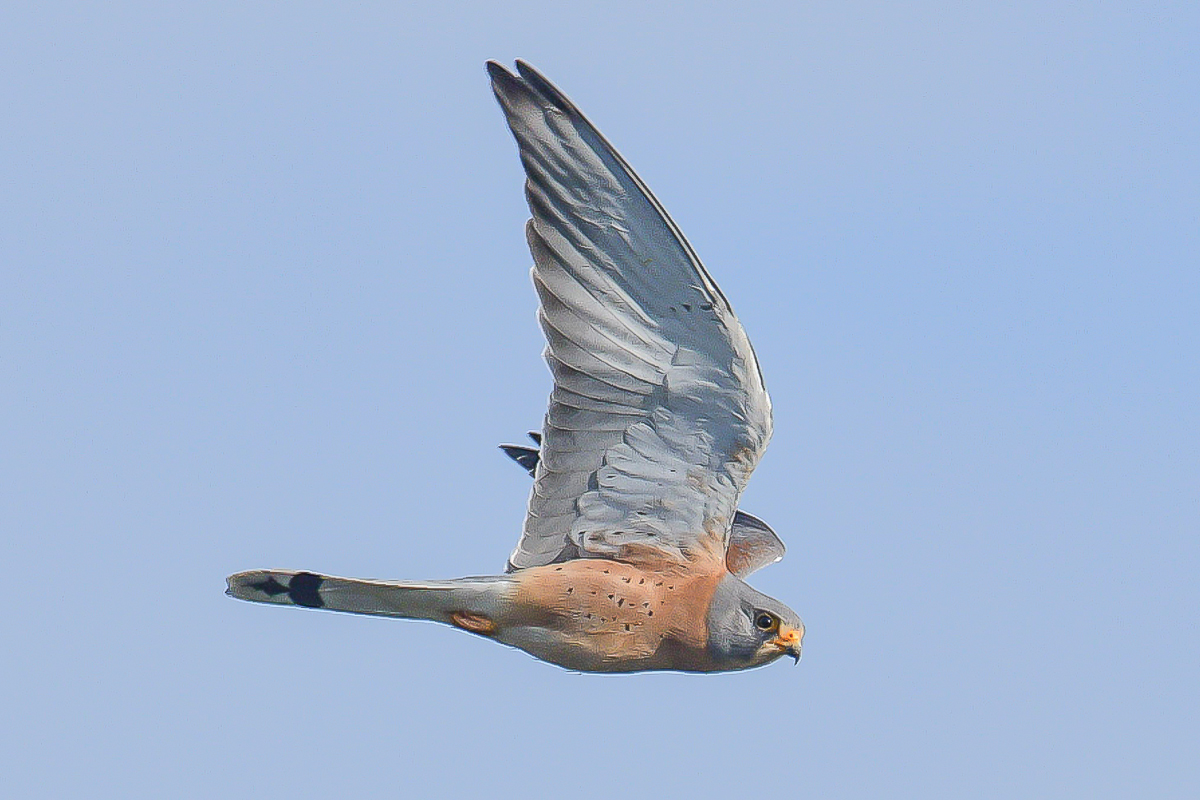
Lesser Kestrel
- Common Name: Lesser Kestrel
- Scientific Name: Falco naumanni
- Nepali Name(s): सानो बौँडाई (Sano Boundai)
- IUCN Red List Status: Least Concern (LC)
- National Red List Status (Nepal): Near Threatened (NT)
- CITES Appendix: Appendix II
- CMS Appendix: Appendix I & II
Measurements & Physical Profile
- Body Length: 29–32 cm
- Wingspan: 58–73 cm
- Weight: 90–208 g
Did You Know?
Unlike most falcons which are solitary, the Lesser Kestrel is highly social and colonial, often nesting in dense groups in holes in buildings, walls, or cliffs. While in Nepal, they are rarely seen nesting but are occasionally observed in small, nomadic feeding flocks.
Distribution & Habitat
Global Distribution
A long-distance migrant that breeds across the Mediterranean and Central Asia and winters primarily in sub-Saharan Africa, though smaller numbers regularly winter or pass through the Indian Subcontinent.
Distribution within Nepal
A rare and sporadic winter visitor and passage migrant, with records mostly involving small numbers in the lowlands and open areas of the Tarai.
Preferred Habitats
Open country, including grasslands, agricultural fields, and semi-arid steppes. In winter, they favor regions with abundant insect life, often congregating in large groups to exploit temporary food flushes.
Behavior & Ecology
Foraging Behavior
A social hunter that often forages in groups. They frequently hover or "kite" in the air while scanning the ground before dropping on prey.
Diet & Ecosystem Role
- Diet: Primarily an insectivore (grasshoppers, locusts, beetles) during the breeding season. In wintering areas, they remain heavily reliant on insects but may take small reptiles or rodents.
- Ecosystem Role: Because they feed in large groups on swarming insects, they act as important natural suppressors of agricultural pest outbreaks.
Breeding Biology
Breeding occurs from April to July in the western parts of its range (Europe/Central Asia). Colonial nester; utilizes holes in old buildings, stone masonry, or cliff crevices. Lays 3 to 5 eggs. Incubation lasts for approximately 28–30 days; fledging occurs within 35–40 days.
Migration
- Status: Long-distance migrant.
- Movement: Travels thousands of kilometers annually, with populations moving between Palearctic breeding grounds and African/South Asian wintering areas.
Population Status
- Global Population: 80,000 – 134,000 mature individuals.
- Population Trend: Stable
- National Population (Nepal): Unknown.
Threats
- Habitat Loss: Intensive agriculture and the removal of old, cavity-rich buildings and stone structures in breeding areas.
- Pesticide Use: Significant reduction of insect prey populations due to widespread use of broad-spectrum insecticides.
- Climate Change: Affects the timing of insect emergence, which can lead to a mismatch in food availability during the critical breeding and migration periods.
Conservation Actions
Existing Measures
- International: Protected under CITES Appendix II and CMS Appendix I & II.
Recommended Measures
- Building Preservation: Promote the maintenance of old buildings and ruins that provide critical colonial nesting holes in breeding ranges.
- Insecticide Regulation: Reduce the use of heavy insecticides in foraging areas to ensure an adequate supply of insect biomass for migrating flocks.
- Monitoring: Increase ornithological surveys in the Tarai during the winter months to better understand the frequency and habitat usage of this rare visitor.
References
- BirdLife International (2021). Species factsheet: Lesser Kestrel Falco naumanni. Downloaded from https://datazone.birdlife.org/species/factsheet/lesser-kestrel-falco-naumanni on 06/08/2026
- Ferguson-Lees, J., & Christie, D. A. (2001). Raptors of the World. Christopher Helm, London.
- Inskipp C., Baral H. S., Phuyal S., Bhatt T. R., Khatiwada M., Inskipp, T, Khatiwada A., Gurung S., Singh P. B., Murray L., Poudyal L. and Amin R. (2016). The status of Nepal’s Birds: The national red list series. Zoological Society of London, UK.
- Orta, J. and G. M. Kirwan (2020). Lesser Kestrel (Falco naumanni), version 1.0. In Birds of the World (J. del Hoyo, A. Elliott, J. Sargatal, D. A. Christie, and E. de Juana, Editors). Cornell Lab of Ornithology, Ithaca, NY, USA. https://doi.org/10.2173/bow.leskes1.01