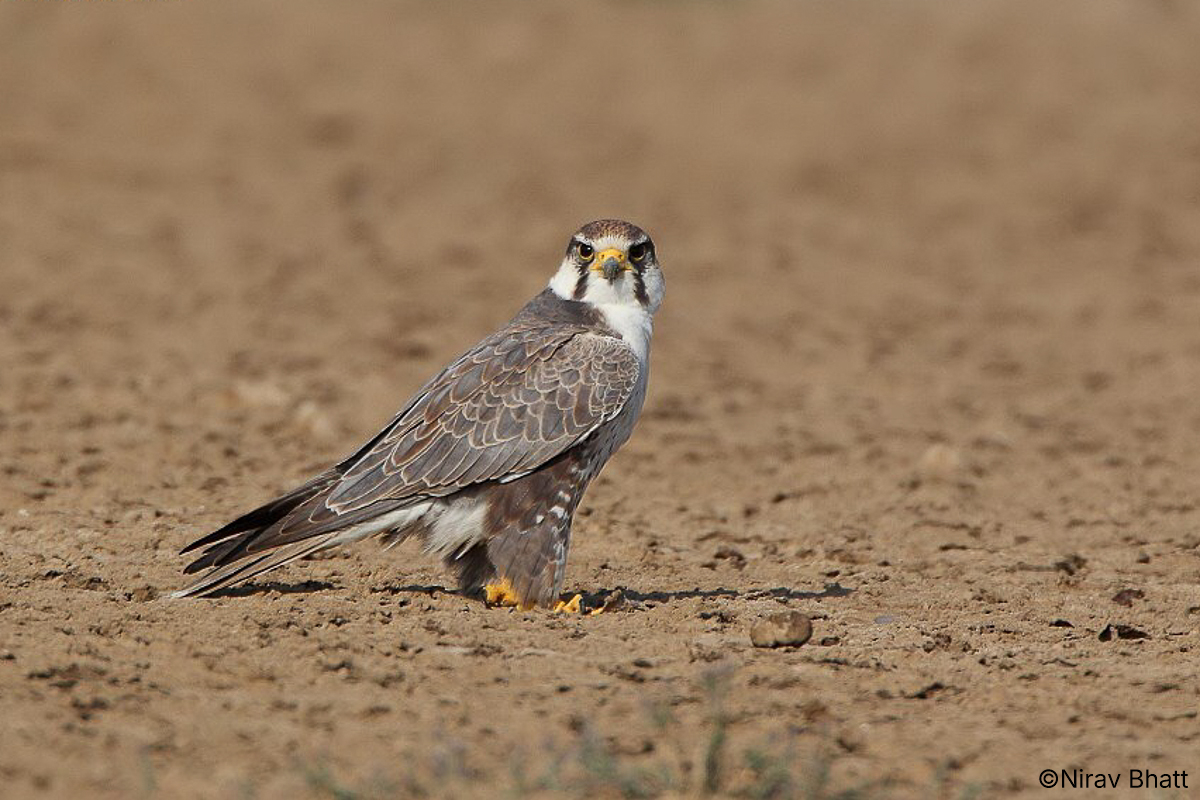
Laggar Falcon
- Common Name: Laggar Falcon
- Scientific Name: Falco jugger
- Nepali Name(s): लागर वाज (Laagar Baaz)
- IUCN Red List Status: Near Threatened (NT)
- National Red List Status (Nepal): Critically Endangered (CR)
- CITES Appendix: Appendix I
- CMS Appendix: Not listed
Measurements & Physical Profile
- Body Length: 39–46 cm
- Wingspan: 88–107 cm
- Weight: 525–850 g
Did You Know?
The Laggar Falcon is one of the most culturally significant raptors in the Indian subcontinent, historically prized and trained for falconry by royalty. Unlike many other falcons that strictly favor pristine wilderness, the Laggar has shown a unique ability to adapt to human-altered landscapes, though this proximity often puts it in conflict with modern infrastructure and pesticides.
Distribution & Habitat
Global Distribution
Endemic to the Indian subcontinent; found in Pakistan, India, Nepal, and potentially parts of Bangladesh and Myanmar.
Distribution within Nepal
A scarce resident primarily found in the southern Tarai and lower foothills, particularly in open agricultural landscapes and dry riverbeds.
Preferred Habitats
Open country, scrublands, arid plains, and agricultural mosaics with scattered tall trees.
Elevational Range
From the lowland plains up to approximately 1,500 meters.
Behavior & Ecology
Flight & Foraging Behavior
Exhibits powerful, fast flight and is capable of spectacular high-speed stoops. It hunts primarily from a high perch or by patrolling low over open fields to surprise prey.
Diet & Ecosystem Role
- Diet Breakdown: Primarily consumes small to medium-sized birds (such as pigeons, doves, and parrots), small mammals (rodents), and occasionally lizards and large insects.
- Ecological Role: Acts as an apex predator in open-country habitats, helping to regulate local bird and rodent populations, which contributes to the ecological balance of agricultural and grassland mosaics.
Breeding Biology
The breeding season typically extends from January to April. The Laggar Falcon does not build its own nest; instead, it frequently usurps the abandoned stick nests of larger raptors or corvids, often located in tall, isolated trees such as Bombax ceiba or on artificial structures like pylons. The female lays a clutch of 3 to 4 reddish-brown spotted eggs. Incubation lasts about 32–35 days, primarily carried out by the female, while the male provides food. Chicks fledge in approximately 40–45 days and remain dependent on parents for several weeks after their first flight.
Migration
Status: Strictly resident species; it does not undertake regular seasonal migrations, although juveniles may disperse from their natal territories to find suitable breeding grounds.
Population Status
- Global Population: 10,000 – 20,000 mature individuals.
- Population Trend: Decreasing.
- National Population Estimates (Nepal): Very low; 10-20 individuals.
Threats
- Habitat Loss: Conversion of open scrublands and grasslands into intensive agriculture.
- Electrocution: High mortality rates due to collision and electrocution on poorly insulated medium-voltage power lines.
- Pesticides: Secondary poisoning from eating birds or rodents exposed to agricultural pesticides.
- Illegal Trade: Historical and ongoing pressure from the illegal falconry trade.
Conservation Actions
Existing Measures
- National: Populations benefit from general protections in Nepal’s lowland national parks.
Recommended Measures
- Infrastructure Safety: Insulating power lines in known falcon territories.
- Chemical Regulation: Banning toxic agricultural pesticides.
- Anti-Poaching: Strengthening community-based anti-poaching initiatives.
References
- BirdLife International (2020). Species factsheet: Laggar Falcon Falco jugger. Downloaded from https://datazone.birdlife.org/species/factsheet/laggar-falcon-falco-jugger on 07/08/2026
- Clark, W. S., G. M. Kirwan, and J. S. Marks (2020). Laggar Falcon (Falco jugger), version 1.0. In Birds of the World (J. del Hoyo, A. Elliott, J. Sargatal, D. A. Christie, and E. de Juana, Editors). Cornell Lab of Ornithology, Ithaca, NY, USA. https://doi.org/10.2173/bow.lagfal1.01
- Inskipp C., Baral H. S., Phuyal S., Bhatt T. R., Khatiwada M., Inskipp, T, Khatiwada A., Gurung S., Singh P. B., Murray L., Poudyal L. and Amin R. (2016). The status of Nepal’s Birds: The national red list series. Zoological Society of London, UK.
- Naoroji, R. (2006). Birds of Prey of the Indian Subcontinent. Om Books International, New Delhi.