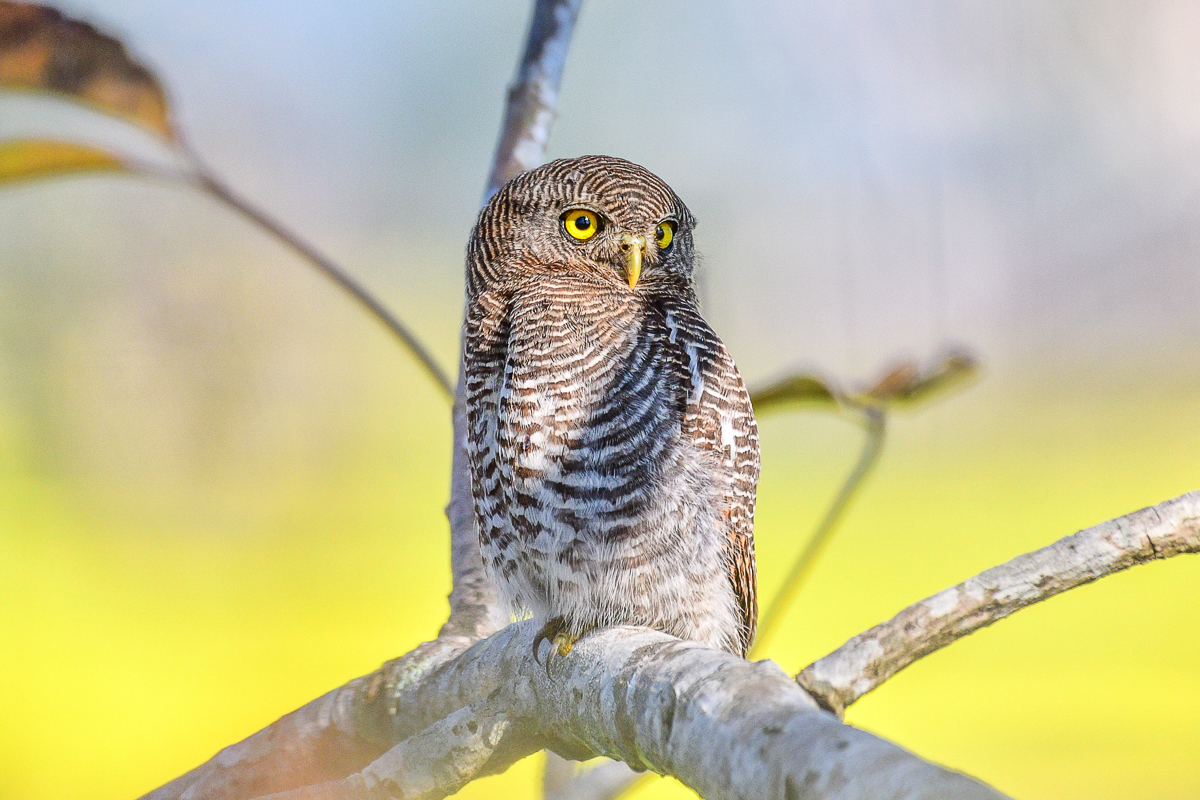
Jungle Owlet
- Common Name: Jungle Owlet
- Scientific Name: Glaucidium radiatum
- Nepali Name(s): डुन्डुल (Dundul)
- IUCN Red List Status: Least Concern (LC)
- National Red List Status (Nepal): Least Concern (LC)
- CITES Appendix: Appendix II
Measurements & Physical Profile
- Body Length: 20–22 cm
- Wing Length: 12–13.6 cm
- Weight: 88–114 g
Did You Know?
Unlike most owls that are strictly nocturnal, the Jungle Owlet is highly diurnal and crepuscular. You will often see them calling and hunting in bright sunlight! They are expert natural pest controllers, consuming massive quantities of forest insects.
Distribution & Habitat
Global Distribution
Endemic to the Indian subcontinent, found throughout India, Nepal, Bhutan, and parts of Bangladesh.
Distribution within Nepal
A common resident across the Tarai, Siwaliks, and lower-to-mid hill forests. It is well-represented in protected areas like Chitwan and Bardia National Parks.
Preferred Habitats
Favors open, deciduous forests, secondary growth, forest edges, and cultivated areas with scattered, large mature trees.
Elevational Range
Occurs from the lowland plains up to approximately 1,500 meters above sea level.
Behavior & Ecology
Activity Patterns
Primarily diurnal and crepuscular. It exhibits a direct, undulating flight and is often observed perching conspicuously on exposed branches to "sit-and-wait" for prey.
Diet & Ecosystem Role
- Diet: Primarily insectivorous (large beetles, grasshoppers, crickets). Opportunistically predates on small lizards, geckos, and occasionally small birds or mice.
- Ecosystem Role: Acts as a vital indicator of forest health; its role as a mid-level predator regulates insect populations, maintaining the balance of forest-floor and canopy arthropod communities.
Breeding Biology
The breeding season runs from March to May. Secondary cavity nester; utilizes abandoned woodpecker holes or natural rot-holes in mature trees, typically 3–10 meters above the ground. Clutch size is 2 to 4 (usually 3) white, rounded eggs, laid directly on existing cavity debris. Incubation, fledging period and parental roles are not well documented, but it is believed the incubation lasts 28–30 days (primarily by the female); fledging occurs after approximately 4 weeks.
Migration
- Status: Resident.
- Movement: Non-migratory; maintains a stable home range throughout the year.
Population Status
- Global Population: Unknown.
- Population Trend: Decreasing.
- National Population (Nepal): Unknown.
Threats
- Habitat Loss: Deforestation and the removal of large, mature, or decaying "hollow" trees are the greatest threats to their nesting success.
- Pesticide Bioaccumulation: The loss of insect biomass due to heavy pesticide application in agricultural zones near forest fringes directly impacts their food supply.
- Disturbance: Sensitive to excessive human activity near nesting sites.
Conservation Actions
Existing measures
Currently, no species-specific conservation programs exist for the Jungle Owlet. However, its vital habitats are safeguarded within Nepal's network of protected areas and community-managed forests.
Recommended Measures
- Cavity Retention: Prioritize the retention of dead and dying cavity-bearing trees within community forestry programs.
- Pesticide Management: Promote organic farming practices in agricultural areas adjacent to forest edges to maintain a healthy prey base.
References
- BirdLife International (2024). Species factsheet: Jungle Owlet Glaucidium radiatum. Downloaded from https://datazone.birdlife.org/species/factsheet/jungle-owlet-glaucidium-radiatum on 09/08/2026
- Holt, D. W., R. Berkley, C. Deppe, P. L. Enríquez, J. L. Petersen, J. L. Rangel Salazar, K. P. Segars, K. L. Wood, and J. S. Marks (2020). Jungle Owlet (Glaucidium radiatum), version 1.0. In Birds of the World (J. del Hoyo, A. Elliott, J. Sargatal, D. A. Christie, and E. de Juana, Editors). Cornell Lab of Ornithology, Ithaca, NY, USA. https://doi.org/10.2173/bow.junowl1.01
- Inskipp C., Baral H. S., Phuyal S., Bhatt T. R., Khatiwada M., Inskipp, T, Khatiwada A., Gurung S., Singh P. B., Murray L., Poudyal L. and Amin R. (2016). The status of Nepal’s Birds: The national red list series. Zoological Society of London, UK.
- König, C., F. Weick, and J.-H. Becking (2008). Owls of the World. Second edition. Christopher Helm, London, UK.