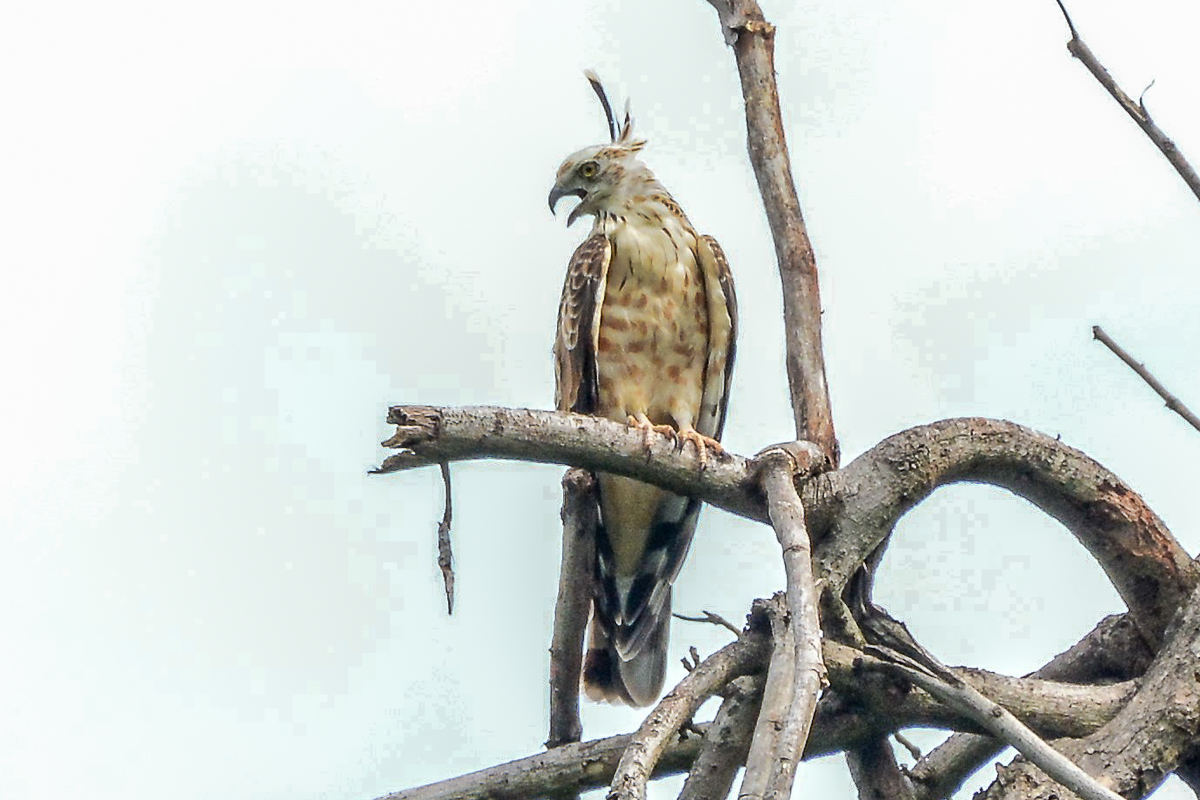
Jerdon's Baza
- Common Name: Jerdon's Baza
- Scientific Name: Aviceda jerdoni
- Nepali Name: कैलो जुरेबाज (Kailo Jurebaaz)
- IUCN Red List Status: Least Concern (LC)
- National Red List Status (Nepal): Critically Endangered (CR)
- CITES Appendix: Appendix II
Measurements & Physical Profile
- Body Length: 41–48 cm
- Wingspan: 109 - 117 cm
- Weight: ~350 g
Did You Know?
Jerdon's Baza is easily identified by its long, thin, black crest with a white tip, which is almost always held erect. It is a highly specialized raptor with broad, paddle-shaped wings, perfectly adapted for maneuverability within dense forest canopies.
Distribution & Habitat
Global Distribution
A sedentary resident across the Indomalayan realm, ranging from the Himalayan foothills (eastern Nepal, India, and Bhutan) through Southeast Asia, including Sumatra, Singapore, and the Philippines.
Distribution within Nepal
It is one of the least-studied raptors in the country. Records are primarily localized in the eastern districts of Ilam and Jhapa. Sightings have been documented from 70 m up to 1,048 m, spanning from Shorea robusta (Sal) forests to mid-hill forest types.
Preferred Habitats
A forest-dependent specialist. It favors dense, primary, or mature secondary forests, woodland edges, and sometimes tall-canopied tea estates.
Behavior & Ecology
Foraging Behavior
Unlike most raptors, it is a specialized insectivore. It predominantly hunts insects such as grasshoppers, beetles, and mantises, occasionally taking small lizards or frogs.
Hunting Specialization
It exhibits unique foraging behavior; it often transports prey items in its beak rather than its talons, allowing it to navigate dense canopy foliage more effectively.
Breeding Biology
Breeding typically occurs from March to June. They build compact, cup-shaped nests constructed from twigs and leaves, usually concealed high within the canopy of dense, broadleaf forests. Both parents share the incubation of the 2 to 3 eggs for 24 -27 days. The chicks are tended by both adults, receiving a steady supply of insects and small reptiles. The young fledge after approximately 30–35 days, remaining dependent on their parents for protection and foraging practice for several weeks.
Migration
- Status: Resident.
- Movement: Non-migratory; remains within its established forest territories year-round.
Population Status
- Global Population: 6,700 mature individuals.
- Population Trend: Decreasing.
- National Population (Nepal): 10-50 individuals.
Threats
- Habitat Fragmentation: The conversion of foothill forests into agricultural land or urban areas directly destroys essential nesting and foraging territories.
- Sensitivity to Disturbance: As a shy, forest-interior species, it is highly sensitive to human encroachment. The removal of large, old shade trees—particularly within tea estates and forest fringes—deprives the species of its primary breeding and roosting sites.
Conservation Actions
Existing Measures
- International: Protected under CITES Appendix II.
Recommended Measures
- Forest Connectivity: Protect existing corridors of mature forest in the Ilam and Jhapa districts to link isolated habitat patches.
- Tea Estate Management: Implement wildlife-friendly guidelines for tea estates that include the retention of large, native shade trees.
- Localized Monitoring: Conduct systematic surveys during the breeding season to identify and protect active nest sites from human disturbance.
References
- BirdLife International (2020). Species factsheet: Jerdon's Baza Aviceda jerdoni. Downloaded from https://datazone.birdlife.org/species/factsheet/jerdons-baza-aviceda-jerdoni on 06/08/2026
- Clark, W. S. and G. M. Kirwan (2020). Jerdon's Baza (Aviceda jerdoni), version 1.0. In Birds of the World (J. del Hoyo, A. Elliott, J. Sargatal, D. A. Christie, and E. de Juana, Editors). Cornell Lab of Ornithology, Ithaca, NY, USA. https://doi.org/10.2173/bow.jerbaz1.01
- Ferguson-Lees, J., & Christie, D. A. (2001). Raptors of the World. Christopher Helm, London.
- Inskipp C., Baral H. S., Phuyal S., Bhatt T. R., Khatiwada M., Inskipp, T, Khatiwada A., Gurung S., Singh P. B., Murray L., Poudyal L. and Amin R. (2016). The status of Nepal’s Birds: The national red list series. Zoological Society of London, UK.
- Naoroji, R. (2006). Birds of Prey of the Indian Subcontinent. Om Books International, New Delhi.